
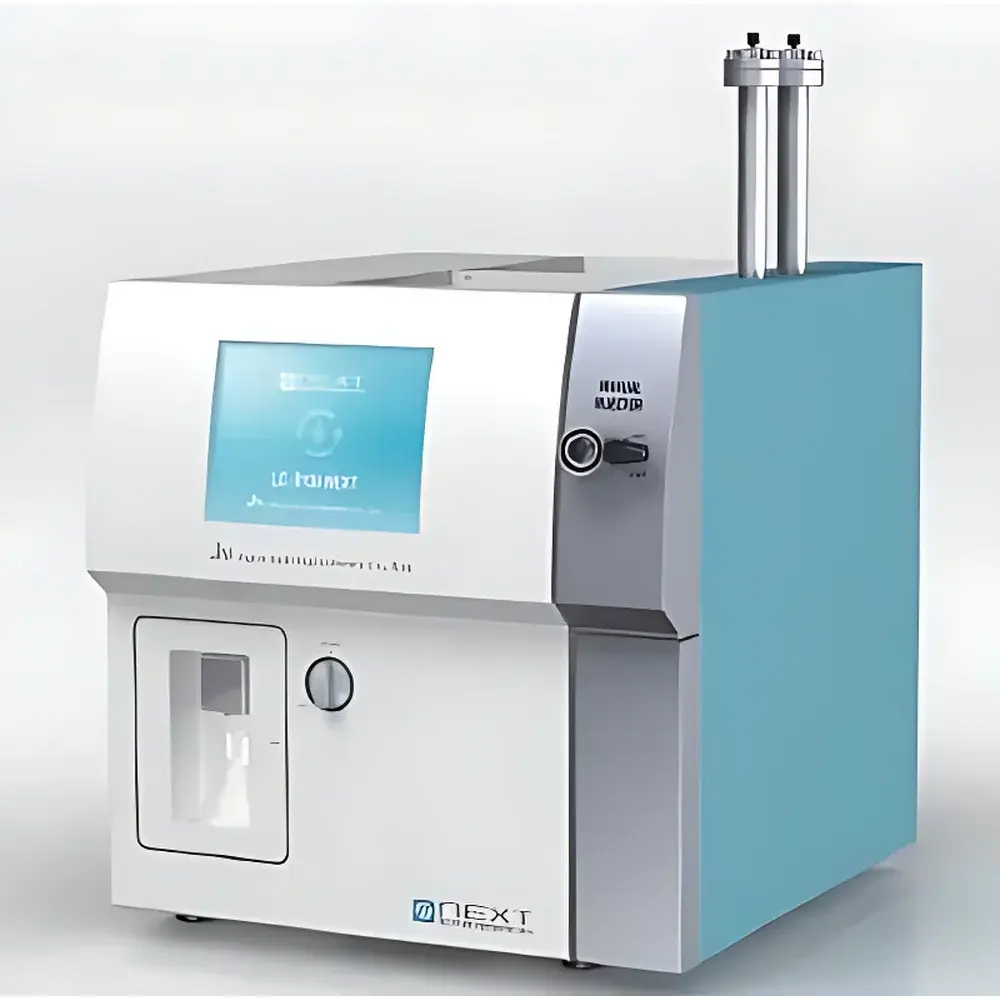
JAI LC-9110NEXT / LC-9130NEXT Fully Automated Recirculating Preparative Liquid Chromatography System
| Brand | JAI |
|---|---|
| Origin | Japan |
| Model | LC-9110NEXT / LC-9130NEXT |
| Instrument Type | High-Pressure Preparative Liquid Chromatograph |
| Maximum Pressure | 30 MPa (LC-9110NEXT) / 20 MPa (LC-9130NEXT) |
| Flow Rate Range | 0.001–9.999 mL/min (LC-9110NEXT) / 0.01–30.00 mL/min (LC-9130NEXT) |
| Touchscreen Interface | 8.4-inch LCD with capacitive touch |
| Sample Loop Options | 3 mL (std), 5/10 mL (LC-9110NEXT) |
| Auto-Recirculation Cycles | Up to 99 cycles (programmable) |
| Fraction Collection | Standard, up to 33 fractions (time- or signal-triggered) |
| Backflow Prevention | Patented solenoid-valve-based anti-backflow system |
| Maintenance Access | Front-accessible pump, detector, and fluidic modules |
| Power Supply | 85–240 V AC, 800 VA |
| Dimensions (W×H×D) | 464 × 492 × 504 mm |
| Weight | ~38 kg |
Overview
The JAI LC-9110NEXT and LC-9130NEXT are fully automated recirculating preparative liquid chromatography systems engineered for high-reproducibility purification of milligram-to-gram quantities of organic compounds, natural products, peptides, and synthetic intermediates. Built upon JAI’s proprietary recirculation architecture, these instruments implement high-pressure liquid chromatography (HPLC) principles—specifically isocratic or gradient elution under controlled backpressure—with integrated closed-loop sample reintroduction to maximize recovery yield and compound purity without column overloading. Unlike conventional preparative HPLC systems that rely on single-pass elution, the NEXT series enables repeated passage of partially resolved fractions through the same column, enhancing resolution for closely eluting peaks and improving separation efficiency for challenging separations such as diastereomers or structurally analogous metabolites. The systems operate within regulated environments compliant with GLP and GMP-aligned workflows, supporting traceable method execution and audit-ready operation in pharmaceutical development, academic natural product isolation, and fine chemical synthesis laboratories.
Key Features
- Patented Anti-Backflow Protection System: A solenoid-controlled valve network actively prevents solvent or analyte backflow during high-backpressure recirculation cycles—eliminating detector saturation, baseline distortion, and irreversible column fouling caused by reverse-phase solvent migration.
- Front-Serviceable Modular Architecture: Pump heads, UV-Vis detectors, and flow cells are designed for rapid front-panel extraction—reducing mean time to repair (MTTR) and enabling seal replacement or optical alignment without disassembling the chassis.
- Integrated Recirculation Control: Programmable cycle count (1–99), real-time pressure monitoring, and event-triggered loop initiation (e.g., post-peak detection or user-defined retention window) ensure deterministic, repeatable fraction enrichment.
- Touch-Optimized Workflow Interface: An 8.4-inch capacitive LCD panel hosts intuitive, context-sensitive menus for method setup—including gradient profiles, collection logic, auto-wash sequences, and recirculation scheduling—without requiring external PC software.
- Automated Sequence Injection & Repetition: Supports programmable injection volumes (100 µL–50 mL) and automatic re-injection of retained fractions; memory retention of prior runs allows exact replication of purification protocols across shifts or operators.
- Self-Contained Fraction Management: Standard fraction collector accommodates up to 33 vials with dual triggering modes (time-based or UV-signal threshold), plus optional siphon-based collection for continuous low-flow applications.
Sample Compatibility & Compliance
The LC-9110NEXT and LC-9130NEXT accommodate a broad range of sample matrices—including crude extracts, reaction mixtures, and formulated APIs—across reversed-phase (C18, C8), normal-phase (silica, cyano), and ion-exchange columns (up to 25 mm ID). Column compatibility extends to pressures up to 30 MPa (LC-9110NEXT) and 20 MPa (LC-9130NEXT), supporting sub-5 µm particle packings and monolithic stationary phases. All fluidic pathways employ chemically resistant materials (e.g., PEEK, stainless steel 316L, sapphire windows) compatible with aggressive solvents (TFA, HFIP, DCM, THF). The system meets mechanical safety requirements per IEC 61010-1 and electromagnetic compatibility standards EN 61326-1. Data integrity features—including electronic signatures, method versioning, and audit trail logging—support alignment with FDA 21 CFR Part 11 and EU Annex 11 when paired with validated LIMS or ELN integration.
Software & Data Management
Instrument control and data acquisition are managed natively via the embedded touchscreen OS—no host PC required for routine operation. Method files (.lcm) store complete chromatographic parameters, collection rules, recirculation logic, and wash protocols with timestamped revision history. Raw UV traces and pressure logs are saved in vendor-neutral CSV format for third-party analysis (e.g., MATLAB, Python pandas). Optional Ethernet connectivity enables remote monitoring, centralized method deployment, and secure transfer to laboratory information management systems (LIMS). All user actions—including parameter edits, manual triggers, and maintenance events—are recorded in an immutable audit trail with operator ID, timestamp, and action description—fully compliant with GLP documentation requirements.
Applications
- Purification of synthetic intermediates in API process development where >99.5% purity is required prior to crystallization or salt formation.
- Isolation of bioactive natural products from plant or microbial extracts using iterative recirculation to resolve co-eluting flavonoids or alkaloids.
- Preparative chiral separations of racemic mixtures on polysaccharide-based columns, leveraging recirculation to achieve baseline resolution without column re-equilibration delays.
- Recovery and concentration of labile peptides following solid-phase synthesis, minimizing exposure to shear stress via low-pulsation dual-plunger pumping.
- Method scouting and scale-up studies—identical methods run on LC-9110NEXT (analytical-prep hybrid) and LC-9130NEXT (high-flow production mode) demonstrate linear scalability across flow rates and column dimensions.
FAQ
What distinguishes recirculation mode from standard preparative HPLC?
Recirculation mode dynamically reintroduces unresolved fractions back onto the same column for additional passes—increasing theoretical plates per run without hardware modification. This is particularly effective for separations limited by column efficiency rather than solubility or throughput.
Can the system be operated without the touchscreen interface?
No—the embedded 8.4-inch LCD is the primary and only local control interface; no physical buttons or external keypad is provided. Remote operation requires optional network configuration and authenticated access.
Is method transfer between LC-9110NEXT and LC-9130NEXT supported?
Yes—method files are cross-compatible. Flow rate and pressure limits are enforced at runtime; exceeding LC-9130NEXT’s 20 MPa ceiling will trigger an interlock, while LC-9110NEXT permits full use of its 30 MPa capability.
How does the anti-backflow system integrate with UV detection?
The solenoid valves isolate the flow cell during pressure transients associated with valve switching or pump refill strokes—preventing solvent peak distortion and ensuring stable baseline integrity throughout multi-cycle operations.
What maintenance intervals are recommended for the P-9101B and P-9104B pumps?
JAI recommends seal inspection every 500 hours of operation or after 2000 injections, whichever occurs first. Front-access design allows seal replacement in <15 minutes without tools beyond a supplied torque wrench.





