
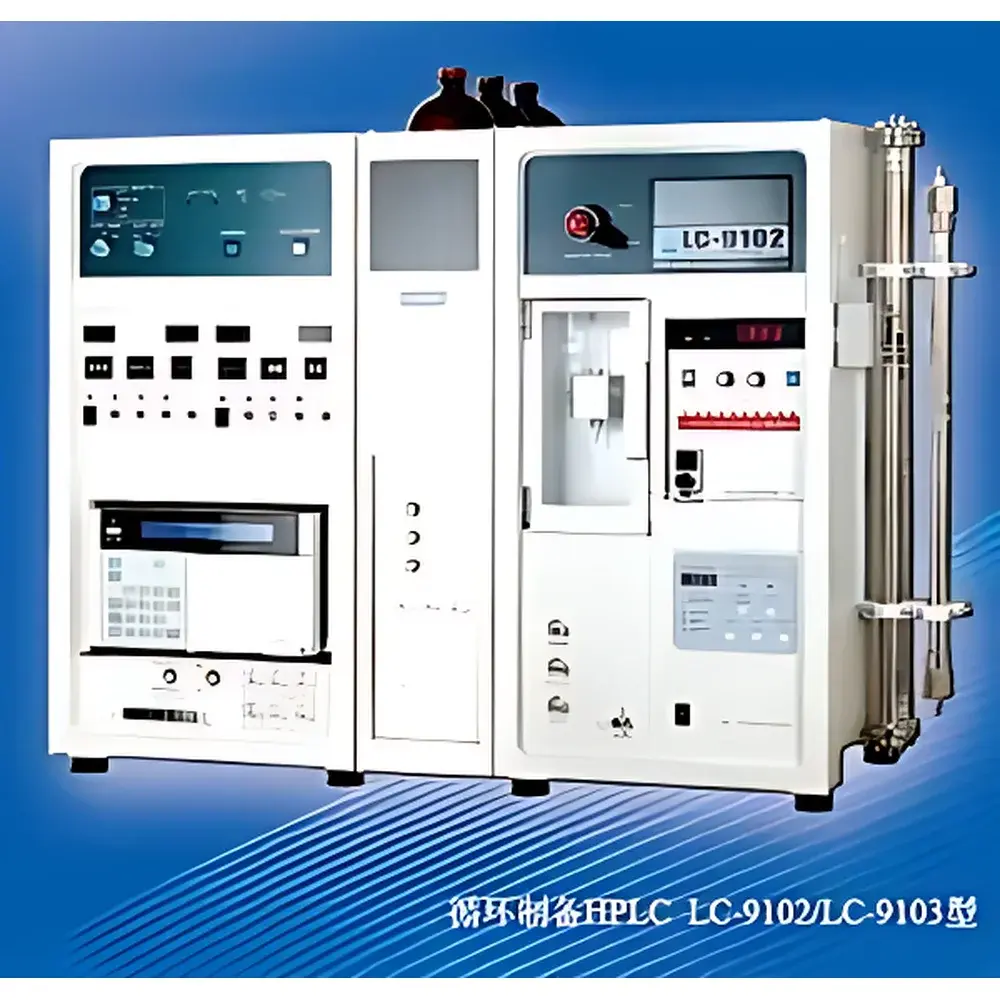
JAI LC-9102 / LC-9103 Preparative Liquid Chromatography System with Low-Pressure Quaternary Gradient Elution
| Brand | JAI |
|---|---|
| Origin | Japan |
| Model | LC-9102 / LC-9103 |
| Pump Type | L-7100 (LC-9102) / L-7150 (LC-9103) |
| Max Pressure | 39.2 MPa (LC-9102) / 20 MPa (LC-9103) |
| Flow Range | 0.001–9.999 mL/min (LC-9102) / 0.01–30.00 mL/min (LC-9103) |
| Gradient Capability | Low-pressure quaternary mixing, linear or multi-segment profiles |
| Flow Precision | <2% RSD at 1 mL/min |
| Column Capacity | Up to four 40 × 600 mm columns |
| Wetted Materials | SUS316, sapphire, ruby, PTFE, PEEK, ceramic, fused silica |
| Power | AC 100–240 V, 50/60 Hz, 800 VA |
| Weight | 100 kg (LC-9102) / 120 kg (LC-9103) |
| Dimensions (W×H×D) | 860 × 675 × 500 mm |
Overview
The JAI LC-9102 and LC-9103 are high-performance preparative liquid chromatography systems engineered for scalable purification of organic compounds, natural products, pharmaceutical intermediates, and synthetic peptides. Designed around low-pressure quaternary gradient elution architecture, these systems integrate a dual-piston reciprocating pump with built-in pulse-dampening and in-line degassing—eliminating the need for external vacuum or helium-based degassers. The core separation principle relies on differential partitioning of analytes between a stationary phase (typically silica- or polymer-based preparative columns) and dynamically modulated mobile phases, enabling precise control over retention time, resolution, and peak shape across multi-gram to kilogram-scale separations. With over three decades of iterative refinement in cyclic chromatography methodology, the LC-9102/LC-9103 platform addresses systemic challenges inherent in large-volume preparative workflows—including piston-induced band broadening, filter-induced backpressure variability, and detector cell fouling—through rigorously optimized fluidic pathways, thermally stabilized flow cells, and pressure-compensated valve actuation.
Key Features
- Low-pressure quaternary gradient system with electromagnetic solenoid valves, supporting up to four independent solvent channels and programmable linear or multi-segment gradient profiles
- Integrated degassing via pulsation-dampened dual-piston pump design—no external degasser required under standard operating conditions
- Single-button functional switching between standard gradient elution and closed-loop recycling mode without hardware reconfiguration or tubing disassembly
- Modular compatibility with JAI LC-9101 automation suite: identical autosampler (Rheodyne 7725i-based), automatic loop controller, fraction collector, and data acquisition software
- Robust wetted-path construction using chemically inert materials including sapphire/ruby check valves, PEEK and PTFE tubing, ceramic pump seals, and fused silica flow cells
- Expandable column configuration supporting up to four 40 mm × 600 mm preparative columns; optional guard column mounting for extended column lifetime and system protection
Sample Compatibility & Compliance
The LC-9102/LC-9103 accommodates a broad range of sample matrices—including crude extracts, reaction mixtures, fermentation broths, and formulated APIs—with minimal pre-treatment. Its wide flow range (0.001–30.00 mL/min) and pressure tolerance (up to 39.2 MPa) permit operation with both conventional silica gels (e.g., S-15, NH₂, C18) and high-strength polymeric media (e.g., Toyopearl, Sephadex LH-20). The system meets essential requirements for regulated environments: all electronic modules support audit-trail-enabled data logging compliant with FDA 21 CFR Part 11 when paired with validated JAI ChromaView™ software; fluidic components conform to USP and ISO 10993-1 for material biocompatibility; and mechanical design adheres to IEC 61010-1 safety standards for laboratory equipment. Optional UV/RI dual detection enables real-time orthogonal characterization of non-chromophoric compounds, supporting method development per ICH Q2(R2) guidelines.
Software & Data Management
ChromaView™ software provides unified control of pump gradients, injection sequences, fraction triggering, and real-time spectral monitoring. It supports GLP-compliant workflow management through user-role authentication, electronic signatures, version-controlled method storage, and immutable audit trails for all instrument events—including pressure transients, flow deviations, valve position changes, and fraction collection timestamps. Raw chromatographic data is stored in vendor-neutral .cdf format (NetCDF-based), ensuring long-term archival integrity and third-party analysis compatibility (e.g., with OpenChrom or Chromeleon). Batch processing tools allow automated integration, baseline correction, and purity assessment across sequential runs, while customizable report templates facilitate direct export to LIMS or regulatory submission packages.
Applications
- Purification of synthetic small molecules (e.g., kinase inhibitors, PROTACs) requiring >95% purity for biological assay validation
- Isolation of natural product fractions from plant or microbial extracts for structure–activity relationship (SAR) studies
- Desalting and buffer exchange of oligonucleotides and peptides prior to lyophilization or formulation
- Recycling-mode purification of chiral compounds using immobilized chiral stationary phases (e.g., Chiralpak AD-H, OD-H)
- Process development support for downstream purification steps in API manufacturing, aligned with Q5A and Q5C quality guidelines
- Method transfer from analytical to preparative scale using retention time normalization and volumetric scaling algorithms embedded in ChromaView™
FAQ
What distinguishes the LC-9102 from the LC-9103 in terms of operational scope?
The LC-9102 employs the L-7100 pump with higher maximum pressure (39.2 MPa) and finer low-flow resolution (0.001 mL/min), making it suitable for high-resolution separations on narrow-bore or high-backpressure columns. The LC-9103 uses the L-7150 pump, optimized for high-flow throughput (up to 30 mL/min) at moderate pressures (≤20 MPa), ideal for rapid loading and coarse fractionation.
Can the system operate in both normal-phase and reversed-phase modes?
Yes—the fluidic architecture and wetted-material selection support full solvent compatibility, including chlorinated solvents (e.g., CH₂Cl₂), polar aprotic solvents (e.g., THF, DMF), and aqueous/organic mixtures. Solvent selection must comply with pump seal and detector cell specifications.
Is method validation documentation available for regulated use?
JAI provides IQ/OQ protocols and performance qualification templates aligned with ASTM E2500 and ISO/IEC 17025 requirements. Full validation support—including installation verification, operational testing, and system suitability criteria—is available through certified field application engineers.
How is column equilibration managed during gradient recycling?
The ChromaView™ software includes dynamic equilibration routines that monitor baseline stability and backpressure drift before initiating each cycle, automatically adjusting dwell volume compensation and post-cycle re-equilibration time based on column geometry and mobile phase composition.
Are replacement parts and service contracts globally supported?
JAI maintains authorized service centers in North America, EMEA, and APAC regions. Critical consumables—including pump seals, check valves, and detector flow cells—are stocked regionally with ≤72-hour dispatch for urgent replacements under active maintenance agreements.




