
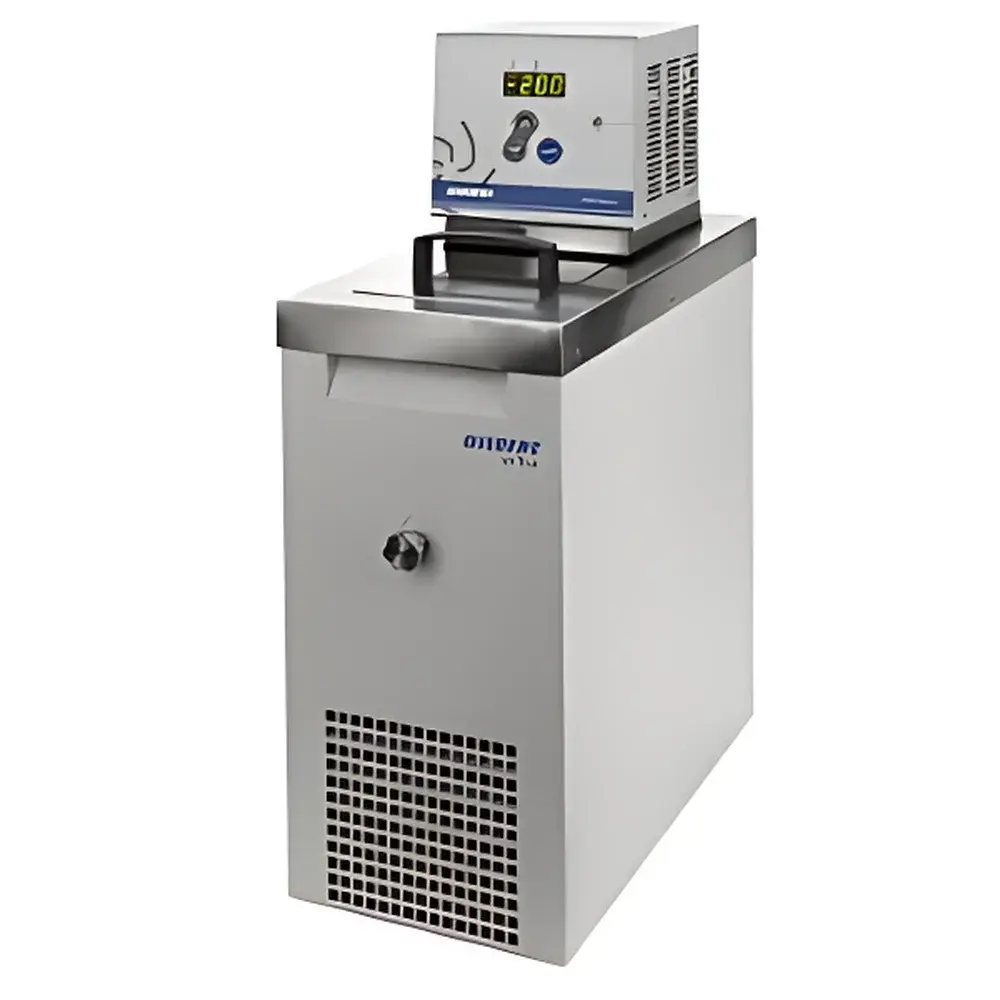
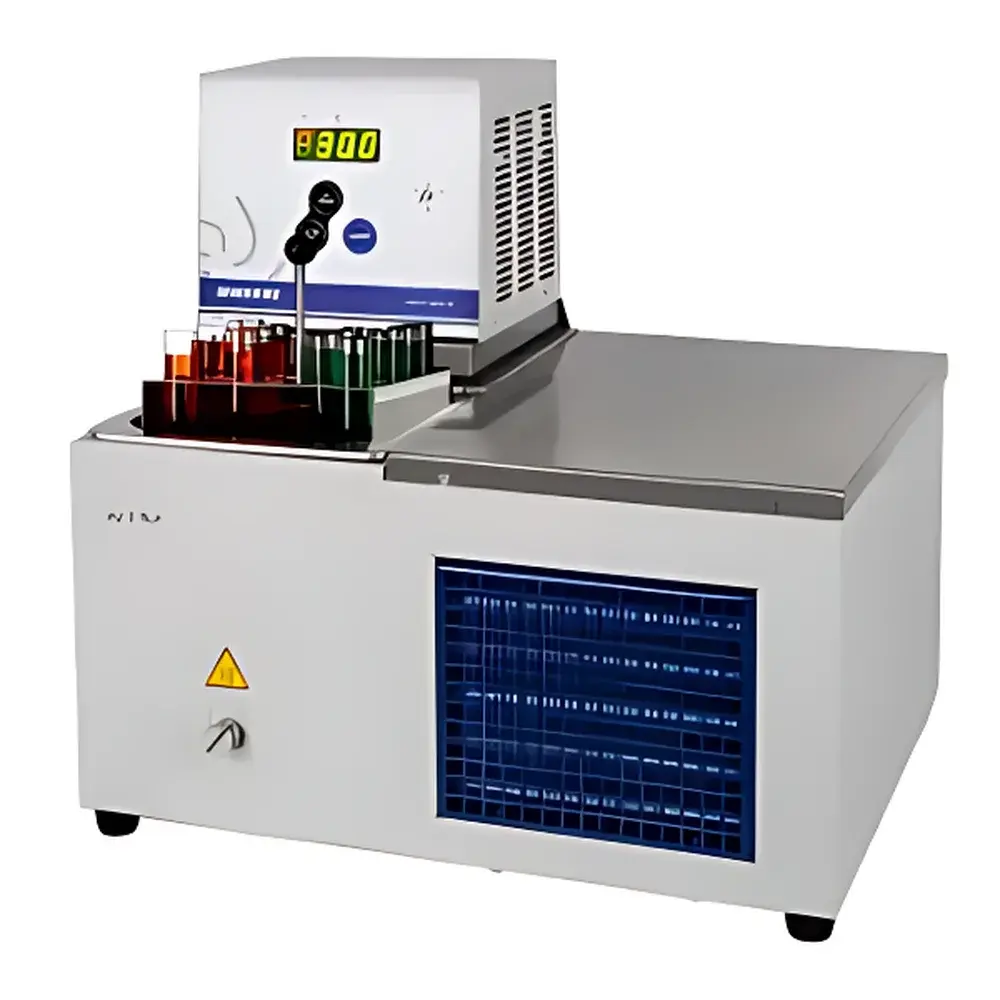
WIGGENS WT Series Heating and Cooling Circulators
| Brand | WIGGENS |
|---|---|
| Origin | Germany |
| Model Range | WT2 / WT4 / WT4P / WT6 / WT5F / WT12F / WT15F |
| Instrument Type | Temperature-Controlled Circulating Bath |
| Circulation Mode | Internal & External |
| Temperature Control | Dual-Mode (Heating & Refrigeration) |
| Bath Volume | 4–26 L |
| Temperature Range | −20 °C to +100 °C (model-dependent, up to −30 °C on WT4P) |
| Temperature Stability | ±0.05 °C (WT2–WT6) |
| Heating Power | 1.5 kW |
| Refrigeration Power (at 20 °C) | 150–480 W |
| Flow Rate | 10 L/min |
| Max. Pump Pressure | 0.23 bar |
| Bath Opening / Depth | 12×11×15 cm to 30×16×20 cm |
| Dimensions (W×D×H) | 22×42×64 cm to 35×67×44 cm |
| Weight | 23–33 kg |
Overview
The WIGGENS WT Series Heating and Cooling Circulators are precision-engineered laboratory thermal management systems designed for stable, bidirectional temperature control across a broad operational range (−30 °C to +100 °C, depending on model). These units operate on the principle of forced liquid circulation—using a closed-loop system with integrated heating elements and compressor-based refrigeration—to deliver highly reproducible thermal environments for external equipment or direct sample immersion. Unlike single-function baths, the WT Series implements Active Cooling Control technology, enabling continuous refrigeration capability at any point within its full temperature span—not only during cooldown but also during dynamic setpoint maintenance or heat-load compensation. This architecture ensures minimal thermal overshoot and rapid recovery after perturbations, making it suitable for applications demanding high temporal and spatial temperature fidelity, such as column oven conditioning in HPLC, jacketed reactor control, or optical instrument stabilization.
Key Features
- Compact footprint with optimized internal component layout and enlarged heat-dissipation zones—ensuring long-term controller reliability under continuous operation
- Three-button intuitive interface with dedicated keys for setpoint adjustment, mode selection (standby/auto-start), and circulation toggle
- PID-based digital temperature regulation with adaptive tuning algorithms for enhanced stability (±0.05 °C on WT2–WT6 models; ±0.2 °C on larger-volume WT5F/WT12F/WT15F units)
- 1.5 kW high-efficiency stainless-steel heating coil—resistant to corrosion and scale formation, compatible with water, ethanol, silicone oil, and other common heat-transfer fluids
- Adjustable internal/external flow ratio control—enabling precise distribution of thermal energy between bath immersion and remote device cooling
- Integrated float-level sensor with audible/visual low-fluid alarm and automatic power cutoff to prevent dry-run damage
- Front-mounted drain valve for rapid, spill-free bath fluid replacement—critical for cross-contamination-sensitive workflows
- Overtemperature protection active across the entire working range, independent of setpoint value
Sample Compatibility & Compliance
The WT Series supports direct sample immersion in open-bath configurations (e.g., test tubes, cuvettes, small reactors) as well as indirect temperature control via external recirculation loops connected to analytical instrumentation—including viscometers, rheometers, spectrophotometers, electrophoresis apparatuses, polarimeters, rotary evaporators, and chromatographic columns. All models comply with IEC 61010-1:2010 for electrical safety in laboratory equipment and meet CE marking requirements. The firmware architecture supports audit-ready operation in regulated environments: configurable event logging (including temperature deviations, pump status, and alarm triggers), user-accessible calibration records, and optional password-protected parameter lockdown—all aligned with GLP and GMP documentation expectations. While not inherently 21 CFR Part 11 compliant, the system’s deterministic behavior and traceable calibration paths facilitate integration into validated workflows when paired with appropriate LIMS or ELN platforms.
Software & Data Management
These circulators operate autonomously without mandatory PC connectivity; however, optional RS232 or USB interfaces enable serial communication for remote monitoring and script-driven control (e.g., via LabVIEW or Python-based automation frameworks). Logged data—including real-time temperature, setpoint history, pump runtime, and alarm events—can be exported in CSV format for post-hoc analysis. Firmware updates are performed via USB stick, ensuring version traceability and minimizing downtime. No proprietary cloud services or vendor-hosted platforms are required—data sovereignty remains fully under laboratory control. Calibration coefficients are stored in non-volatile memory and survive power cycles, preserving accuracy over extended service intervals.
Applications
- Stabilization of analytical instruments requiring precise thermal environments: HPLC/GC column ovens, UV-Vis spectrophotometer sample compartments, FTIR accessories
- Controlled-temperature synthesis and reaction monitoring in jacketed glass reactors and calorimeters
- Thermal conditioning of sensors, transducers, and optoelectronic components during characterization
- Viscosity and rheological measurements where temperature-induced fluid property shifts must be minimized
- Cell culture incubation support systems requiring auxiliary cooling below ambient
- Calibration laboratories performing temperature probe verification across extended ranges
FAQ
What is the difference between WT4 and WT4P models?
The WT4P extends the low-temperature limit to −30 °C (vs. −25 °C for WT4) through an upgraded refrigeration circuit and enhanced insulation—ideal for cryogenic sample handling or low-T enzymatic assays.
Can the WT series be used with organic solvents?
Yes—provided the solvent is chemically compatible with stainless steel (304/316), EPDM seals, and PTFE-coated components. Always verify material compatibility charts before use; avoid chlorinated hydrocarbons and strong oxidizers.
Is external pump pressure sufficient for tall column manifolds?
With a maximum head pressure of 0.23 bar (~2.3 m water column), the built-in pump is suitable for horizontal or moderately vertical external loops (<1.5 m elevation differential); for taller setups, consider adding a secondary booster pump.
How often does calibration require verification?
Annual verification against NIST-traceable references is recommended for GLP-compliant labs; more frequent checks may be necessary if operating near temperature extremes or after mechanical shock.
Does the unit support programmable ramping profiles?
No—these are single-setpoint controllers. For time-dependent temperature ramps, integrate with external programmable logic controllers (PLCs) or third-party software via the serial interface.



