
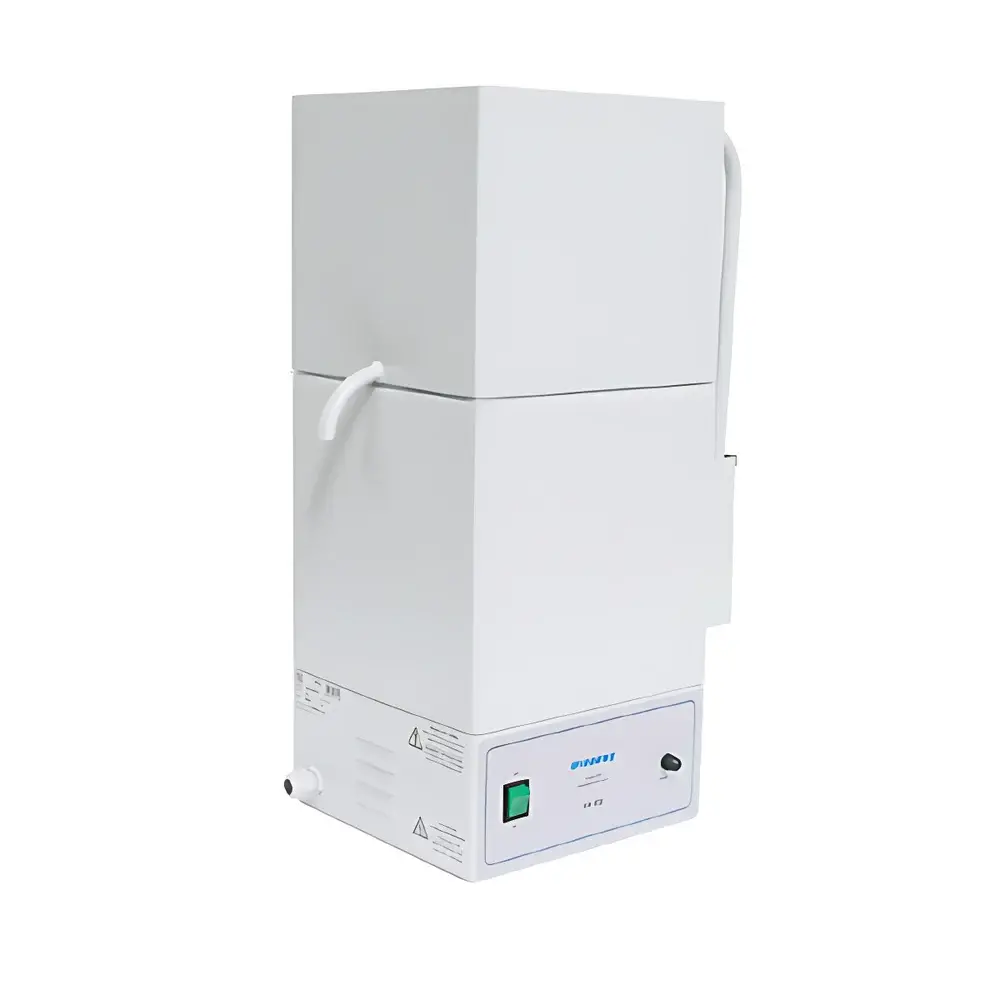
WIGGENS Stainless Steel Sub-boiling Distillation Apparatus
| Brand | WIGGENS |
|---|---|
| Origin | Germany |
| Type | Sub-boiling Distiller |
| Construction | Fully 304 Stainless Steel (chamber, immersion heater, condenser, outlet) |
| Output Rate | 3.5 L/hr or 7 L/hr |
| Conductivity | ≤2.5 µS/cm at 20°C |
| Resistivity | ≥0.4 MΩ·cm at 20°C |
| Safety Features | Low-level cutoff, pressure-relief valve, auto-shutdown on cooling water failure |
| Compliance | EN 61010-1:2002, EN 50082-1:1992, EN 50081-2:1994, Directive 2006/95/EC (LVD), 2004/108/EC (EMC), 2006/42/EC (Machinery) |
| Power Supply | 220 V / 50 Hz |
| Input Power | 3000 W (DA001) or 6000 W (DA002) |
| Dimensions (W×D×H) | 250×220×440 mm (DA001), 260×260×630 mm (DA002) |
| Weight | 12 kg (DA001), 14 kg (DA002) |
Overview
The WIGGENS Stainless Steel Sub-boiling Distillation Apparatus is a precision-engineered laboratory distillation system designed for the continuous production of high-purity water suitable for analytical chemistry, trace metal analysis, cell culture media preparation, and other applications demanding low ionic contamination. Unlike conventional boiling-point distillers, this apparatus operates via sub-boiling (also known as vapor-phase or low-temperature distillation) — a process in which feed water is heated gently to produce vapor without reaching full nucleate boiling. This minimizes aerosol entrainment and volatile organic carryover, while eliminating spattering and foaming-related contamination. All wetted surfaces — including the evaporation chamber, immersion heating element, condenser coil, and collection tubing — are fabricated from certified AISI 304 stainless steel, ensuring chemical inertness and preventing leaching of heavy metals (e.g., Fe, Cr, Ni, Cu) into the distillate. The unit is fully CE-marked and complies with essential EU safety, electromagnetic compatibility (EMC), and machinery directives.
Key Features
- Fully 304 stainless steel construction throughout all fluid-contact components — corrosion-resistant, non-reactive, and compliant with ISO 3506-1 for austenitic stainless fasteners and fittings
- Two scalable models: DA001 (3.5 L/hr output, 3 kW input) and DA002 (7 L/hr output, 6 kW input), both optimized for benchtop installation
- Integrated safety architecture: automatic power cutoff upon low reservoir level detection, pressure-relief valve activation under overpressure conditions, and fail-safe shutdown during insufficient cooling water flow
- Energy-efficient sub-boiling operation — significantly lower energy consumption per liter compared to traditional boiling distillers, with no consumables required (e.g., resins, membranes, or cartridges)
- Robust thermal insulation and optimized condenser geometry ensure stable vapor-phase separation and consistent distillate quality across extended operational cycles
- Front-accessible control panel with status indicators for power, heating, water level, and fault conditions — designed for intuitive monitoring in GLP-compliant environments
Sample Compatibility & Compliance
This distiller accepts municipal tap water, deionized water, or softened feed water as input. It is not intended for direct use with seawater, highly turbid, or chemically aggressive industrial effluents. The resulting distillate meets ASTM D1193 Type IV specifications for “reagent water” and is appropriate for use in ICP-MS sample preparation, HPLC mobile phase formulation, and calibration standard dilution where conductivity ≤2.5 µS/cm (20 °C) and resistivity ≥0.4 MΩ·cm (20 °C) are required. The apparatus conforms to EN 61010-1:2002 for electrical safety in laboratory equipment, EN 50082-1:1992 for immunity to electromagnetic disturbances, and EN 50081-2:1994 for emission limits. Its mechanical design satisfies Directive 2006/42/EC, and its electrical interface complies with Low Voltage Directive 2006/95/EC and EMC Directive 2004/108/EC.
Software & Data Management
The WIGGENS sub-boiling distiller operates as a standalone analog-controlled system with no embedded microprocessor or digital interface. As such, it does not feature data logging, remote monitoring, or software integration capabilities. This architecture eliminates firmware vulnerabilities, reduces long-term maintenance complexity, and ensures deterministic behavior under continuous operation — a critical advantage in regulated environments where auditability and reproducibility outweigh connectivity requirements. All operational parameters (power draw, flow rate, temperature profile) remain stable and repeatable across units, supporting compliance with GLP and GMP documentation practices through manual logbook entries or external environmental monitoring systems.
Applications
- Preparation of ultra-low-conductivity water for atomic absorption spectroscopy (AAS) and inductively coupled plasma (ICP) techniques
- Formulation of reagent-grade solvents and standards in quality control laboratories
- Supply of purified water for sterilization autoclaves and glassware rinsing stations
- Backup or primary purification source in facilities where RO or ion-exchange systems require frequent regeneration or pose microbial risk
- Education and training labs requiring robust, transparent distillation principles demonstration without proprietary consumables
FAQ
What feed water quality is recommended for optimal performance?
Tap water with total dissolved solids (TDS) < 500 ppm and free chlorine < 2 ppm is preferred. Pre-filtration (e.g., 5 µm sediment filter + activated carbon) is advised if feed contains particulates or chloramines.
Can this distiller be connected to a centralized cooling water system?
Yes — it features standardized 8 mm inner-diameter inlet/outlet ports compatible with common laboratory cooling loops. Flow rate must be maintained at ≥1.5 L/min to prevent thermal shutdown.
Is routine descaling required?
No — sub-boiling operation prevents scale formation on heating surfaces. However, periodic inspection and cleaning of the feed water reservoir and condensate path with diluted nitric acid (1–2% v/v) is recommended every 6 months for hard-water regions.
Does the unit comply with FDA 21 CFR Part 11 requirements?
Not applicable — as an analog-only device with no electronic data generation, storage, or user authentication, it falls outside the scope of Part 11. Its simplicity supports paper-based recordkeeping aligned with ALCOA+ principles.



