
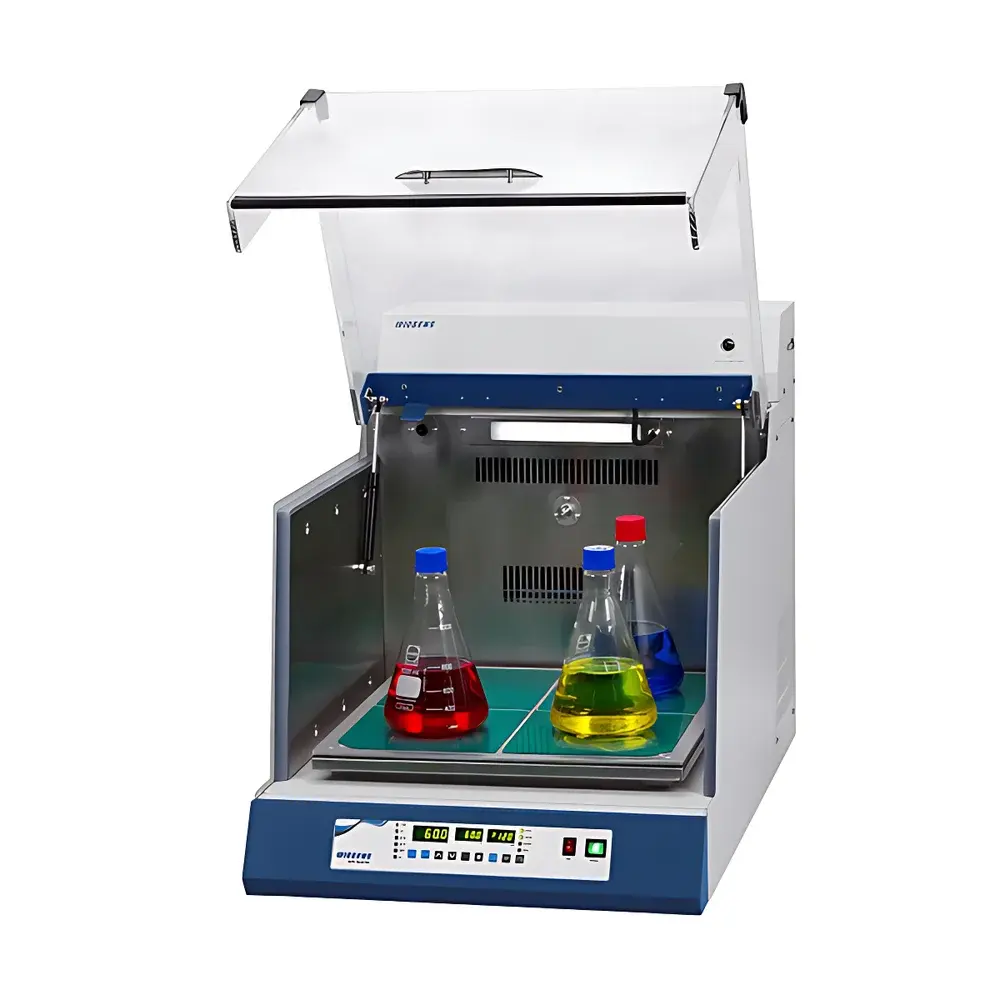
WIGGENS WS-600 Temperature-Controlled Orbital Shaker Incubator
| Brand | WIGGENS |
|---|---|
| Origin | Germany |
| Model | WS-600 |
| Timer Range | 10 sec – 999 h 59 min 59 sec |
| Oscillation Frequency | 30–300 rpm |
| Amplitude Options | 20 mm, 30 mm (standard), 40 mm |
| Temperature Range | +5 to +60 °C |
| Number of Shaking Platforms | 4 |
Overview
The WIGGENS WS-600 Temperature-Controlled Orbital Shaker Incubator is an engineered platform for precise, reproducible cultivation and mixing under controlled thermal and mechanical conditions. Designed for demanding life science laboratories, it integrates orbital shaking with active air-jacketed temperature regulation—enabling simultaneous control of incubation temperature and oscillation dynamics across up to four independently configurable platforms. Its core operation relies on brushless DC motor-driven orbital motion (±0.5° eccentricity) coupled with PID-regulated forced-air circulation, ensuring minimal thermal gradient deviation (±1.0 °C at 38 °C) and consistent rotational kinetics regardless of load distribution. Unlike passive benchtop shakers, the WS-600 maintains thermodynamic stability during prolonged runs (up to 999 hours), making it suitable for aerobic microbial fermentation, suspension cell culture, hybridization assays, and enzymatic reaction optimization where both temperature homogeneity and motion fidelity are critical.
Key Features
- Four independent orbital shaking platforms (450 × 450 mm each), each supporting up to 15 kg load capacity with mechanical stability across full amplitude (20–40 mm) and speed (30–300 rpm) ranges
- PID-controlled air-jacketed heating system (600 W power output) with ±0.1 °C accuracy at 38 °C and uniformity maintained within ±1.0 °C across chamber volume
- Brushless DC motor drive delivering long-term operational reliability (>20,000 h MTBF), zero carbon dust generation, and consistent speed maintenance (±1 rpm at 150 rpm) under variable load conditions
- Programmable multi-mode oscillation: forward rotation, reverse rotation, pause-interval sequencing, and position-hold stop—all individually assignable per platform with time resolution down to 10 seconds
- Safety-integrated fail-safes: automatic motor and blower shutdown upon door opening; overtemperature alarm with heater cutoff; configurable auto-restart or auto-halt behavior following power interruption
- Touch-sensitive control interface with real-time parameter display, password-protected settings lock, and non-volatile memory retention for up to 10 user-defined protocols
Sample Compatibility & Compliance
The WS-600 accommodates diverse vessel formats via interchangeable platform accessories—including universal spring-clamp plates, pre-mounted clamp assemblies, silicone-damped trays, separatory funnel holders, microplate adapters, tube racks, and adhesive mounting pads—ensuring secure retention of Erlenmeyer flasks (50–5000 mL), test tubes, deep-well plates, and custom bioreactor vessels. Its design conforms to IEC 61010-1:2010 safety standards for laboratory equipment and supports GLP-compliant workflows through traceable parameter logging (when paired with optional RS-232/USB data export). While not certified for medical device manufacturing under ISO 13485, its thermal and mechanical repeatability meets common validation requirements for QC microbiology (e.g., USP , ISO 21528-2), pharmaceutical stability testing (ICH Q1A), and academic research governed by OECD GLP principles.
Software & Data Management
The WS-600 operates autonomously via its embedded controller but supports external monitoring and protocol synchronization through standard serial (RS-232) and USB-B interfaces. Optional WIGGENS LabLink software enables remote configuration, real-time graphing of temperature and RPM profiles, timestamped event logging (door opens, alarms, mode transitions), and export of CSV-formatted datasets compatible with LIMS integration. Audit trail functionality records operator ID, parameter changes, and execution timestamps—meeting foundational expectations for FDA 21 CFR Part 11 compliance when deployed in regulated environments with appropriate IT governance controls (e.g., electronic signature enforcement, access restriction policies).
Applications
- Aerobic bacterial and yeast cultivation requiring defined oxygen transfer rates (kLa optimization via amplitude/speed tuning)
- Mammalian suspension cell expansion in serum-free media under tightly controlled thermal setpoints
- Nucleic acid hybridization (Southern/Northern blotting), antigen-antibody binding assays, and ELISA plate washing steps
- Enzyme kinetic studies involving temperature-dependent reaction rates and substrate mixing efficiency
- Food microbiology enrichment protocols (e.g., ISO 6579 for Salmonella detection) and dairy starter culture propagation
- Chemical synthesis requiring homogeneous reagent dispersion and heat-assisted dissolution kinetics
FAQ
What is the maximum load per platform, and how is load compensation achieved?
Each platform supports up to 15 kg. The brushless DC motor and adaptive PID feedback loop continuously monitor torque demand and adjust power delivery to maintain programmed RPM within ±1 rpm tolerance—even when flask mass or viscosity changes during operation.
Can the WS-600 operate at temperatures below ambient?
No. The unit provides only heating capability within a range of +5 °C to +60 °C. It does not include refrigeration or Peltier cooling elements.
Is calibration documentation provided with the instrument?
Factory calibration certificates for temperature and speed sensors are available upon request and may be included in IQ/OQ documentation packages for GxP environments.
How many protocols can be stored internally?
The device retains up to 10 fully programmable protocols—including temperature setpoint, oscillation mode, amplitude, RPM, and timing sequence—with non-volatile memory preservation during power loss.
Are third-party accessories compatible with the WS-600 platforms?
Yes. Standardized M6 threaded mounting holes (25 mm pitch grid) enable integration of OEM or custom fixtures meeting DIN 12878 or ISO 8573-1 mechanical interface guidelines.





