
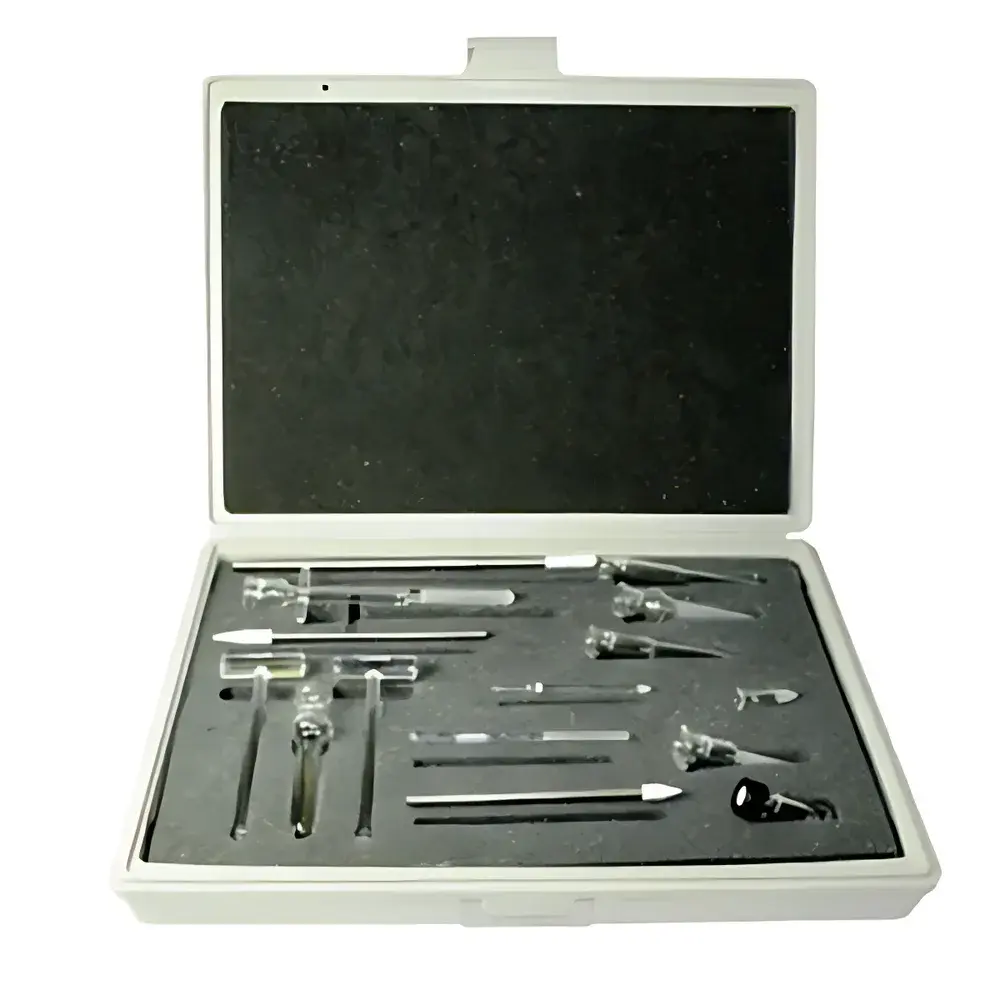
WHEATON Miniature Tissue Grinder Set
| Brand | SOCOREX |
|---|---|
| Origin | USA |
| Manufacturer Type | Authorized Distributor |
| Origin Category | Imported |
| Model | Miniature Set |
| Instrument Type | Manual Mechanical Cell Disruptor |
| Sterilization | Autoclavable (121°C, 20 min) |
| Material | Low-Extractable Borosilicate Glass (WHEATON 33) |
| Package Includes | 7 Units (1× Tenbroeck, 1× G.P.I. 0.5 mL, 1× Dounce 1 mL, 1× 0.1 mL, 1× 0.2 mL, 1× Potter-Elvehjem 2 mL, 1× Conical 1 mL) |
| Compliance | USP <661.1>, ISO 8536-1 |
Overview
The WHEATON Miniature Tissue Grinder Set is a precision-engineered suite of manually operated mechanical homogenizers designed for reproducible, low-shear disruption of soft biological tissues, cultured cells, and subcellular fractions in small-volume applications. Each unit operates on the fundamental principle of controlled clearance-based shearing—where a tightly fitted pestle rotates or reciprocates within a calibrated glass tube to generate localized hydrodynamic stress sufficient to rupture membranes while preserving labile macromolecules such as nucleic acids, native enzymes, and membrane proteins. Constructed exclusively from WHEATON 33 low-extractable borosilicate glass, the set eliminates leachable contaminants critical for sensitive downstream assays including qPCR, Western blotting, and metabolite profiling. All components are fully autoclavable at 121°C for 20 minutes, ensuring compliance with GLP laboratory hygiene standards and enabling repeated use without cross-sample carryover.
Key Features
- Seven distinct grinder configurations optimized for volume-specific homogenization: 0.1 mL, 0.2 mL, 0.5 mL, 1 mL (Dounce & conical), 2 mL (Potter-Elvehjem), and 1 mL Tenbroeck—all with precisely defined pestle-to-tube clearance tolerances (±2 µm).
- WHEATON 33 borosilicate glass tubing meets USP <661.1> Class VI biocompatibility requirements and exhibits ≤0.5 µg/g sodium leachate after 24 h extraction (per ISO 8536-1), minimizing interference in ion-sensitive assays.
- G.P.I. 13-425 threaded cap design on the 0.5 mL grinder ensures secure sealing during vortex-assisted homogenization and prevents aerosol escape during high-viscosity sample processing.
- Graduated scale etching (0.05 mL increments) on all tubes supports volumetric accuracy under microscope-guided dissection workflows.
- No moving parts or electrical components—eliminates risk of electromagnetic interference, thermal denaturation, or metal ion contamination common in rotor-stator or ultrasonic systems.
Sample Compatibility & Compliance
The set accommodates fresh, frozen, or fixed tissues—including murine brain cortex, plant leaf mesophyll, insect larvae, and adherent mammalian cell monolayers—with minimal foaming or heat generation. It is validated for use with RIPA, NP-40, and CHAPS-based lysis buffers, as well as cryoprotectant-containing suspensions (e.g., 10% glycerol). All units comply with ISO 13485–certified manufacturing controls applied to medical device accessories and satisfy analytical method validation criteria per ICH Q2(R2) for manual sample preparation steps. Documentation includes full traceability to raw material lot numbers and autoclave cycle validation reports upon request.
Software & Data Management
As a purely mechanical, non-electronic instrument system, the WHEATON Miniature Tissue Grinder Set requires no firmware, drivers, or proprietary software. However, its standardized dimensions and clear labeling support integration into digital lab notebook platforms (e.g., LabArchives, Benchling) via barcode-scannable order numbers (357421, 357535, etc.). Each component’s unique catalog number enables automated inventory reconciliation and audit-ready calibration log maintenance under FDA 21 CFR Part 11–compliant electronic record systems when paired with timestamped usage entries.
Applications
- Preparation of nuclear extracts from primary lymphocytes using the 1 mL Dounce grinder (clearance: 0.025 mm) to preserve chromatin integrity.
- Isolation of mitochondria from rat liver tissue via sequential grinding in 2 mL Potter-Elvehjem (loose-fitting) followed by 0.5 mL G.P.I. (tight-fitting) units.
- Homogenization of single-cell suspensions prior to scRNA-seq library construction, where RNA integrity (RIN > 9.0) is maintained through absence of acoustic cavitation.
- Extraction of membrane-bound receptors from HEK293T transfectants using 0.2 mL grinders to limit proteolytic degradation during rapid processing on ice.
- Standardized tissue pulverization for inter-laboratory reference material studies governed by ISO/IEC 17043 proficiency testing protocols.
FAQ
Are replacement pestles available separately?
Yes—each pestle is cataloged individually (e.g., 357421-P for Tenbroeck pestle); all are interchangeable only within their designated tube series.
Can these grinders be used with organic solvents such as chloroform or methanol?
WHEATON 33 glass is chemically resistant to all common aqueous and polar organic solvents; however, prolonged exposure (>1 h) to concentrated HF or hot KOH is not recommended.
What is the maximum recommended centrifugal force if tubes are spun post-grinding?
All tubes are rated for 13,000 × g (e.g., 15 min at 13,000 rpm in a fixed-angle rotor), verified per ASTM D638 tensile testing of annealed borosilicate specimens.
Is there lot-specific certificate of analysis (CoA) documentation?
Yes—CoAs listing extractables testing, dimensional inspection data, and autoclave cycle validation are provided with each shipment.
Do the conical and Potter-Elvehjem grinders support motorized pestle drives?
No—these units are strictly hand-operated to maintain user-defined shear rate control; motor adapters are neither supplied nor validated by WHEATON or SOCOREX.




