
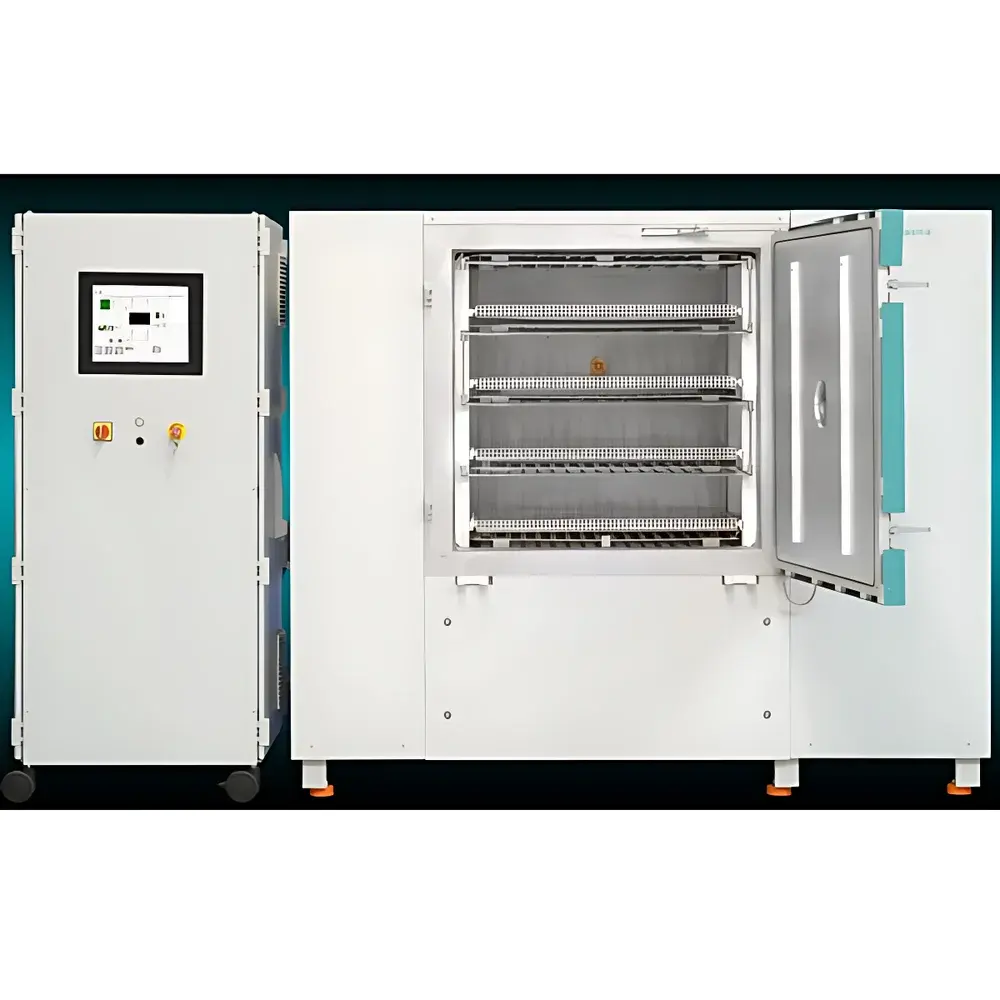
Europlasma CD875 Nanofics Low-Pressure Plasma Surface Treatment System
| Brand | Europlasma |
|---|---|
| Origin | Belgium |
| Model | CD875 |
| RF Frequency | 50 Hz |
| Power Supply | 380 V AC, 3-phase, 40 A |
| Chamber Volume | 875 L |
| Chamber Dimensions | 1000 × 1260 × 695 mm |
| Chamber Material | Anodized Aluminum |
| Vacuum Measurement | Baratron Capacitance Manometer |
| Vacuum Pump | Dry Scroll Pump |
| Gas Inlet | 1/4″ (6.45 mm) with MFC |
| Exhaust Port | Ø28 mm |
| Control System | PLC-based Automated Control |
| Safety Certifications | CE compliant |
| Operating Temperature | <40 °C |
| Tray Configuration | 4× adjustable trays (858 × 672 mm, 220 mm spacing) |
| Viewing Window | Integrated quartz viewport |
| Safety Features | Emergency stop, vacuum interlock, thermal cutoff |
Overview
The Europlasma CD875 Nanofics Low-Pressure Plasma Surface Treatment System is an industrial-grade, fully automated plasma processing platform engineered for precision surface functionalization under controlled vacuum conditions. Operating on the principle of low-pressure (typically 10–100 Pa) radiofrequency (RF) plasma generation at 50 Hz, the system enables non-thermal, dry surface modification without bulk heating—maintaining substrate integrity while achieving uniform treatment at temperatures below 40 °C. Unlike atmospheric plasma systems, the CD875’s high-volume aluminum chamber (875 L) ensures stable plasma homogeneity across large or multi-layered sample loads, making it suitable for R&D validation, pilot-scale process development, and pre-production batch treatment in regulated environments. The Nanofics technology leverages tailored gas chemistries (e.g., C₄F₈, CHF₃, O₂, Ar) to deposit ultra-thin, conformal nanoscale coatings (<10 nm) that impart hydrophobicity, corrosion resistance, oxidation barrier properties, and enhanced adhesion—without altering mechanical or optical bulk characteristics.
Key Features
- Robust anodized aluminum reaction chamber (1000 × 1260 × 695 mm) with integrated quartz viewing window for real-time process observation and optical diagnostics.
- Four independently configurable stainless-steel sample trays (858 × 672 mm), spaced at 220 mm intervals, supporting flexible loading of heterogeneous components—including PCB assemblies, textile rolls, filtration membranes, and biomedical substrates.
- High-stability vacuum architecture featuring a dry scroll pump and Baratron capacitance manometer, enabling precise pressure control from 5 Pa to 150 Pa with repeatability ±0.5 Pa.
- PLC-based automation system with password-protected operator interface, supporting programmable recipes for vacuum ramping, gas dosing (via mass flow controller), RF power modulation, dwell time, and cooldown sequencing.
- Comprehensive safety subsystems: hardware-integrated emergency stop, vacuum interlock preventing RF activation unless target pressure is achieved, overtemperature cutoff (<45 °C), and CE-compliant electrical architecture.
- Dual-gas capability via standardized 1/4″ Swagelok inlet (1 bar max input pressure) and Ø28 mm exhaust port compatible with abatement systems or catalytic scrubbers per ISO 14001 requirements.
Sample Compatibility & Compliance
The CD875 accommodates rigid, flexible, porous, and temperature-sensitive substrates—including polymeric films (PET, PI, PC), printed circuit boards, metal alloys (Al, Ti, stainless steel), glass optics, ceramic filters, and natural/synthetic textiles. Its low-thermal-load operation (<40 °C) prevents warping, outgassing, or degradation of heat-labile materials such as adhesives, elastomers, or bio-coated surfaces. The system conforms to CE Machinery Directive 2006/42/EC and Electromagnetic Compatibility Directive 2014/30/EU. While not inherently GLP- or GMP-certified, its audit-ready PLC logging (timestamped vacuum, pressure, RF voltage/current, gas flow, temperature) supports alignment with ISO 13485 (medical devices), IATF 16949 (automotive), and ASTM D726-18 (hydrophobicity testing) when deployed within validated laboratory workflows.
Software & Data Management
The embedded HMI provides intuitive recipe management with up to 99 user-defined protocols, each storing vacuum profile, gas composition, RF power setpoint, treatment duration, and tray position parameters. All operational data—including real-time sensor readings and alarm events—are logged in CSV format to internal SD storage (expandable) with UTC timestamps. Optional Ethernet/IP connectivity enables integration into LabVantage or Thermo Fisher SampleManager LIMS via Modbus TCP. Audit trails meet FDA 21 CFR Part 11 requirements when paired with external identity management (e.g., LDAP authentication) and electronic signature modules—facilitating compliance in regulated QC/QA labs.
Applications
- Electronics: Hydrophobic nanocoating of Bluetooth earbuds, AR glasses housings, and drone casings to resist sweat, humidity, and salt fog per IEC 60529 IPX4/IPX7 test protocols.
- Textiles: Durable water repellency (DWR) on nylon and polyester outdoor apparel without fluorocarbon-based finishes—reducing environmental impact while meeting AATCC TM193 standards.
- Filtration: Surface grafting of PVDF and PTFE membranes to improve fouling resistance and wettability control in pharmaceutical sterile filtration and wastewater reuse applications.
- Biomedical: Plasma activation of PDMS microfluidic chips prior to protein immobilization; silanization of glass slides for DNA microarray fabrication.
- Automotive: Adhesion promotion on PP/TPO bumpers prior to painting or bonding, eliminating solvent-based primers per VOC emission regulations (EU Directive 2004/42/EC).
FAQ
What vacuum level is required for stable Nanofics plasma ignition?
Stable plasma ignition and uniform coating deposition are achieved between 15–60 Pa, with optimal process window typically at 30 ± 5 Pa using argon/oxygen or fluorocarbon precursor blends.
Can the CD875 handle continuous roll-to-roll substrates?
No—the CD875 is a batch-processing system designed for discrete parts or cut fabrics. For continuous web treatment, Europlasma offers inline variants (e.g., CD-Roll series) with integrated unwinding/tensioning modules.
Is remote monitoring supported out-of-the-box?
Basic remote status viewing (vacuum, temperature, cycle completion) is available via optional web server module; full SCADA integration requires custom Modbus TCP configuration and firewall provisioning.
What maintenance intervals are recommended for the dry pump and RF generator?
Dry scroll pump oil change every 3,000 operating hours; RF matching network inspection and capacitor calibration annually or after 500 plasma cycles—per Europlasma Service Bulletin PL-CD875-REV3.
Does Nanofics treatment affect surface topography measured by AFM?
Atomic force microscopy studies confirm sub-nanometer RMS roughness change (<0.2 nm) post-treatment, verifying the process is truly surface-selective without etching or micromasking effects.



