
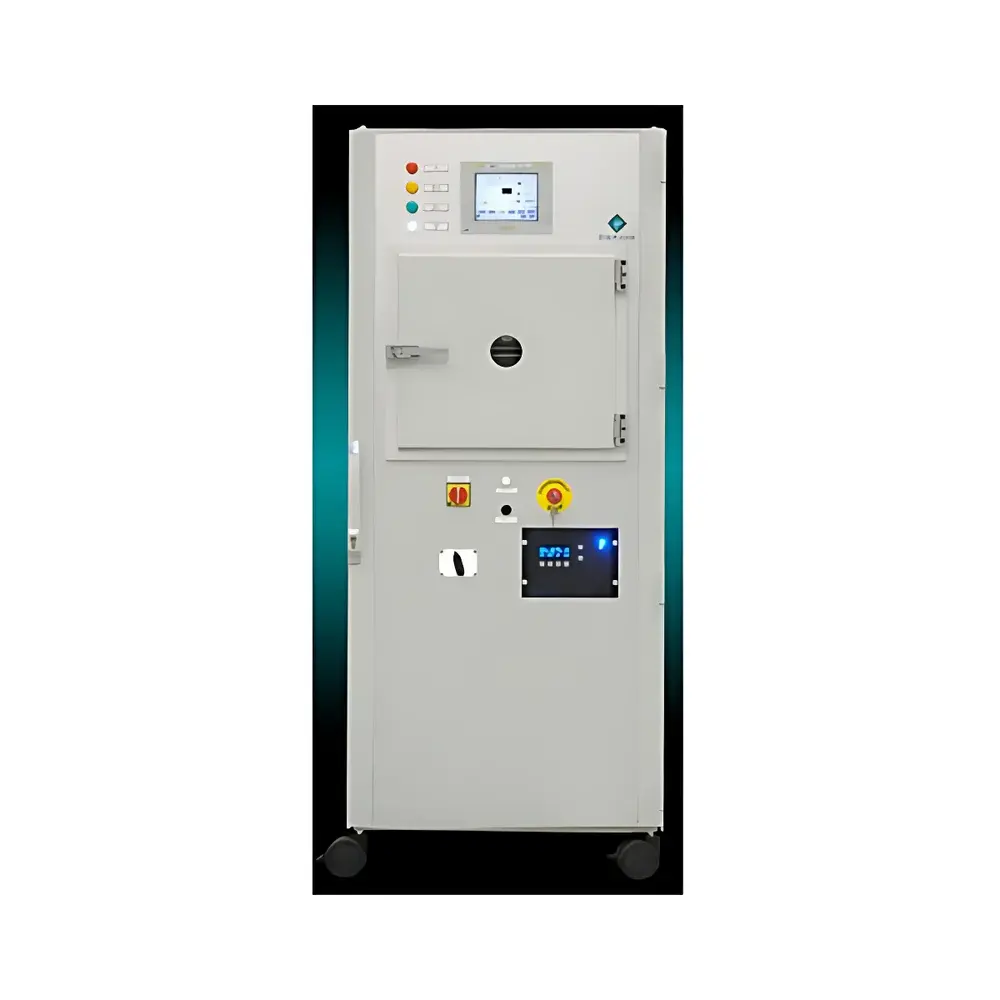
Europlasma CD400 Nanofics Low-Pressure Plasma Surface Treatment System
| Brand | Europlasma |
|---|---|
| Origin | Belgium |
| Model | CD400 |
| RF Frequency | 50 Hz |
| Power Supply | 380 V AC, 3-phase, 40 A |
| Chamber Dimensions | 500 × 400 × 445 mm |
| Chamber Volume | 89 L |
| Chamber Material | Anodized Aluminum |
| Vacuum Measurement | Pirani Gauge |
| Vacuum Pump | Dry Scroll Pump |
| Gas Inlets | 2 MFC-Controlled Ports + 1 Liquid Monomer Inlet |
| Gas Input Connection | 1/4″ (6.45 mm) |
| Exhaust Port | Ø28 mm |
| Control System | PLC-Based Automated Interface with Password Protection |
| Safety Features | Emergency Stop, Vacuum Interlock, Thermal Cut-off, CE Certified |
Overview
The Europlasma CD400 Nanofics is a benchtop low-pressure plasma surface treatment system engineered for precision functionalization, cleaning, and nanoscale thin-film deposition under controlled vacuum conditions. Operating on the principle of capacitively coupled radiofrequency (RF) plasma generation at 50 Hz, the system sustains stable glow discharge in noble or reactive gas environments (e.g., Ar, O₂, N₂, CF₄, or custom monomer vapors), enabling non-thermal surface activation without bulk heating—critical for temperature-sensitive substrates such as polymers, elastomers, and flexible electronics. The Nanofics process leverages plasma-induced grafting and polymerization to deposit ultra-thin, conformal, covalently bonded hydrophobic, anti-corrosive, or oxidation-resistant nanolayers (<10 nm thickness), all while maintaining substrate integrity below 40 °C. Unlike atmospheric plasma systems, its low-pressure architecture (typically 0.1–10 Pa operating range) ensures high uniformity, reproducible treatment depth, and minimal ion bombardment damage—making it suitable for R&D validation, pre-bonding surface preparation, and pilot-scale functional coating development.
Key Features
- Robust anodized aluminum reaction chamber (89 L volume; internal dimensions 500 × 400 × 445 mm) with integrated viewing window for real-time process observation
- Dual gas inlet system with mass flow controllers (MFCs) for precise regulation of two gaseous precursors; optional third port for liquid monomer vaporization via heated injection line
- Integrated dry scroll vacuum pump with Pirani gauge feedback, enabling rapid evacuation (<60 s to ≤5 Pa) and stable pressure maintenance during treatment
- PLC-based automation platform supporting programmable multi-step recipes—including vacuum ramping, gas purging, RF ignition delay, power ramping, dwell time, and controlled venting
- Comprehensive parameter logging: real-time monitoring of chamber pressure, RF power delivery, gas flow rates, treatment duration, and chamber temperature with ±0.5 °C accuracy
- Industrial-grade safety architecture compliant with EN 61000-6-2/6-4 and EN 61000-6-3, featuring emergency stop, thermal interlock (cut-off at >50 °C), vacuum lockout, and CE marking
Sample Compatibility & Compliance
The CD400 accommodates diverse sample geometries on two standard 360 × 360 mm trays, supporting flat, curved, or stacked components up to 120 mm height. It is routinely used for pretreatment of polypropylene, PET, PDMS, PTFE, PC, and FR-4 laminates prior to adhesive bonding, inkjet printing, or metallization. In regulated environments, the system supports GLP-compliant documentation through optional audit-trail-enabled software (available as upgrade). While not inherently 21 CFR Part 11 certified, its deterministic PLC logic, password-protected parameter editing, and timestamped event logging provide foundational traceability for ISO 13485, IATF 16949, or ASTM D726-19 surface energy validation workflows.
Software & Data Management
The embedded HMI interface enables intuitive recipe creation, execution, and archival. Each run generates a timestamped log file (.csv) containing vacuum profile, gas flow history, RF power envelope, and thermal trend data—exportable via USB or Ethernet. Optional PC-based software (Europlasma ControlSuite™) adds remote supervision, statistical process control (SPC) charting, comparative batch analysis, and PDF report generation with digital signature support. All system firmware updates are delivered via signed binary packages to ensure integrity and version traceability.
Applications
- Electronics: Hydrophobic nanocoating of Bluetooth earbuds, AR glasses housings, and drone casings to meet IPX4–IPX7 moisture resistance standards per IEC 60529
- Textiles: Durable water repellency (DWR) on nylon and polyester membranes without fluorocarbon chemistry—validated per AATCC Test Method 22
- Medical Devices: Surface activation of silicone catheters and polyurethane tubing to enhance heparin immobilization efficiency
- Automotive: Adhesion promotion on PP bumpers prior to plasma-sprayed thermal barrier coatings
- Research: Controlled surface grafting of acrylic acid or hexamethyldisiloxane (HMDSO) for tunable surface energy (20–72 mN/m) mapping
FAQ
What vacuum level does the CD400 achieve, and how is it measured?
The system uses a calibrated Pirani gauge to monitor pressure continuously, achieving base pressures of ≤0.5 Pa with the standard dry scroll pump. For processes requiring lower background contamination, optional turbomolecular pumping can extend the operational range down to 10⁻⁴ Pa.
Can the CD400 handle liquid monomers like HMDSO or allylamine?
Yes—the dedicated liquid monomer inlet includes temperature-controlled vaporization and MFC-regulated carrier gas dilution, enabling reproducible plasma polymerization of organosilicon and amine-based precursors.
Is remote monitoring or integration with lab information management systems (LIMS) supported?
Native Ethernet connectivity allows Modbus TCP communication for integration into factory automation networks; LIMS export requires CSV parsing or optional ControlSuite™ middleware.
What maintenance intervals are recommended for the vacuum pump and RF generator?
The dry scroll pump requires oil-free operation with filter replacement every 2,000 hours; the RF generator has no consumables and is rated for >10,000 hours MTBF under nominal load conditions.
Does the system comply with electromagnetic compatibility (EMC) requirements for laboratory use?
Yes—the CD400 meets EN 61326-1 (Laboratory Equipment EMC) and EN 55011 Class B emission limits, ensuring safe co-location with sensitive analytical instruments such as SEMs or FTIR spectrometers.



