
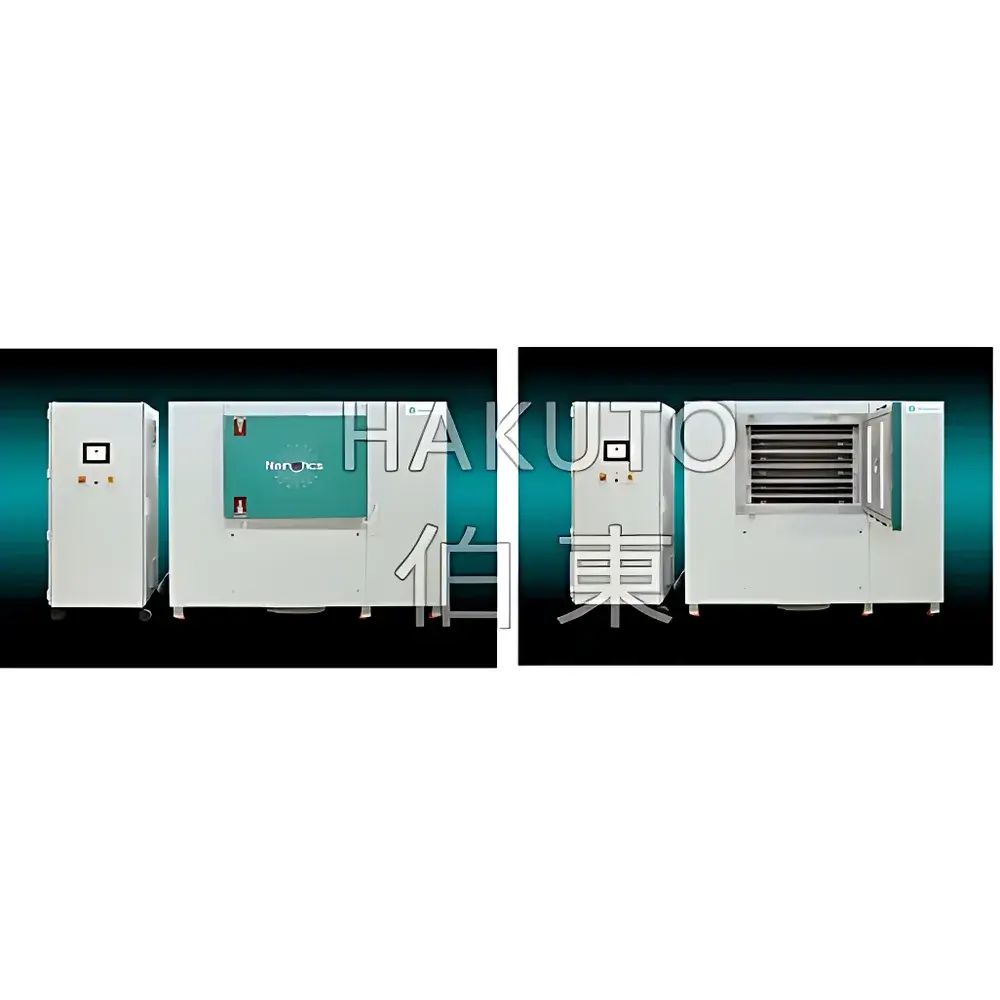
Europlasma CD1000 Low-Pressure Plasma Nanocoating System
| Brand | Europlasma |
|---|---|
| Origin | Belgium |
| Model | CD 1000 |
| Coating Thickness | 50–500 nm (single-layer), 1–3 µm (multi-layer) |
| Waterproof Rating | IPX2–IPX8 |
| Cycle Time | 10–30 min (standard), 3–4 h (multi-layer) |
| Substrate Compatibility | Nonwovens, polymer films, meshes, nanofiber webs, PCBs, electronic assemblies, 3D components |
| Compliance | ISO 10993-5 (cytotoxicity), ISO 10993-10 (irritation/sensitization), halogen-free formulation |
| Operating Environment | Low-pressure plasma chamber, vacuum-based surface polymerization & atomic layer deposition (ALD)-compatible process |
Overview
The Europlasma CD1000 is a precision-engineered low-pressure plasma nanocoating system designed for industrial-scale functional surface modification of sensitive substrates. Unlike conventional liquid-based or atmospheric plasma processes, the CD1000 operates under controlled vacuum conditions to enable uniform, conformal deposition of sub-100 nm functional polymer layers via plasma-enhanced surface polymerization and ALD-compatible precursor chemistry. This physical-vapor-phase process ensures molecular-level control over coating architecture—without solvent residues, thermal degradation, or dimensional distortion—making it ideal for electronics, medical devices, filtration media, and wearable technologies where integrity of microstructures, acoustic transmissivity, and biocompatibility are non-negotiable.
Key Features
- Vacuum-integrated low-pressure plasma chamber (10⁻²–10⁻³ mbar range) with precise gas flow control and RF power modulation (13.56 MHz)
- Scalable batch-mode processing for rigid and flexible substrates—including PCBs, MEMS assemblies, earphone drivers, AR/VR optical components, and porous nanofiber membranes
- Multi-layer coating capability: sequential deposition of barrier base layers (e.g., PlasmaGuard® S/E) and hydrophobic top layers (e.g., Nanofics® 110/120) in a single vacuum cycle
- Real-time process monitoring via integrated mass spectrometry and optical emission spectroscopy (OES) for endpoint detection and reproducibility assurance
- Automated recipe management supporting >100 user-defined protocols with audit-trail logging compliant with FDA 21 CFR Part 11 requirements
- Modular hardware architecture enabling future upgrades to roll-to-roll (R2R) configurations (e.g., CD1000/500, CD1800/800)
Sample Compatibility & Compliance
The CD1000 accommodates substrates ranging from flat wafers and printed circuit boards to 3D-molded housings and breathable nonwoven laminates. Its low-energy plasma chemistry preserves substrate morphology, electrical conductivity, and acoustic transparency—critical for microphone diaphragms and speaker grilles. All Nanofics® and PlasmaGuard® coatings are certified halogen-free per IEC 61249-2-21 and demonstrate full compliance with ISO 10993-5 (in vitro cytotoxicity) and ISO 10993-10 (skin sensitization and irritation). Coating adhesion is validated per ASTM D3359 (cross-hatch tape test) and IPC-TM-650 2.4.1 (thermal shock resistance). The system supports GLP/GMP-aligned documentation workflows, including electronic signatures, version-controlled SOPs, and raw sensor data export for regulatory submissions.
Software & Data Management
Equipped with Europlasma’s proprietary NanoControl™ software suite, the CD1000 provides intuitive graphical interface for parameter definition (power, pressure, pulse duration, monomer ratio), real-time plasma diagnostics, and post-process coating characterization reporting. All process data—including chamber pressure profiles, RF impedance traces, and OES spectral snapshots—are timestamped, encrypted, and stored locally with optional cloud backup. Software modules support statistical process control (SPC) charting, failure mode analysis (FMEA) integration, and automated report generation aligned with ISO/IEC 17025 laboratory accreditation standards.
Applications
- Consumer electronics: IPX7/IPX8-rated waterproofing of smartphones, smartwatches, TWS earbuds, and AR glasses without compromising signal integrity or tactile feedback
- Medical devices: Biocompatible hydrophobic barriers on surgical instrument housings, diagnostic sensors, and wound-contact filtration membranes
- Industrial filtration: Oleophobic nanocoatings on HEPA-grade nanofiber filters for HVAC and cleanroom applications
- Outdoor wearables: Durable water-repellent (DWR) finishes on technical textiles and membrane laminates meeting ISO 4920 and AATCC 22 standards
- Automotive electronics: Conformal moisture protection for ADAS camera modules and battery management system (BMS) PCBs operating under thermal cycling and vibration stress
FAQ
What vacuum level is required for Nanofics® coating deposition?
The CD1000 operates at 1×10⁻² to 5×10⁻³ mbar, optimized for stable glow discharge and monomer fragmentation control during plasma polymerization.
Can the system coat high-aspect-ratio through-holes or internal cavities?
Yes—the low-pressure plasma environment enables excellent step coverage and line-of-sight independence, achieving uniform coating thickness within ±5% across complex 3D geometries.
Is process validation support available for ISO 13485 or IATF 16949 environments?
Europlasma provides IQ/OQ/PQ protocol templates, traceable calibration certificates, and on-site qualification assistance for regulated manufacturing sites.
How does Nanofics® differ from traditional Parylene or ALD coatings?
Nanofics® uses plasma-polymerized organic precursors (e.g., fluorinated siloxanes), offering tunable WCA >120°, lower deposition temperature (<80°C), and faster throughput than Parylene C or Al₂O₃ ALD—while maintaining comparable barrier performance.
What maintenance intervals are recommended for the RF generator and vacuum pumps?
RF matching network calibration every 500 hours; turbomolecular pump oil change every 6,000 hours; chamber cleaning and electrode inspection every 200 cycles—documented in the included Preventive Maintenance Manual.



