
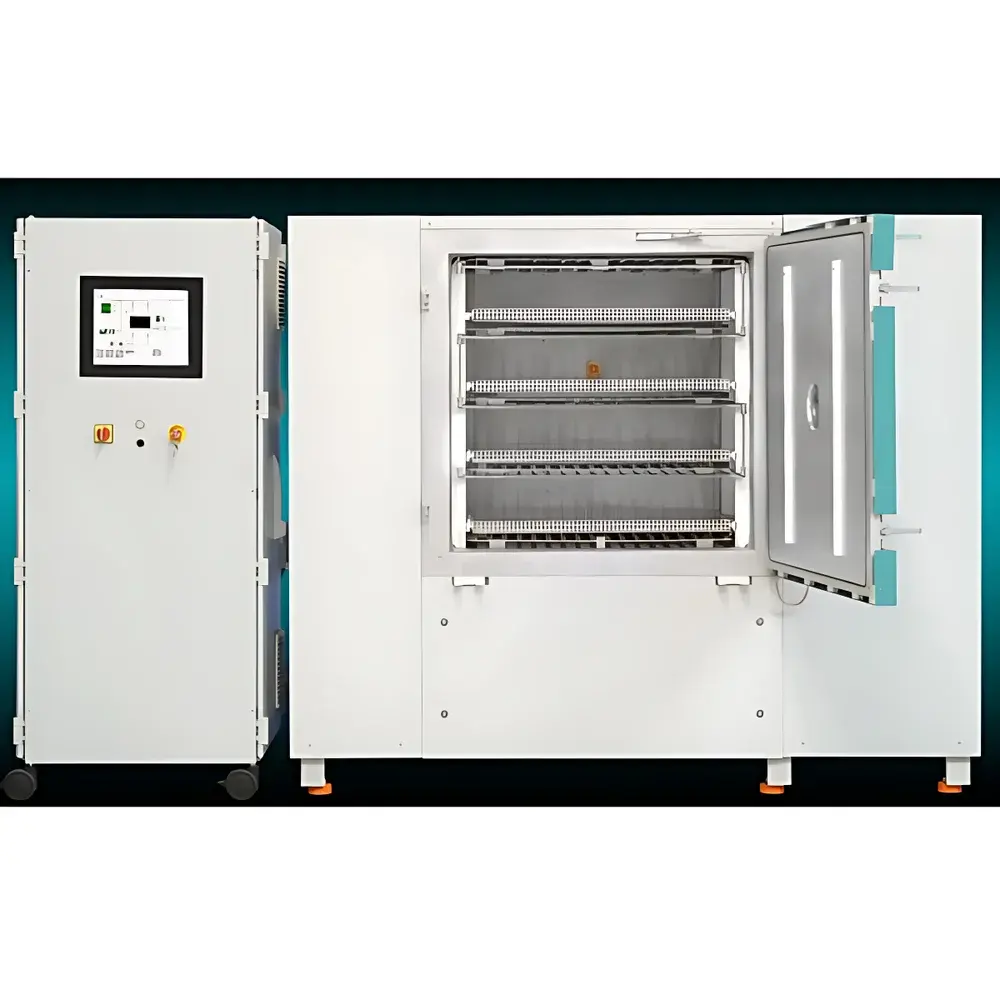
Europlasma CD681 Nanofics Low-Pressure Plasma Surface Treater
| Brand | Europlasma |
|---|---|
| Origin | Belgium |
| Model | CD681 |
| RF Frequency | 50 Hz |
| Power Supply | 380 V AC, 3-phase, 40 A |
| Chamber Volume | 681 L |
| Chamber Dimensions | 1000 × 980 × 695 mm |
| Chamber Material | Anodized Aluminum |
| Tray Configuration | 4 trays (858 × 672 mm each, 150 mm spacing) |
| Vacuum System | Dry Pump + Baratron Capacitance Manometer |
| Gas Inlet | 1/4″ (6.45 mm) with MFC |
| Exhaust Port | 28 mm diameter |
| Control System | PLC-based Automated Interface |
| Safety Certifications | CE compliant |
| Operating Temperature | <40 °C |
Overview
The Europlasma CD681 Nanofics Low-Pressure Plasma Surface Treater is an industrial-grade, vacuum-based plasma processing system engineered for precision surface functionalization under controlled low-pressure environments. Utilizing radiofrequency (RF)-generated cold plasma at 50 Hz, the system operates without thermal damage to heat-sensitive substrates—maintaining chamber temperatures below 40 °C throughout treatment cycles. Unlike atmospheric plasma systems, the CD681 employs a high-vacuum architecture (measured via Baratron capacitance manometer) to ensure reproducible plasma density, uniform reactive species distribution, and minimal contamination risk. Its 681-liter aluminum chamber—constructed from anodized, non-magnetic, corrosion-resistant alloy—supports large-volume batch processing while meeting stringent cleanliness requirements for R&D laboratories and pilot-scale production lines in electronics, textiles, filtration, and biomedical device manufacturing.
Key Features
- Large-capacity processing chamber (681 L) with four vertically adjustable aluminum trays (858 × 672 mm; 150 mm inter-tray spacing), enabling simultaneous treatment of heterogeneous or multi-layered samples.
- Integrated dry vacuum pump system with real-time pressure monitoring via Baratron sensor—ensuring stable base pressure and accurate process repeatability across multiple cycles.
- PLC-driven automation platform supporting full parameter logging: vacuum ramp rate, gas dosing (via mass flow controller), RF power delivery, process duration, chamber temperature, and final pressure stabilization.
- Single-gas inlet configuration (1/4″ stainless steel port, max input pressure 1 bar) compatible with common process gases including O₂, Ar, N₂, CF₄, and custom gas mixtures for oxidation, etching, or hydrophobic coating deposition.
- CE-certified safety architecture featuring emergency stop circuitry, vacuum interlock protection, overtemperature cutoff, and password-protected operator access to critical process parameters.
- Front-mounted observation window (tempered quartz) allows real-time visual verification of plasma ignition, uniformity, and glow discharge stability without breaking vacuum.
Sample Compatibility & Compliance
The CD681 accommodates rigid and flexible substrates up to 850 mm in width—including printed circuit boards (PCBs), polymer films, woven/nonwoven textiles, ceramic filters, medical-grade polymers (e.g., PEEK, PU, silicone), and metal components. Its low-temperature operation (<40 °C) prevents warping, outgassing, or degradation of thermally labile materials. The system complies with EU Machinery Directive 2006/42/EC and Electromagnetic Compatibility Directive 2014/30/EU. All control logic and data logs adhere to principles aligned with ISO/IEC 17025 for testing laboratory competence and support GLP-compliant documentation workflows when integrated with external LIMS platforms.
Software & Data Management
While the CD681 utilizes a deterministic PLC control core (no proprietary PC software required), it provides analog/digital I/O interfaces (4–20 mA, RS-485 Modbus RTU) for integration into centralized facility SCADA or MES systems. All operational parameters—including vacuum profile, gas flow transients, RF voltage/current waveforms, and cycle timestamps—are timestamped and stored locally on non-volatile memory. Audit trails retain ≥10,000 complete treatment records with user ID, parameter set version, and pass/fail status flags—facilitating traceability per FDA 21 CFR Part 11 requirements when paired with validated electronic signature modules.
Applications
The Nanofics plasma process enables covalent surface modification without bulk property alteration. In consumer electronics, it delivers conformal hydrophobic nanocoatings on Bluetooth earbuds, AR glasses frames, and drone housings—passing IPX4/IPX7 water resistance validation per IEC 60529. For technical textiles, it imparts durable water repellency (DWR) to nylon and polyester fabrics used in military uniforms and athletic apparel—verified by AATCC Test Method 22 and ISO 4920. In membrane science, it enhances pore-wetting resistance in PVDF and PTFE filters for pharmaceutical sterile filtration. Biomedical applications include improving cell adhesion on Ti-6Al-4V orthopedic implants and increasing hydrophilicity of PDMS microfluidic chips prior to plasma bonding.
FAQ
What vacuum level does the CD681 achieve before plasma ignition?
Typical base pressure is ≤5 × 10⁻² mbar using the integrated dry pump; final operating pressure during plasma generation ranges from 0.1 to 10 mbar depending on gas type and flow rate.
Can the system operate with multiple process gases simultaneously?
The standard configuration includes one MFC-controlled gas inlet; dual-gas capability requires optional manifold retrofit and additional MFC calibration.
Is remote monitoring supported?
Yes—via Modbus RTU over RS-485, enabling connection to third-party HMI or cloud-based dashboards for real-time status and alarm notification.
What maintenance intervals are recommended for the vacuum pump?
Dry pump service is advised every 6,000 operating hours or annually, whichever occurs first; Baratron sensor recalibration is recommended biannually.
Does Nanofics treatment affect material tensile strength or elongation at break?
No measurable change in bulk mechanical properties has been observed in validated polymer substrates (e.g., PET, PP, PC) following Nanofics treatment, as confirmed by ASTM D638 and ISO 527-2 tensile testing protocols.
Related Products



