
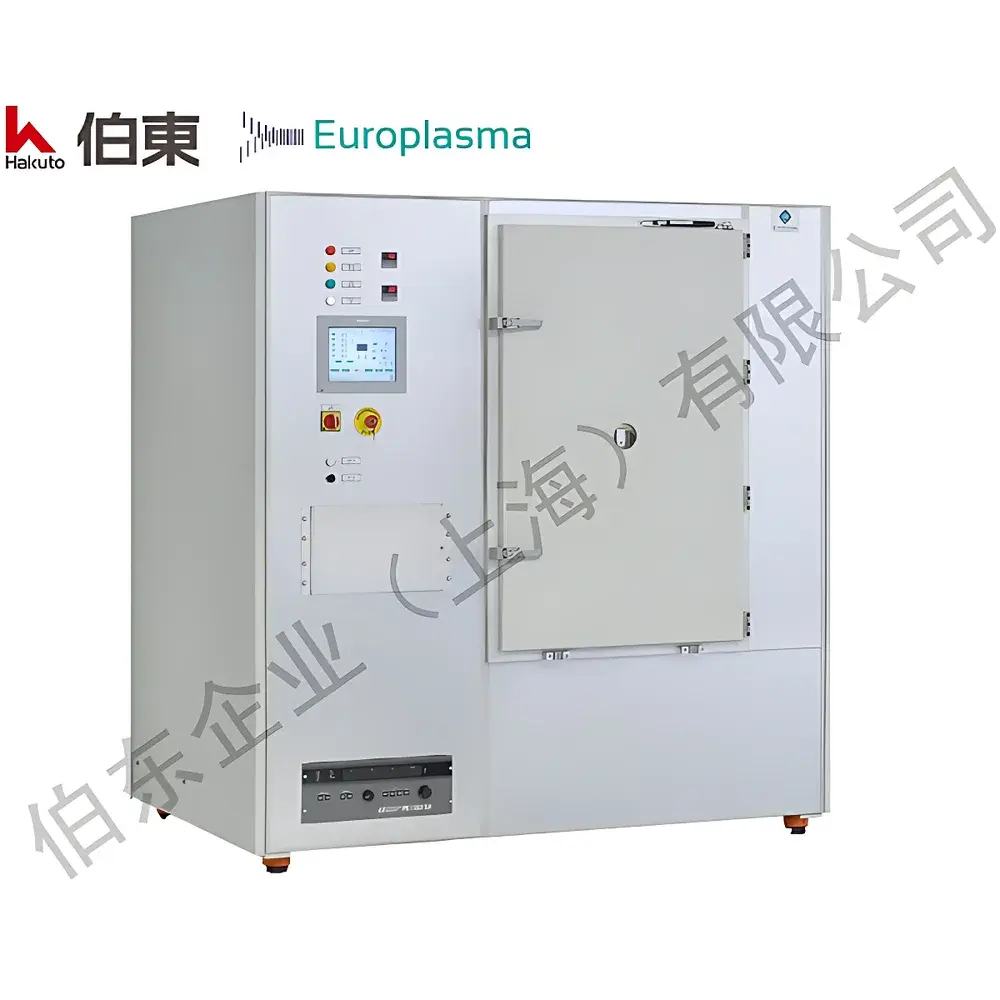
Europlasma CD1200PLC Plasma Surface Activation System
| Brand | Europlasma |
|---|---|
| Origin | Belgium |
| Model | CD1200PLC |
| Chamber Volume | 490 L |
| Chamber Material | Anodized Aluminum |
| Process Gases | Up to 5 Mass Flow Controllers (MFCs) for precise multi-gas mixing (e.g., O₂, Ar, N₂, Air, H₂) |
| Control System | Fully Automated PLC-Based Operation |
| Vacuum System | Integrated High-Throughput Vacuum Pumping |
| Compliance | CE-marked, ISO 9001–certified manufacturing, compatible with GLP/GMP documentation workflows |
Overview
The Europlasma CD1200PLC is a high-capacity, fully automated low-pressure plasma surface activation system engineered for reproducible, non-destructive functionalization of polymeric substrates—particularly polymethyl methacrylate (PMMA) and other optically transparent thermoplastics used in biomedical and microfluidic device manufacturing. Operating on the principle of capacitively coupled radiofrequency (RF) plasma generation under controlled vacuum conditions (typically 0.1–10 Pa), the system delivers uniform, shallow-depth (70 mN/m post-treatment. The result is a stable, hydrophilic surface characterized by water contact angles (WCA) consistently below 10° immediately after treatment and sustained below 50° for ≥18 months under ambient storage—validated per ASTM D7334 and ISO 8287 protocols.
Key Features
- Large-volume vacuum chamber (490 L) with anodized aluminum construction for corrosion resistance, thermal stability, and electromagnetic shielding.
- Modular gas delivery architecture supporting up to five independent mass flow controllers (MFCs), enabling precise stoichiometric blending of process gases—including O₂ (for oxidative activation), Ar (for physical sputtering enhancement), N₂ (for amine group incorporation), and synthetic air (for cost-effective industrial scaling).
- Integrated 13.56 MHz RF generator with impedance-matching network, delivering stable plasma density across complex 3D geometries—ensuring uniform treatment of microchannels, through-holes, and sharp edges inaccessible to liquid coatings.
- PLC-based automation with recipe-driven operation, real-time pressure/temperature monitoring, and audit-trail logging compliant with FDA 21 CFR Part 11 requirements when paired with validated software extensions.
- No halogenated precursors required; fully compatible with PlasmaGuard® technology—eliminating use of fluorinated or chlorinated chemistries per REACH Annex XIV and IEC 62474 material declarations.
Sample Compatibility & Compliance
The CD1200PLC is validated for batch processing of rigid and semi-rigid polymer substrates including PMMA, polystyrene (PS), cyclic olefin copolymer (COC), and polyethylene terephthalate glycol (PETG). It accommodates standard labware formats (e.g., 150 mm Petri dishes, 96-well plates, microfluidic chip carriers) as well as custom fixtures for high-aspect-ratio components. All treatments conform to ISO 10993-5 (cytotoxicity screening) and USP extractables testing when performed under cleanroom-grade operating conditions (ISO Class 7 or better). Chamber design meets EN 61000-6-3 (EMC) and EN 61000-6-4 emission standards, with full CE marking for installation within EU-based R&D and pilot-scale production environments.
Software & Data Management
The system operates via a touchscreen HMI interface running deterministic real-time firmware. Process parameters—including base pressure, gas composition ratios, RF power setpoint (50–500 W), treatment duration (15–30 min typical), and cooldown cycle—are stored as encrypted .xml recipe files. Optional data export modules support CSV/TXT output for LIMS integration and generate PDF reports containing timestamped chamber logs, MFC calibration traces, and operator ID metadata. When deployed in regulated environments, optional 21 CFR Part 11 add-ons provide electronic signatures, role-based access control, and immutable audit trails—fully traceable to individual treatment cycles and raw sensor outputs.
Applications
- Surface activation of PMMA substrates for cell-adhesive bioassay plates and organ-on-chip platforms requiring long-term WCA stability (≤50° over 12+ months).
- Pre-treatment of microfluidic channel walls prior to bonding or protein immobilization—enhancing capillary filling efficiency and reducing bubble nucleation.
- Functionalization of optical components (e.g., lenses, waveguides) without altering transmission spectra in the visible–NIR range (400–1100 nm).
- Enabling inkjet-printed electrode patterning on insulating polymers by increasing surface wettability and nucleation density.
- Preparing recyclable polymer packaging films for barrier coating adhesion—replacing corona discharge in high-speed roll-to-roll lines.
FAQ
What is the typical treatment time for PMMA activation?
Standard activation cycles range from 18 to 25 minutes at 200 W RF power and 5 Pa O₂ pressure—optimized to achieve WCA <10° without inducing surface ablation or haze formation.
Can the system handle irregularly shaped 3D parts?
Yes. The uniform plasma distribution and low-pressure regime ensure complete coverage of recessed features, internal cavities, and undercuts—verified using XPS depth profiling and dye penetration tests.
Is post-treatment aging validation included in the standard protocol?
Accelerated aging studies (per ISO 11607-1) are supported via optional environmental chambers; baseline shelf-life data (≥18 months at 23°C/50% RH) is provided in the system’s technical dossier.
Does the equipment require external cooling water or compressed air?
No. The CD1200PLC uses air-cooled RF generators and dry scroll vacuum pumps—minimizing infrastructure dependencies for lab-floor deployment.
How is process repeatability ensured across multiple batches?
Each run records full sensor telemetry; statistical process control (SPC) charts can be generated from exported logs to monitor Cp/Cpk trends per ASTM E2917 guidelines.



