
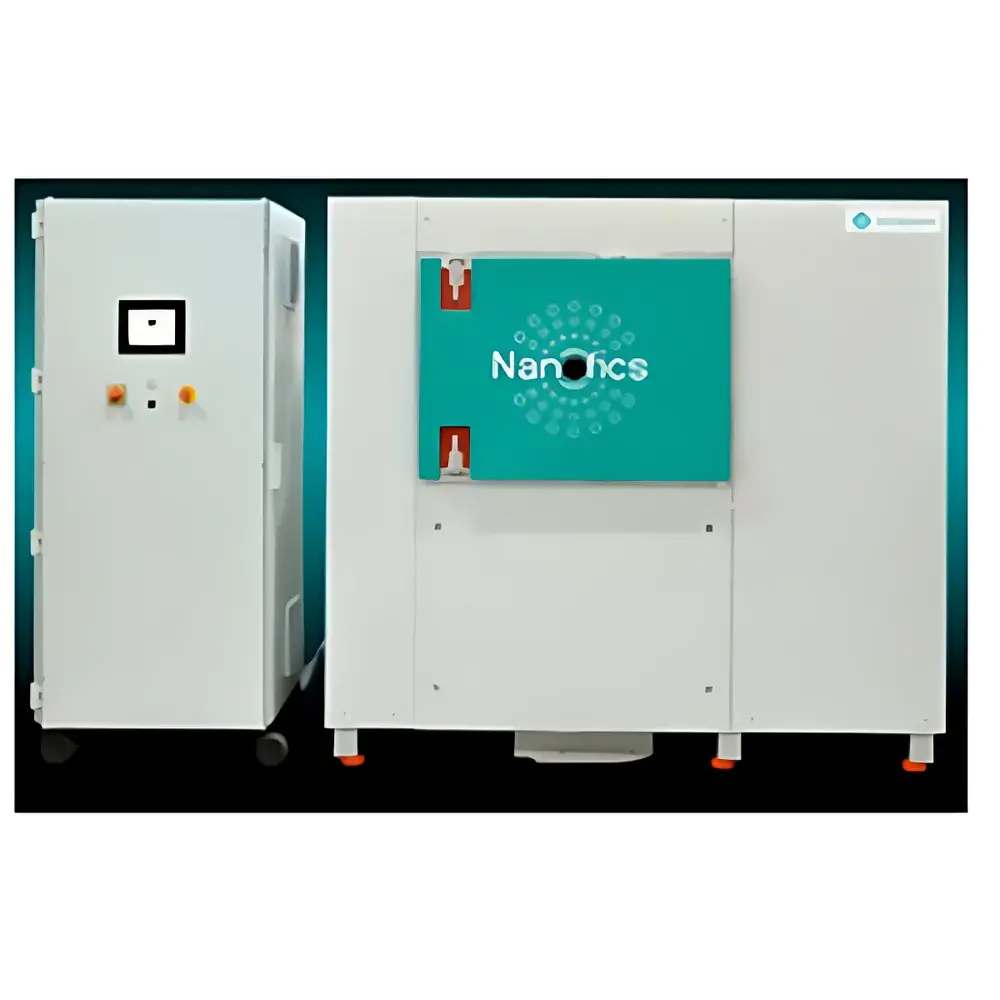
Europlasma CD600 PLC Low-Pressure Plasma Surface Treater
| Brand | Europlasma |
|---|---|
| Origin | Belgium |
| Model | CD600 PLC |
| RF Frequency | 50 Hz |
| Power Supply | 380 V AC, 3-phase, 40 A |
| Chamber Dimensions | 600 × 600 × 600 mm |
| Chamber Volume | 216 L |
| Chamber Material | Anodized Aluminum |
| Vacuum System | Dry Scroll Pump (480 m³/h), Dual Pirani Gauges |
| Gas Inlet | 1/4″ (6.45 mm) with MFC |
| Exhaust Port | Ø28 mm |
| Control Interface | 17″ Touchscreen HMI with PLC-based Automation |
| Compliance | CE Certified |
| Safety Features | Emergency Stop, Vacuum Interlock, Thermal Overload Protection |
| Operating Modes | Plasma Activation, Hydrophilic Coating (WCA < 10°), Oleophobic/Hydrophobic Coating (WCA > 120°), Halogen-Free PlasmaGuard® and Nanofics® Functionalization |
Overview
The Europlasma CD600 PLC is a laboratory-scale low-pressure plasma surface treater engineered for precise, repeatable, and process-controlled surface functionalization under controlled vacuum conditions. Based on capacitively coupled radiofrequency (RF) plasma generation at 50 Hz, the system operates in the glow discharge regime to enable non-thermal, non-destructive modification of material surfaces. Unlike atmospheric plasma systems, this vacuum-based platform ensures uniform plasma density distribution across complex 3D geometries and eliminates ambient contamination—critical for reproducible surface chemistry outcomes in R&D and pre-production validation. The CD600 PLC is purpose-built for academic laboratories, materials science departments, and quality control labs requiring traceable, GLP-aligned surface engineering capabilities for polymers, metals, ceramics, textiles, and biomedical substrates.
Key Features
- Robust anodized aluminum chamber (600 × 600 × 600 mm, 216 L volume) with integrated viewport for real-time process observation
- Integrated dry scroll vacuum pump system (480 m³/h pumping speed) with dual Pirani gauges for accurate pressure monitoring from 10⁻² to 10 mbar
- PLC-driven automation architecture with 17-inch industrial touchscreen HMI—enabling full parameter logging, recipe management, and audit-ready operation sequences
- Dedicated gas delivery module with mass flow controller (MFC) for precise dosing of Ar, O₂, N₂, CF₄, or custom gas mixtures via standardized 1/4″ inlet (max. 1 bar input pressure)
- Two certified functionalization pathways: Nanofics® for ultra-hydrophilic nanocoating (water contact angle 120°)
- Comprehensive safety interlocks—including emergency stop, vacuum chamber door lockout, thermal cutoff (≤80°C), and RF generator overcurrent protection—fully compliant with EN 61000-6-2/6-4 and CE directives
Sample Compatibility & Compliance
The CD600 PLC accommodates diverse sample formats: rigid substrates up to 552 × 522 × 40 mm (standard tray), flexible membranes, medical catheters, PCB assemblies, and porous textiles. Its uniform plasma field enables consistent treatment of heterogeneous surfaces without edge effects. All process parameters—including base pressure, gas composition, RF power ramp profile, exposure duration, and post-treatment dwell time—are fully programmable and digitally recorded. The system supports documentation requirements aligned with ISO 13485 (medical devices), ASTM D726 (surface wettability), and USP (surface energy characterization). Full electronic log files—including timestamps, operator ID, parameter deviations, and alarm events—meet FDA 21 CFR Part 11 readiness when deployed with validated software configuration.
Software & Data Management
The embedded PLC firmware provides deterministic real-time control of all hardware subsystems. Process recipes are stored locally with version control and password-protected access levels (operator, engineer, administrator). Each run generates a timestamped .csv report containing vacuum curve data, RF forward/reflected power, chamber temperature, gas flow stability, and endpoint confirmation signals. Optional OPC UA integration allows bidirectional communication with LIMS or MES platforms. Audit trails capture all parameter changes, user logins, and system alerts—retained for ≥12 months per internal retention policy. No cloud dependency; all data remains on-device unless explicitly exported via USB or Ethernet.
Applications
- Biomedical device manufacturing: activation of polyurethane catheters and silicone implants prior to bonding or cell seeding; functionalization of PET vascular grafts for enhanced endothelial adhesion
- Electronics assembly: removal of organic contaminants and oxide layers from PCB pads prior to conformal coating; surface conditioning of flexible OLED substrates
- Energy materials: hydrophilization of separator films for lithium-ion batteries to improve electrolyte uptake and ionic conductivity
- Technical textiles: durable water-repellent (DWR) finishing of Gore-Tex®-grade membranes without fluorinated chemistries
- Labware preparation: permanent hydrophilization of polystyrene culture flasks and microfluidic PDMS chips to eliminate batch-to-batch variability in cell attachment assays
FAQ
What vacuum level is required for stable plasma ignition?
Stable plasma ignition occurs between 0.1–5 mbar, depending on gas type and electrode geometry. The system automatically stabilizes within this range using closed-loop pressure control.
Can the CD600 PLC operate with reactive gases such as oxygen or ammonia?
Yes—gas compatibility includes O₂, N₂, Ar, CF₄, SF₆, and NH₃. MFC calibration and chamber material selection ensure long-term compatibility with aggressive chemistries.
Is remote monitoring or troubleshooting supported?
The unit features Ethernet port and Modbus TCP support for integration into facility SCADA systems; remote diagnostics require prior authorization and secure VPN access.
How is process repeatability verified between runs?
Each cycle logs raw sensor data (pressure, power, temperature); users may export datasets for statistical process control (SPC) analysis using external tools like JMP or Python Pandas.
Does the system comply with electromagnetic compatibility (EMC) standards for laboratory environments?
Yes—certified to EN 61326-1:2013 for laboratory equipment, including immunity to electrostatic discharge (ESD), radiated RF fields, and fast transients.



