
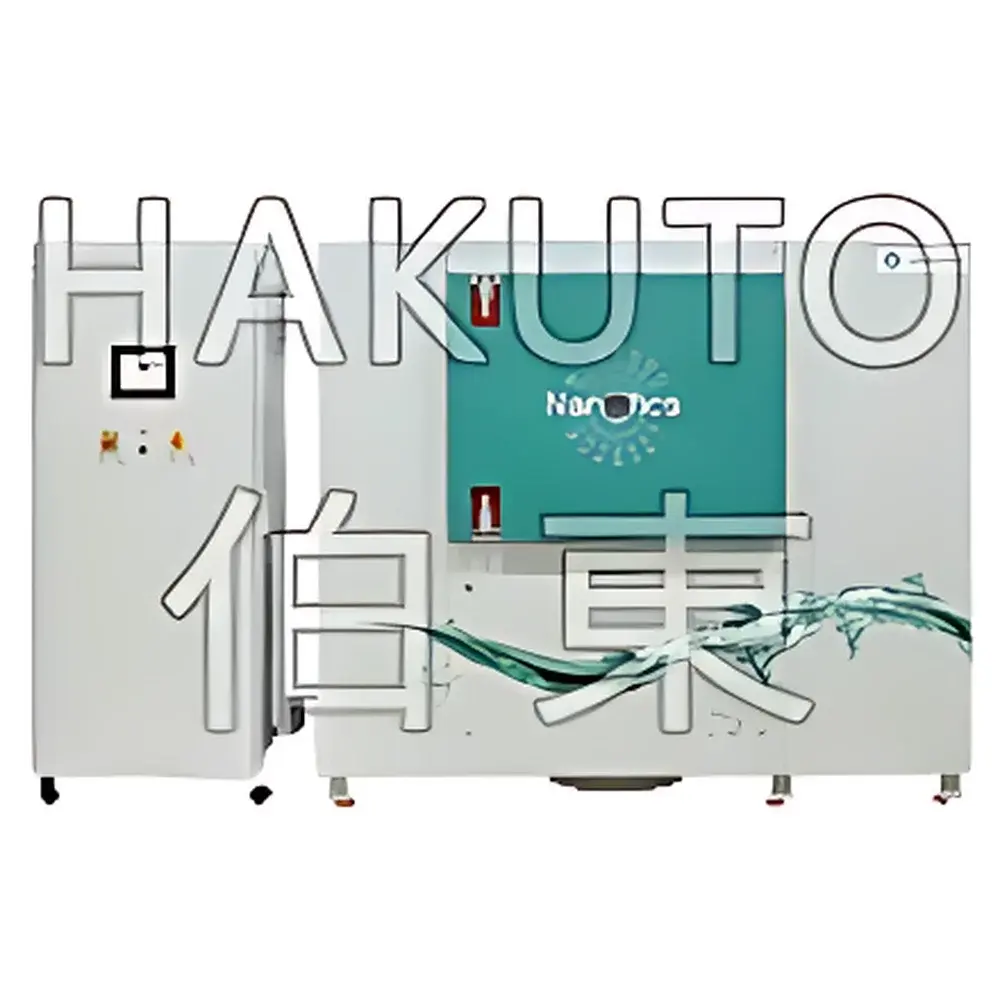
Europlasma CD-1000 Plasma Surface Treatment System
| Brand | Europlasma |
|---|---|
| Origin | Belgium |
| Model | CD-1000 |
| Power | 5 kW |
| Chamber Dimensions | 1000 × 700 × 700 mm |
| Chamber Volume | 490 L |
| Chamber Material | Anodized Aluminum |
| Process Gases | O₂, Ar, and other process-compatible gases |
| Control System | PLC-based fully automated operation |
| Vacuum System | Dry scroll vacuum pump with Pirani gauge |
| RF Generator | Custom-configurable frequency and power delivery |
| Electrical Supply | 380 V AC, 3-phase, 50 Hz, 40 A |
| Gas Inlet | 1/4″ (6.45 mm) stainless steel port with mass flow controller (MFC), max inlet pressure 1 bar |
| Exhaust Port | 28 mm diameter |
| Safety Certifications | CE compliant |
| Emergency Features | E-stop, vacuum interlock, thermal cutoff |
Overview
The Europlasma CD-1000 Plasma Surface Treatment System is a high-capacity, industrial-grade plasma-enhanced chemical vapor deposition (PECVD) platform engineered for functional nanoscale surface modification of electronic assemblies and precision components. Designed and manufactured in Belgium, the system operates under low-pressure plasma conditions to enable uniform, conformal, and halogen-free nanocoating deposition—primarily leveraging oxygen and argon-based chemistries—to achieve hydrophobic and oleophobic properties without altering bulk material characteristics. Its core principle relies on controlled plasma dissociation of precursor gases followed by surface polymerization or atomic-layer-like film growth at near-ambient substrate temperatures. This enables robust, pinhole-free coatings under 100 nm thickness—fully compatible with sensitive electronics such as printed circuit boards (PCBs), flex circuits, MEMS devices, and fully assembled consumer electronics including AR glasses, wireless earbuds, smartphones, and sports wearables requiring IPX7 or higher ingress protection.
Key Features
- 490-liter anodized aluminum process chamber with ergonomic front-loading door and integrated quartz viewport for real-time visual monitoring of plasma glow and sample positioning
- PLC-driven automation architecture supporting recipe-based process control, full parameter logging, and integration-ready communication protocols (Modbus TCP, OPC UA) for ERP/MES linkage
- Dry scroll vacuum pumping system with Pirani gauge feedback, achieving base pressures down to 10⁻² mbar; optimized for rapid pump-down and gas exchange cycles
- Configurable RF generator (13.56 MHz or custom frequency) with precise forward/reflected power regulation and impedance matching for stable plasma ignition across diverse substrates
- Three standard 858 × 672 mm load trays—modular and interchangeable—supporting batch processing of PCB panels, subassemblies, or finished devices with minimal handling
- Comprehensive safety framework including hardware-integrated emergency stop, vacuum interlock, overtemperature cut-off, and CE-compliant electromagnetic compatibility (EMC)
Sample Compatibility & Compliance
The CD-1000 accommodates three-dimensional geometries, high-aspect-ratio features, and heterogeneous material stacks—including FR-4, polyimide, ceramics, and coated metals—without shadowing or edge effects. Its low-temperature PECVD process avoids thermal stress on solder joints, adhesives, and polymer encapsulants. All process parameters—including chamber pressure, gas flow rates, RF power, treatment time, and temperature—are traceable and auditable, aligning with GLP and ISO 9001 quality management requirements. While not intrinsically FDA 21 CFR Part 11 certified, its data logging architecture supports validation documentation for regulated environments when deployed with qualified software extensions and audit trail modules.
Software & Data Management
The embedded HMI interface provides intuitive navigation through multi-step process sequences, with password-protected operator tiers (setup, run, maintenance). All operational parameters—including vacuum ramp profiles, gas dosing timelines, RF power curves, and real-time chamber temperature—are timestamped and stored locally on industrial-grade SSD storage. Export formats include CSV and XML for external analysis. Optional Ethernet/IP connectivity allows remote diagnostics, predictive maintenance alerts, and SPC charting via third-party SCADA platforms. Process recipes are version-controlled and exportable for cross-facility replication.
Applications
- Conformal waterproofing of PCBs and flex-rigid hybrids prior to final assembly
- Nanobarrier coating for moisture-sensitive sensors and battery modules
- Surface energy tuning of medical device housings for improved adhesive bonding
- Hydrophobic finishing of optical lenses and waveguides in AR/VR systems
- Pre-treatment of polymer substrates for enhanced ink adhesion in digital printing
- Functionalization of microfluidic channel walls to suppress protein adsorption
FAQ
What types of substrates can be processed in the CD-1000?
Standard substrates include rigid and flexible PCBs, ceramic packages, injection-molded plastic enclosures, and fully assembled electronic devices—provided they are vacuum-compatible and non-outgassing above 60 °C.
Is the Nanofics® coating compatible with rework or repair processes?
Yes—the sub-100 nm coating is chemically inert and thermally stable up to 120 °C, allowing standard reflow soldering and localized rework without delamination or degradation.
Can the system be validated for ISO 13485 or IATF 16949 environments?
With documented IQ/OQ/PQ protocols and calibrated instrumentation records, the CD-1000 meets foundational requirements for validation in medical device and automotive electronics manufacturing.
Does Europlasma provide application development support?
Yes—application engineers offer on-site process optimization, coating characterization (contact angle, FTIR, XPS), and failure mode analysis for customer-specific materials and geometries.
What maintenance intervals are recommended for the vacuum system and RF generator?
Dry pump oil change every 3,000 operating hours; RF matching network inspection and recalibration every 6 months or after 500 plasma cycles—logbook entries are automatically generated by the PLC system.



