
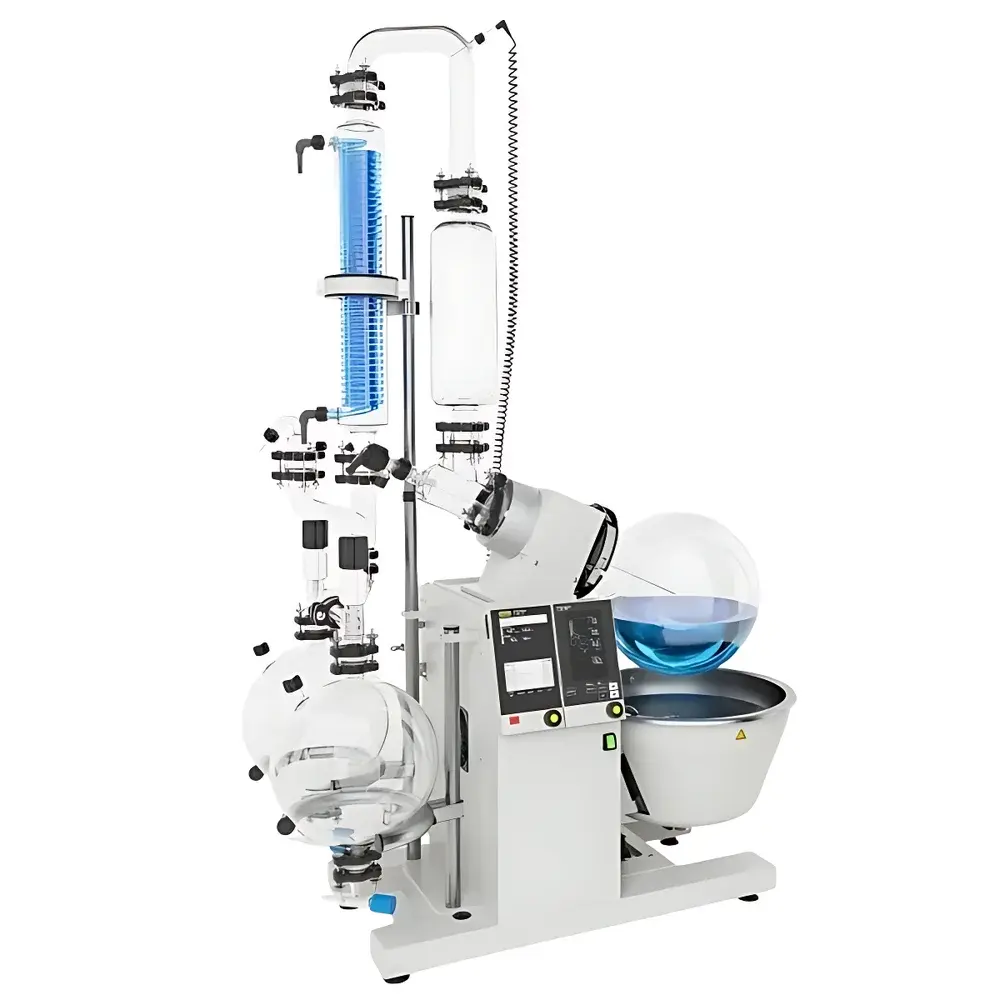
BUCHI R-220 Pro Extraction Rotary Evaporator
| Brand | BUCHI |
|---|---|
| Origin | Switzerland |
| Manufacturer | BUCHI AG |
| Type | Imported Instrument |
| Model | R-220 Pro Extraction |
| Capacity | 20 L |
| Ultimate Vacuum | ≤ 20 mbar |
| Rotational Speed | 5–150 rpm |
| Heating Temperature Range | Ambient to 180 °C |
| Temperature Control Accuracy | ±2 °C |
| Cooling Surface Area | Configuration-dependent (standard glassware set) |
Overview
The BUCHI R-220 Pro Extraction Rotary Evaporator is an integrated, modular platform engineered for concurrent solid–liquid extraction and high-throughput solvent removal under reduced pressure. As the inventor of rotary evaporation technology, BUCHI has refined this system using Couette-flow principles—rotating sample flasks immersed in heated baths while subjecting solvents to controlled vacuum and condensation—to deliver reproducible, scalable purification workflows. Unlike conventional rotary evaporators, the R-220 Pro Extraction incorporates a dedicated 4 L double-jacketed extraction chamber that enables continuous percolation or static maceration of botanical matrices (e.g., dried herbs, seeds, or biomass) while simultaneously distilling recovered solvents. Its architecture supports both batch and semi-continuous operation modes, making it suitable for natural product isolation, phytochemical screening, and preparative-scale purification in academic labs, contract research organizations (CROs), and GMP-compliant pilot facilities.
Key Features
- Modular dual-function design: integrates a 4 L jacketed extraction cell with a 20 L rotary evaporation system, enabling parallel extraction and solvent recovery
- Programmable SOP-driven operation: preconfigured methods guide users step-by-step through extraction, concentration, and solvent switching protocols
- Automated foam management: adaptive rotation speed modulation and vacuum ramping minimize bumping and foaming during volatile or surfactant-rich extractions
- Remote monitoring via BUCHI LabX® Mobile: real-time status alerts, process completion notifications, and deviation warnings pushed directly to iOS/Android devices
- Enhanced safety architecture: P+G (plastic-coated glass) components, integrated safety grid, and transparent polycarbonate shielding conform to EN 61010-1 and IEC 61326-1 requirements
- Corrosion-resistant construction: 316 stainless steel chassis, chemically inert PTFE and Kalrez® seals, and solvent-resistant control panel materials ensure long-term reliability in aggressive organic media
- 24/7 operational readiness: industrial-grade motor, sealed bearing assembly, and redundant thermal cutoffs support unattended overnight runs
Sample Compatibility & Compliance
The R-220 Pro Extraction accommodates heterogeneous solid samples—including ground plant material, resins, mycelial pellets, and polymer-bound analytes—as well as liquid–liquid partition systems. Its extraction chamber accepts standard 40–60 mesh particle sizes and supports solvent systems ranging from hexane and ethyl acetate to ethanol–water mixtures and supercritical CO₂-compatible co-solvents. All wetted parts comply with USP Class VI biocompatibility standards. The system meets ISO/IEC 17025 traceability requirements when operated with calibrated temperature sensors and vacuum transducers. Full audit trails—including method parameters, vacuum profiles, bath temperatures, and user logins—are generated in accordance with FDA 21 CFR Part 11 when paired with LabX® software and electronic signature modules.
Software & Data Management
Control and data acquisition are managed through BUCHI LabX® software (v4.0+), which provides GLP-compliant electronic notebooks, customizable report templates, and automated PDF generation with digital signatures. The system logs all critical process variables at ≥1 Hz resolution, including rotational torque, condenser temperature, vapor temperature, and absolute pressure. Raw datasets export in CSV, XML, and ASTM E1394-compliant formats. Integration with LIMS platforms (e.g., Thermo Fisher SampleManager, LabWare) is supported via OPC UA and RESTful API interfaces. All firmware updates are digitally signed and verified prior to installation to maintain integrity under IEC 62443-3-3 cybersecurity guidelines.
Applications
- Isolation of terpenoids, alkaloids, and polyphenols from medicinal plants using sequential ethanol/water and dichloromethane extraction cycles
- Concentration of fermentation broths containing heat-sensitive enzymes or monoclonal antibodies without denaturation
- Recovery and reuse of high-purity solvents (e.g., THF, DMF, NMP) from reaction workups in fine chemical synthesis
- Accelerated solvent extraction (ASE)-equivalent workflows for EPA Method 3545A compliance in environmental residue analysis
- Preparative purification of lipid extracts from microalgae for omega-3 fatty acid enrichment studies
- Development of green extraction protocols aligned with ISO 14040 life cycle assessment frameworks
FAQ
What types of solvents are compatible with the R-220 Pro Extraction’s heating bath and condenser system?
The system supports silicone oil baths up to 180 °C and dry ice/acetone or chilled glycol condensers down to –40 °C, accommodating common organic solvents including acetone, methanol, chloroform, and ethyl acetate. Highly corrosive solvents (e.g., concentrated HCl, bromine) require optional Hastelloy C-276 condenser upgrades.
Can the extraction chamber be sterilized for pharmaceutical applications?
Yes—the 4 L double-jacketed chamber is autoclavable at 121 °C for 20 minutes; all gaskets and valves are supplied in EPDM or FKM variants validated for repeated steam sterilization per ISO 13408-1.
Is method transfer possible between R-220 Pro Extraction units across different laboratories?
LabX® method files include embedded calibration metadata and hardware configuration fingerprints, enabling direct import/export between identically equipped R-220 Pro Extraction systems without recalibration.
How does the system handle viscous or particulate-laden extracts?
The extraction cell features bottom-mounted magnetic stirring and an integrated 50 µm sintered glass frit to retain solids while permitting filtrate flow into the rotary evaporation path—eliminating manual filtration steps.
Does the instrument support regulatory submission-ready documentation?
When deployed with LabX® IQ/OQ/PQ packages and 21 CFR Part 11 add-ons, the system generates full validation documentation compliant with ICH Q5A, Q5C, and EU Annex 15 requirements.



