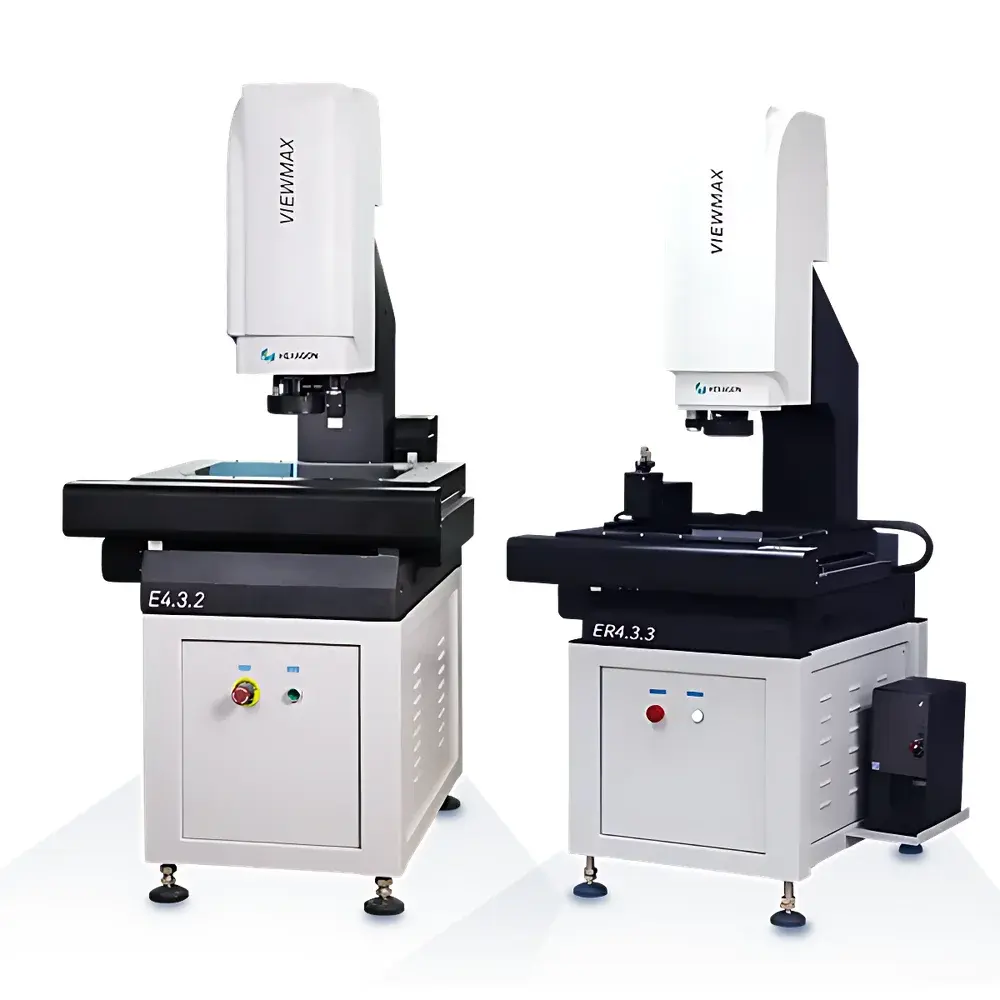
Hexagon Metrology VIEWMAX E/ER Series Image Measuring System
| Brand | Hexagon |
|---|---|
| Origin | Shandong, China |
| Manufacturer Type | Authorized Distributor |
| Origin Category | Domestic (China) |
| Model | VIEWMAX E/ER |
| Pricing | Upon Request |
| Base Material | Granite |
| Drive System | Precision Ground Ball Screw |
| Control System | Full-Closed-Loop Servo Control on X/Y/Z Axes |
| Camera | High-Resolution Color CMOS Sensor |
| Lens | 6.5:1 Motorized Zoom Lens |
| Illumination | Coaxial White LED, Transmitted Green LED, 6-Ring 8-Zone Surface Ring Light |
| Software | METUS Measurement Suite |
| Navigation | Real-Time Video Measurement Guidance System |
| Optional Probes | MCP Touch Probe, CWS Confocal White Light Sensor |
| ER Variant | Dual-Axis Rotary Table (Tilt & Rotation) |
| Environmental Requirements | 18–22°C (±1°C/h, ±2°C/24h, ±1°C/m), 40–70% RH, 220 V ±10%, 50/60 Hz, 1000 VA, Ground Resistance < 4 Ω |
Overview
The Hexagon Metrology VIEWMAX E/ER Series is a high-precision image measuring system engineered for non-contact geometric metrology of small- to medium-sized mechanical and electronic components. Based on digital optical imaging principles—specifically, high-magnification telecentric optics combined with sub-pixel edge detection algorithms—the system delivers traceable, repeatable dimensional measurements in accordance with ISO 10360-7 (coordinate measuring machines—part 7: characterization of image measurement systems) and supports compliance with ISO/IEC 17025 requirements for calibration laboratories. The E series emphasizes stability and optical fidelity through its massive granite base, precision-ground column, and thermally stable kinematic design; the ER variant extends capability via a motorized dual-axis rotary table (tilt ±90°, rotation 360° continuous), enabling automated multi-face inspection without manual repositioning—a critical advantage for stamped metal parts, injection-molded housings, PCBs, and thin-film printed substrates.
Key Features
- Monolithic granite structure (grade G-1) with vibration-damped base and precision-lapped stage—ensures long-term thermal and mechanical stability under controlled lab conditions.
- Ground ball screw transmission with preloaded linear guides on all three axes—minimizes backlash and hysteresis, supporting positioning repeatability ≤ ±0.5 µm (per ISO 10360-2).
- Full-closed-loop servo control architecture—provides real-time position feedback and dynamic error compensation during motion, essential for high-speed scanning and step-and-repeat measurement routines.
- 6.5:1 motorized zoom lens with programmable focus tracking—enables seamless magnification switching (typically 15×–100× optical) while maintaining parfocality and depth-of-field consistency across measurement fields.
- Multi-spectral illumination system: coaxial white LED (for specular surface contrast), transmitted green LED (optimized for transparent or translucent materials), and a configurable 6-ring × 8-zone ring light—each segment independently addressable to optimize edge contrast for features such as burrs, chamfers, or micro-textures.
- METUS software platform—certified for GLP/GMP environments, featuring audit trail logging (21 CFR Part 11 compliant when deployed with proper IT infrastructure), customizable report templates (PDF/Excel), GD&T evaluation per ASME Y14.5 and ISO 1101, and scriptable automation via Python API.
Sample Compatibility & Compliance
The VIEWMAX E/ER accommodates parts up to 1425 mm × 1140 mm × 1855 mm (L×W×H) and weighing up to 15 kg, making it suitable for production-floor QA labs and R&D metrology centers. Its optical measurement modality avoids surface deformation risks associated with tactile probing—ideal for soft polymers, anodized aluminum, thin-walled plastic enclosures, and fragile ceramic substrates. All configurations comply with CE marking requirements (EMC Directive 2014/30/EU, Machinery Directive 2006/42/EC) and meet IEC 61000-6-2/6-3 immunity and emission standards. Environmental specifications align with ISO 22068 (metrology laboratory environmental conditions), requiring temperature-controlled rooms (18–22°C, gradient limits strictly enforced) and humidity management (40–70% RH non-condensing) to ensure measurement uncertainty budgets remain within published MPE (Maximum Permissible Error) limits.
Software & Data Management
METUS serves as the unified metrology operating environment—integrating image acquisition, feature extraction, geometric fitting, GD&T analysis, and statistical process control (SPC) in a single interface. Its real-time video navigation system overlays measurement paths, tolerance zones, and auto-focus regions directly onto the live image stream, reducing operator dependency and training time. Raw image data, coordinate point clouds, and measurement logs are stored in encrypted, timestamped project files with full revision history. When configured with network authentication and role-based access controls, METUS satisfies FDA 21 CFR Part 11 requirements for electronic records and signatures—including electronic audit trails, user identity verification, and immutable log retention. Export options include STEP AP214, DXF, CSV, and custom XML schemas for MES/ERP integration.
Applications
- Automotive: Dimensional verification of brake caliper brackets, fuel injector nozzles, and stamped sensor housings—including true position, profile of a surface, and runout on rotating features.
- Electronics: SMT stencil aperture inspection, PCB fiducial alignment accuracy, solder paste volume estimation (via height mapping with optional CWS), and connector pin pitch/colinearity.
- Medical Devices: Critical dimension checks on catheter hubs, syringe barrels, and implant-grade polymer components—supporting ISO 13485 documentation workflows.
- Consumer Electronics: Backlight film registration accuracy, touch panel cutout geometry, and thin-film deposition uniformity assessment using intensity-based edge thresholding.
- Tool & Die: Mold cavity verification, EDM electrode wear analysis, and progressive die strip layout validation across multiple stations via ER-series rotational indexing.
FAQ
What is the difference between the VIEWMAX E and ER models?
The ER model adds a motorized dual-axis rotary table (tilt and rotation axes), enabling automatic reorientation of parts for multi-face measurement without manual intervention—reducing setup time and operator-induced variability.
Is METUS software validated for regulated industries?
Yes—METUS includes configurable audit trail, electronic signature, and user permission modules. Validation support packages (IQ/OQ documentation, test protocols) are available upon request for pharmaceutical, medical device, and aerospace applications.
Can the system measure height or 3D topography?
With the optional CWS confocal white-light sensor, the system performs non-contact surface profiling at sub-micron vertical resolution. Standard image measurement is 2D (X-Y plane); Z-axis is used only for focus optimization unless equipped with CWS or MCP contact probe.
What maintenance is required to sustain measurement accuracy?
Annual calibration by an accredited metrology service provider is recommended. Daily cleaning of optical surfaces with lint-free wipes and isopropyl alcohol, plus quarterly verification of illumination uniformity and focus repeatability, are part of standard lab SOPs.
Does the system support automated inspection routines for high-volume production?
Yes—METUS supports macro scripting, external PLC triggering, and pass/fail decision logic output via digital I/O. Integration with factory automation networks (OPC UA, Modbus TCP) is achievable through optional communication modules.