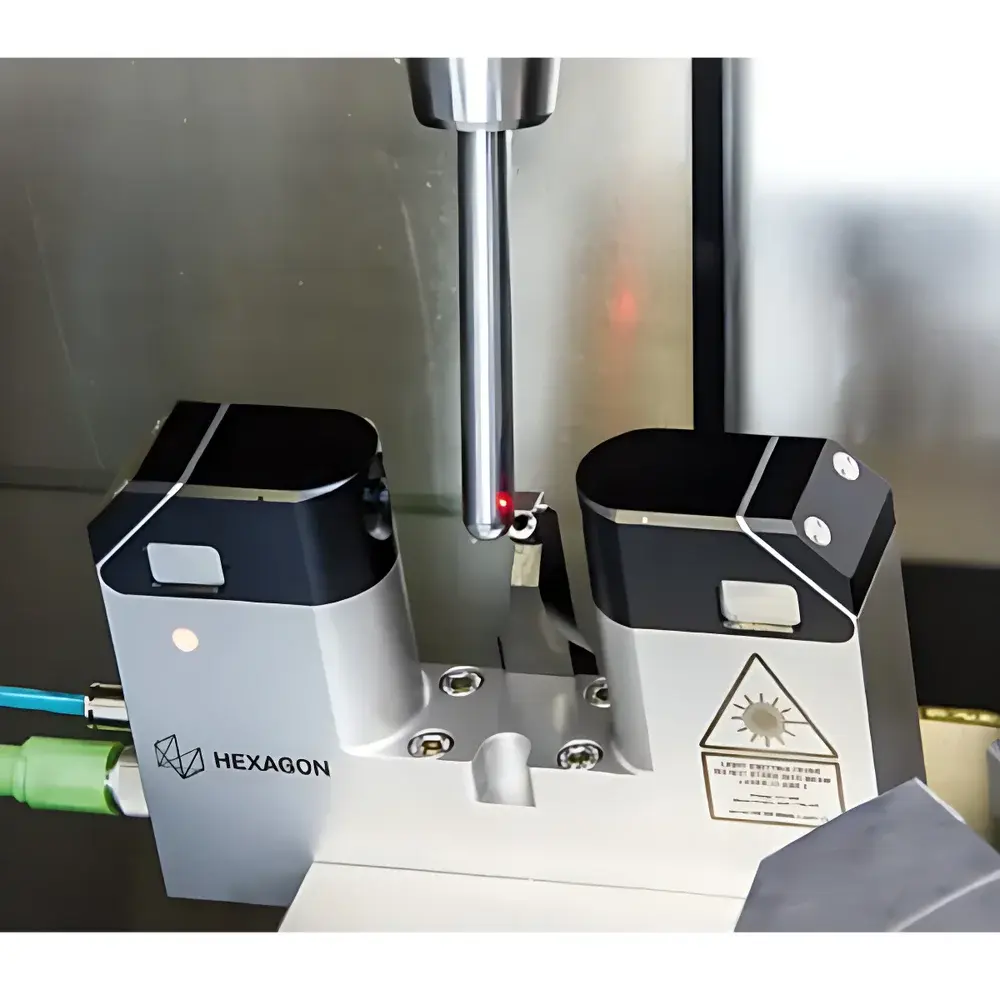
Hexagon Metrology m&h LTS35.60 In-Machine Laser Tool Setting System
| Brand | m&h |
|---|---|
| Origin | Imported |
| Manufacturer Type | Authorized Distributor |
| Model | LTS35.60 |
| Trigger Principle | Focused Laser (650 nm, <1 mW, Class 2 per IEC 60825-1) |
| Repeatability (2σ) | ≤0.1 µm |
| Trigger Axes | ±X, ±Y, ±Z |
| Minimum Measurable Tool Diameter | Ø0.008 mm |
| Aperture Options | 40 mm / 90 mm |
| Dimensions (min.) | 150 × 45 × 102 mm |
| Weight | 2000–2900 g |
| Operating Temperature Range | 5–70 °C |
| Housing Material | Stainless Steel |
| Ingress Protection | IP68 (per EN 60529) |
| Trigger Lifetime | >1,000,000 cycles |
| Signal Interface | Hardwired Cable Transmission |
| Shutter Type | Motorized Fast Shutter Unit |
| Application Scope | High- and Ultra-High-Precision CNC Machining Centers (Including Multi-Axis Milling, Turning, and Mill-Turn Machines) |
Overview
The Hexagon Metrology m&h LTS35.60 is a high-performance, in-machine laser tool setting system engineered for real-time, non-contact measurement of cutting tools directly within the machining environment. Based on focused laser triangulation with a stable 650 nm diode source (<1 mW output, IEC 60825-1 Class 2 compliant), the LTS35.60 delivers sub-micron repeatability (2σ ≤ 0.1 µm) across all three orthogonal axes (±X, ±Y, ±Z). Its core function is to automate the acquisition of critical tool geometry parameters—including tool length, tool diameter, radial runout, and axial offset—while simultaneously detecting tool wear, chipping, breakage, and thermally induced drift in machine kinematics. Designed specifically for integration into modern CNC machining centers—including 5-axis milling, turning, and mill-turn platforms—the system operates under continuous production conditions without requiring manual intervention or machine downtime. The robust stainless-steel housing, sealed to IP68 per EN 60529, ensures operational integrity in coolant-saturated, chip-laden, and high-vibration shop-floor environments.
Key Features
- Focused laser triangulation with fixed-wavelength (650 nm) optics and high-intensity collimation, enabling precise detection of micro-geometric features down to Ø0.008 mm tool diameters.
- Motorized fast shutter unit synchronizes optical exposure with spindle motion, eliminating motion blur during dynamic tool measurement and supporting high-speed tool change cycles.
- Dual-aperture configuration (40 mm and 90 mm) accommodates both compact and large-diameter tooling setups without mechanical reconfiguration.
- Integrated thermal compensation algorithm correlates ambient and spindle temperature inputs (via optional external sensors) to correct for thermal expansion-induced measurement drift.
- Compact form factor (minimum 150 × 45 × 102 mm) enables flexible mounting on turret faces, gantry supports, or machine column surfaces without interfering with work envelope clearance.
- Hardwired cable interface ensures deterministic signal transmission with immunity to electromagnetic interference typical in industrial power distribution zones.
Sample Compatibility & Compliance
The LTS35.60 is compatible with solid carbide, HSS, ceramic, and PCD-tipped cutting tools used in precision milling, drilling, boring, and threading operations. It supports measurement of rotating and stationary tools, including end mills, drills, reamers, inserts, and custom-ground profiles. The system complies with international safety and environmental standards: laser emission conforms to IEC 60825-1:2014 (Class 2); mechanical construction meets EN 60529 (IP68); and electrical interface design follows IEC 61000-6-2/6-4 for industrial immunity and emissions. While not a metrology standard reference instrument, its performance aligns with traceable calibration protocols referenced in ISO 230-6 (Test Code for Determining the Accuracy of Positioning of Numerically Controlled Machine Tools) and supports process validation under ISO 9001:2015 and IATF 16949 quality management frameworks.
Software & Data Management
The LTS35.60 interfaces natively with major CNC control platforms—including Siemens SINUMERIK, Heidenhain TNC, Fanuc OSP, and Mitsubishi M800/M700 series—via standardized PLC I/O mapping or direct RS-232/RS-422 serial protocols. Measurement data is transmitted as ASCII-coded position values (X/Y/Z offsets, diameter deviation, status flags) and logged into the machine’s internal memory or external MES systems via OPC UA or MTConnect adapters. All measurement events—including timestamp, tool ID, axis-specific deviations, and pass/fail flags—are recorded with audit-trail capability suitable for GLP/GMP-aligned production documentation. Optional m&h ToolScope software provides offline trend analysis, SPC charting (X̄-R, Cpk), and automated report generation compliant with ISO/IEC 17025 documentation requirements.
Applications
- Automated pre-cut tool verification prior to first-part machining on high-value aerospace components.
- Real-time wear monitoring of micro-diameter end mills in medical device component milling (e.g., orthopedic implant features).
- Compensation of thermal growth in long-reach boring bars during extended-cycle turbine blade machining.
- Validation of insert geometry consistency across multi-station turret setups in automotive powertrain manufacturing.
- Integration into lights-out manufacturing cells where unattended operation requires autonomous tool health assessment and adaptive parameter updating.
FAQ
What is the minimum tool diameter the LTS35.60 can measure accurately?
The system achieves reliable detection and dimensional evaluation of tools with diameters as small as Ø0.008 mm, enabled by its high-resolution focused laser spot and optimized optical depth-of-field.
Does the LTS35.60 require periodic recalibration?
While the laser sensor itself is factory-calibrated and sealed against drift, annual verification using certified gauge blocks or master tools is recommended per ISO 10360-5 and internal quality procedures.
Can it be used in wet machining environments with high-pressure coolant?
Yes—the IP68-rated stainless-steel enclosure ensures full protection against immersion and high-pressure coolant jets, making it suitable for use in milling and turning applications with through-spindle or flood coolant delivery.
Is the LTS35.60 compatible with robotic loading cells?
Yes, provided the robot controller supports discrete I/O handshake signals or serial command parsing; integration typically requires coordination between the robot OEM and m&h application engineering team.
How is tool breakage detected?
Breakage is inferred from abrupt, statistically significant deviations (>3σ) in measured diameter or length compared to baseline values stored in the tool database, combined with absence of expected trigger response across multiple scan passes.