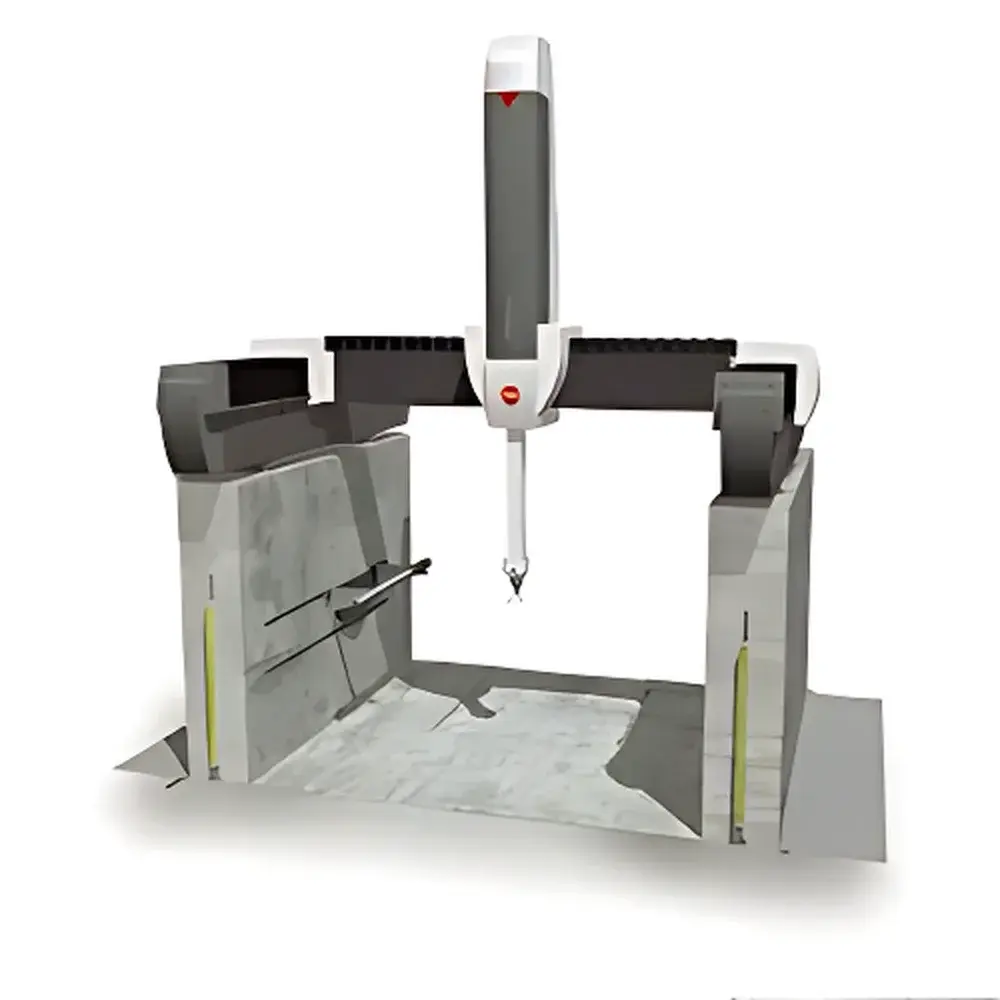
Leitz PMM-G High-Accuracy Bridge Coordinate Measuring Machine
| Brand | Leitz |
|---|---|
| Origin | Shandong, China |
| Manufacturer Type | Authorized Distributor |
| Regional Classification | Domestic (China) |
| Model | PMM-G |
| Configuration | Bridge-Type |
| Operation Mode | Fully Automatic |
| Instrument Orientation | Vertical |
| Measurement Principle | Contact-Based Metrology with Multi-Sensor Integration |
| Maximum Travel Range | 7000 × 4000 × 3000 mm |
| Standard Temperature Range | 18–22 °C |
| Z-Axis Material | Ceramic |
| Guideway Material | Granite |
| Bearing System | Air Bearings with Electronic Gap Monitoring |
| Positioning Resolution | 0.005 µm |
| Vibration Isolation | Active Damping System |
| Thermal Compensation | Integrated Environmental Sensor Network |
| Safety Systems | Dual Laser Scanners + Collision Avoidance Logic |
| Compliance Framework | ISO 10360-2, ISO 15530-3, VDI/VDE 2617, ASTM E1352, GLP/GMP-Ready Data Audit Trail |
Overview
The Leitz PMM-G is a high-accuracy, fully automated bridge-type coordinate measuring machine (CMM) engineered for metrological-grade inspection of large-scale industrial components. Designed and manufactured under Hexagon Metrology’s Leitz brand heritage, the PMM-G implements a high-bridge落地式 (ground-mounted) architecture optimized for structural stability and thermal robustness. Its core measurement principle relies on precision contact probing—augmented by optional non-contact optical sensors—within a rigid granite guideway system and ceramic Z-axis assembly. The machine operates within a tightly controlled thermal envelope (18–22 °C), where its thermally insensitive ceramic Z-column, dual-granite X/Y rails, and active vibration isolation ensure long-term repeatability and traceable accuracy per ISO 10360-2. With maximum volumetric travel up to 7000 mm × 4000 mm × 3000 mm, the PMM-G accommodates oversized aerospace structures, wind turbine gearboxes, railway bogies, and heavy-duty powertrain assemblies—enabling full-part GD&T evaluation without segmentation or repositioning.
Key Features
- High-bridge structural design minimizes moving mass while maximizing stiffness—critical for maintaining MPEE performance across extended travel ranges.
- Monolithic U-shaped granite base foundation provides intrinsic damping and eliminates differential settling; leveling is maintained via motorized height adjustment independent of part weight.
- Ceramic Z-axis with large cross-section resists torsional deflection and exhibits low coefficient of thermal expansion (CTE ≈ 2.5 × 10⁻⁶/K), ensuring dimensional stability under ambient fluctuations.
- Air-bearing motion systems on all axes integrate real-time electronic air-gap monitoring and fail-safe pressure redundancy—eliminating mechanical wear and enabling sub-micron trajectory fidelity.
- Dual-drive X-axis configuration with synchronized dual linear encoders ensures dynamic synchronization and compensates for yaw-induced errors during high-speed scanning.
- LSP-S series scanning probe system supports long-stem styli (up to 500 mm) and delivers high-frequency analog signal acquisition for form, profile, and surface texture analysis.
- SENMATION multi-sensor platform enables seamless integration of tactile, optical (chromatic confocal, structured light), and vision-based probes—all calibrated within a unified metrological framework.
- Active vibration cancellation system continuously monitors floor-borne disturbances (0.5–100 Hz) and applies counter-phase actuation to suppress transmission into the measurement volume.
- Onboard environmental sensor suite (temperature, humidity, air pressure) feeds real-time data to the controller for ISO 15530-3-compliant thermal error compensation.
- Comprehensive safety architecture includes front/rear laser area scanners (IEC 61496-1 compliant), emergency stop logic, and predictive collision avoidance based on path simulation and kinematic modeling.
Sample Compatibility & Compliance
The Leitz PMM-G is qualified for use in regulated manufacturing environments requiring documented metrological traceability. It conforms to ISO 10360-2 (CMM verification), ISO 15530-3 (calibration using calibrated workpieces), and VDI/VDE 2617 Parts 2 & 9 (volumetric accuracy and probing error assessment). Its modular sensor architecture supports compliance with ASTM E1352 (coordinate measuring system validation) and facilitates FDA 21 CFR Part 11–ready audit trails when paired with PC-DMIS Enterprise or QUINDOS software. The system is routinely deployed in aerospace (AS9100), automotive (IATF 16949), and energy sectors—where measurement uncertainty budgets must satisfy ≤ 2.0 µm MPEE (Maximum Permissible Error for length measurement) at full scale, as validated per ISO 10360-2 Annex B.
Software & Data Management
Controlled by Hexagon’s PC-DMIS or QUINDOS metrology software platforms, the PMM-G supports full GD&T evaluation—including ASME Y14.5 and ISO 1101 standards—with statistical process control (SPC) reporting, trend analysis, and automated report generation. Both software suites offer built-in calibration routines compliant with ISO 15530-3 and support encrypted, timestamped audit logs meeting GLP/GMP documentation requirements. Data export formats include QIF (Quality Information Framework), STEP AP242, and XML-based metrology reports compatible with enterprise MES/QMS systems. Optional cloud-enabled remote diagnostics and firmware update management are available through Hexagon’s SmartConnect infrastructure.
Applications
The PMM-G serves Tier-1 suppliers and OEMs engaged in high-value, low-volume production of large mechanical systems. Typical applications include: geometric validation of gear tooth flanks (diameters from 10 mm to 4450 mm), turbine blade root geometry and airfoil contouring, welded frame dimensional integrity (e.g., railcar chassis), composite tooling verification, and turbine housing concentricity and cylindricity assessment. Its multi-sensor capability extends utility into micro-geometric analysis—such as surface finish mapping via chromatic confocal probes—and hybrid inspection workflows combining tactile feature capture with optical freeform surface reconstruction.
FAQ
What is the standard accuracy specification for the Leitz PMM-G?
The base model achieves MPEE ≥ 2.0 µm (per ISO 10360-2) across its full measurement volume, with optional calibration certificates traceable to national metrology institutes (NMI) available upon request.
Can the PMM-G be installed in non-climate-controlled facilities?
While optimal performance requires operation within 18–22 °C ± 0.5 °C, its integrated thermal compensation engine mitigates drift outside this range—though extended deviations may require recalibration per ISO 15530-3 protocols.
Is the system compatible with existing metrology networks and ERP systems?
Yes—via standardized APIs and QIF/STEP AP242 data exchange, the PMM-G integrates with common MES, PLM, and QMS platforms including Siemens Teamcenter, PTC Windchill, and ETQ Reliance.
What certifications does the PMM-G hold for use in regulated industries?
It supports validation under ISO 9001, AS9100, IATF 16949, and 21 CFR Part 11 when configured with appropriate software modules and procedural documentation.
How is maintenance and service support provided globally?
Hexagon Metrology offers global field service, certified technician training, preventive maintenance contracts, and remote diagnostics via SmartConnect—ensuring uptime continuity and metrological assurance across multinational operations.