
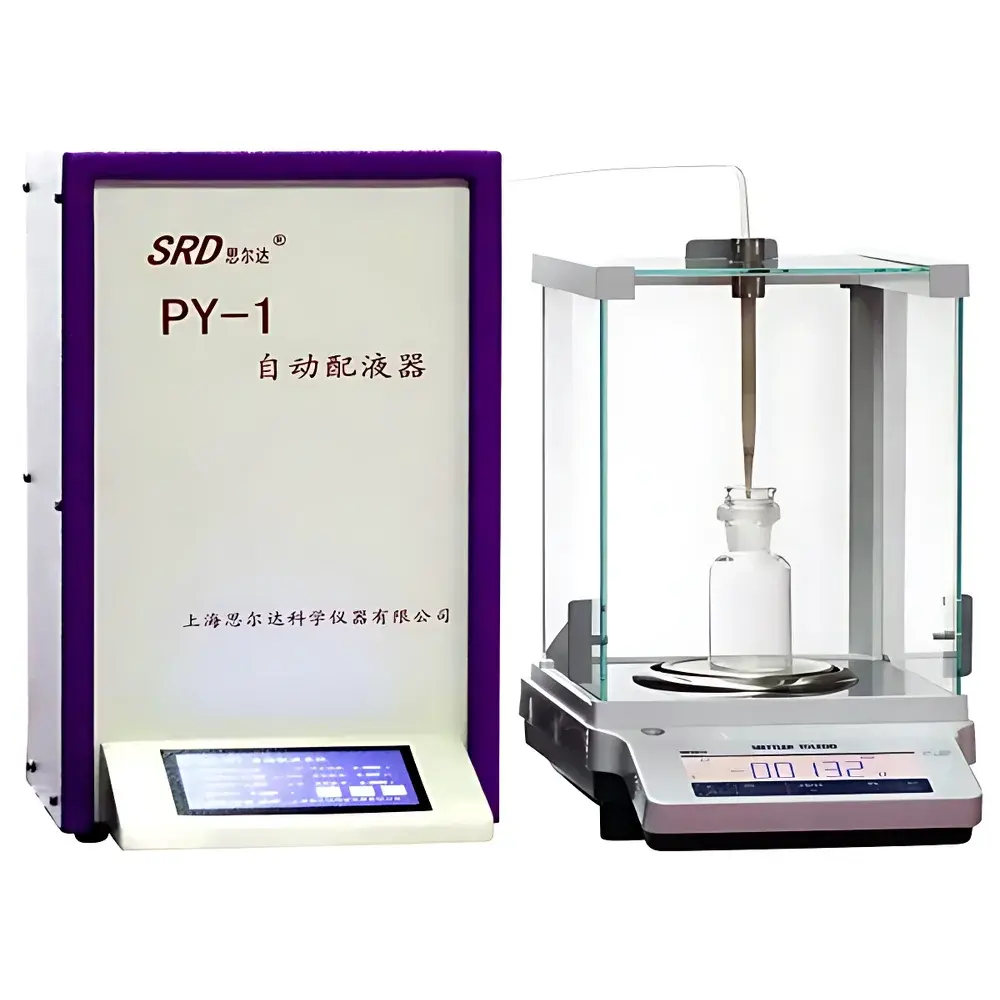
Shanghai SRD PY-1 Automated Solution Preparation Workstation for Intrinsic Viscosity and Polymer Molecular Weight Analysis
| Brand | SRD |
|---|---|
| Origin | Shanghai, China |
| Manufacturer Type | Authorized Distributor |
| Product Category | Domestic |
| Model | PY-1 |
| Pricing | Available Upon Request |
Overview
The Shanghai SRD PY-1 Automated Solution Preparation Workstation is an integrated, precision-engineered platform designed specifically to support standardized intrinsic viscosity (IV), limiting viscosity number (LVN), and polymer molecular weight determination workflows. It operates on the principle of gravimetric solution preparation—leveraging high-resolution analytical balances and calibrated solvent dispensing modules—to eliminate volumetric uncertainties inherent in traditional methods such as volumetric flask-based dilution or manual pipetting. Unlike conventional approaches that rely on fixed-volume glassware (e.g., 25 mL flasks) subject to thermal expansion, meniscus reading variability, and manufacturing tolerances, the PY-1 executes fully traceable mass-based dilutions under controlled environmental conditions. This ensures stoichiometric accuracy aligned with ISO 1628-1 (Plastics — Determination of Viscosity Number), ASTM D4603 (Standard Test Method for Determining Inherent Viscosity of Poly(ethylene terephthalate) (PET)), and USP guidelines for polymer solution preparation prior to capillary viscometry.
Key Features
- Gravimetric dosing architecture: Solvent delivery is dynamically adjusted in real time based on mass feedback from integrated 0.01 mg resolution balance, compensating for temperature-induced density shifts and pipette calibration drift.
- One-touch operation workflow: Pre-programmed protocols for common polymer systems (e.g., PET, PA6, PEEK, cellulose derivatives) enable full solution preparation—from solid sample weighing to final concentration adjustment—with a single touchscreen command.
- Traceable calibration chain: All mass and volume subsystems comply with ISO/IEC 17025 requirements; balance modules are certified to OIML R76 Class I standards, and solvent dispensers undergo periodic verification per ISO 8655-5.
- Environmental stability integration: Optional enclosure with temperature and humidity monitoring (±0.5 °C, ±2% RH) minimizes evaporation loss and thermal buoyancy effects during extended dissolution cycles.
- Modular expandability: Compatible with SRD DVNext series rotational viscometers and Ubbelohde capillary viscometers via RS-232/USB interface for automated data handoff and sequence synchronization.
Sample Compatibility & Compliance
The PY-1 supports solid polymer samples ranging from hygroscopic nylons to thermally sensitive polyacrylates and biopolymers (e.g., chitosan, alginate). It accommodates solvents including phenol/1,1,2,2-tetrachloroethane (for PET), sulfuric acid (for cellulose), formic acid (for polyamides), and NMP (for polyimides). All wetted components are chemically resistant (PTFE-coated valves, borosilicate glass vessels, Hastelloy C-276 dispensing nozzles). The system meets GLP documentation requirements through built-in audit trail functionality—including user login timestamps, parameter change logs, and electronic signature support—fully compliant with FDA 21 CFR Part 11 Annex 11 and EU GMP Annex 11 for regulated QC laboratories.
Software & Data Management
Controlled via SRD ViscoLink™ v3.2 software, the PY-1 provides intuitive protocol creation, version-controlled method storage, and export of raw mass/time/solvent volume datasets in CSV and XML formats. Software enforces mandatory field entries (sample ID, lot number, operator ID, ambient T/RH) and auto-generates ISO 17025-compliant calibration certificates for each run. Integrated LIMS compatibility enables direct upload to LabWare, STARLIMS, or Thermo Fisher SampleManager platforms. All data integrity safeguards—including write-once-read-many (WORM) archiving and SHA-256 hash validation—are implemented to satisfy ALCOA+ principles (Attributable, Legible, Contemporaneous, Original, Accurate, Complete, Consistent, Enduring, Available).
Applications
- Routine QC testing of synthetic fibers and engineering resins per ISO 1628-5 and GB/T 14190–2017.
- Research-grade molecular weight distribution profiling using Mark–Houwink–Sakurada correlations derived from IV measurements.
- Stability studies of biodegradable polymers (PLA, PHA) requiring strict solvent batch traceability and repeatability across multi-site trials.
- Regulatory submissions for medical device polymers (ISO 10993-13) where solution homogeneity and concentration fidelity directly impact cytotoxicity assay validity.
- Educational labs implementing ASTM D1243-based curriculum modules on polymer characterization fundamentals.
FAQ
Does the PY-1 replace capillary viscometers or rotational rheometers?
No—the PY-1 is a pre-analytical workstation. It prepares standardized solutions for downstream analysis using certified viscometers (e.g., Ubbelohde, Cannon-Fenske) or rheometers.
Can it handle volatile or hazardous solvents?
Yes—when used inside a certified fume hood or with optional vapor containment module equipped with activated carbon filtration and pressure-relief venting.
Is method validation support available?
Yes—SRD provides IQ/OQ/PQ documentation templates, uncertainty budgeting worksheets per EURACHEM/CITAC Guide, and on-site qualification services.
What maintenance intervals are recommended?
Balance recalibration every 72 hours of operation; solvent pump tubing replacement every 6 months; annual full metrological verification by SRD-certified service engineers.
How does it ensure compliance with pharmacopeial monographs?
By enforcing fixed mass ratios (e.g., 0.5 g/100 mL for USP ), recording ambient conditions at time of dissolution, and generating immutable electronic records required for FDA inspection readiness.



