
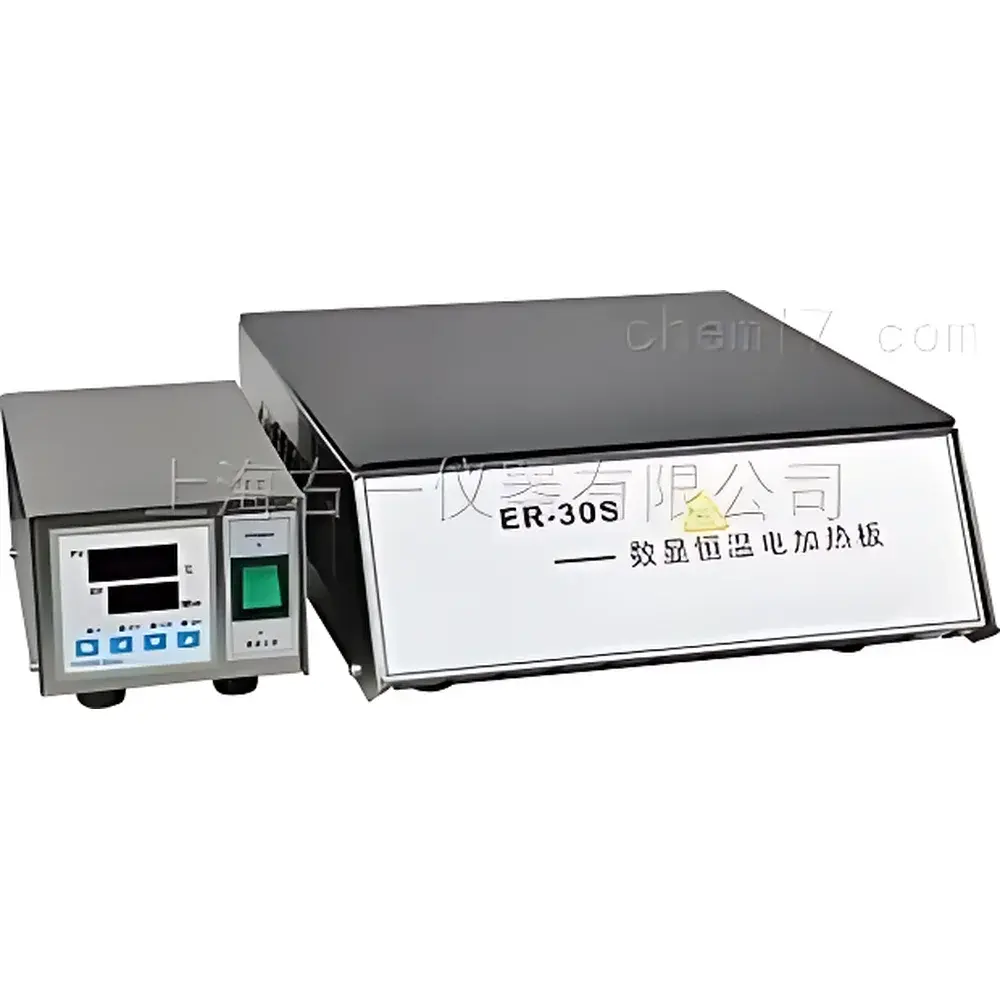
Yoyi ER-30S Digital Display Electric Hot Plate with Ceramic-Glass Surface
| Brand | Yoyi |
|---|---|
| Origin | Shanghai, China |
| Manufacturer Type | Direct Manufacturer |
| Country of Origin | China |
| Model | ER-30S |
| Heating Power | 1200 W |
| Maximum Temperature | 400 °C |
| Temperature Uniformity | ±1 °C |
| Plate Dimensions | 300 × 300 mm |
| Heating Zone Dimensions | 300 × 300 mm |
| Display Type | Digital LED |
Overview
The Yoyi ER-30S Digital Display Electric Hot Plate is an engineered solution for precise, stable, and corrosion-resistant heating in demanding laboratory environments. Designed around a robust ceramic-glass (microcrystalline glass) top surface, this hot plate operates on resistive heating principles—delivering uniform thermal energy across its entire 300 × 300 mm active zone via embedded high-stability heating elements. Its temperature control system utilizes a PID-regulated digital controller with real-time feedback, enabling setpoint accuracy within ±1 °C across the full operating range (RT + 20 °C to 400 °C). Unlike conventional stainless-steel or aluminum-surfaced plates, the microcrystalline glass surface exhibits near-zero thermal expansion (coefficient ~0.1 × 10⁻⁶ /°C), eliminating warping, cracking, or delamination under repeated thermal cycling. This makes the ER-30S particularly suitable for applications requiring long-duration, high-temperature digestion, evaporation, or solvent removal—especially where aggressive reagents such as concentrated HNO₃, HF, H₂SO₄, or NaOH are routinely employed.
Key Features
- Ceramic-glass surface rated for continuous operation up to 400 °C and chemically inert to strong acids, bases, and oxidizing agents—validated per ASTM C724-18 for chemical resistance testing;
- Full perimeter housing constructed from 316L stainless steel—providing superior pitting and crevice corrosion resistance in humid or splash-prone lab settings;
- High-efficiency ceramic fiber insulation layer beneath the heating zone minimizes heat loss, improves thermal response time, and reduces external surface temperatures (<50 °C at ambient conditions);
- Digital LED display with intuitive keypad interface for direct temperature setpoint entry, real-time readout, and over-temperature alarm activation;
- Integrated safety cutoff with dual independent thermal sensors—complying with IEC 61010-1:2010 Ed.3 for laboratory electrical equipment safety;
- Low-mass design (approx. 8.2 kg) facilitates ergonomic handling and benchtop integration without compromising structural rigidity.
Sample Compatibility & Compliance
The ER-30S accommodates standard laboratory vessels including borosilicate glass beakers (up to 2 L), PTFE digestion cups, quartz crucibles, and ceramic evaporating dishes. Its flat, non-porous surface ensures compatibility with volumetric flasks, round-bottom flasks (with support stands), and multi-vessel digestion blocks. The unit meets CE marking requirements and conforms to ISO/IEC 17025:2017 environmental conditioning specifications when used in accredited calibration or sample preparation workflows. For regulated environments—including GLP-compliant pharmaceutical stability studies or EPA Method 3050B/3051A acid digestions—the device supports documented temperature verification using external traceable thermocouples (Type K or Pt100), and its digital interface allows manual logging for audit trails.
Software & Data Management
While the ER-30S operates as a standalone instrument without proprietary software, its digital controller supports analog output (0–5 V or 4–20 mA) for integration into centralized lab monitoring systems (e.g., LabVantage, DeltaV, or custom SCADA). Optional RS-485 Modbus RTU communication module (sold separately) enables remote setpoint adjustment, real-time temperature streaming, and event logging—including power-on duration, max temperature reached, and alarm triggers. All operational data can be exported to CSV via connected industrial PLCs or DAQ systems, satisfying FDA 21 CFR Part 11 requirements when paired with validated electronic signature and audit trail protocols.
Applications
- Acid digestion of soil, sediment, and biological tissues per EPA Methods 3050B, 3051A, and 3052;
- Controlled evaporation of organic solvents (e.g., acetone, chloroform, hexane) during sample concentration prior to GC or LC analysis;
- Pre-heating and temperature equilibration of reaction mixtures in synthetic chemistry workflows;
- Standardization of viscosity reference oils and calibration fluid baths in QC labs;
- Heating of ion chromatography eluents and buffer solutions to reduce backpressure and improve separation efficiency;
- Support platform for hotplate stirrers (when used with compatible magnetic stirrer inserts).
FAQ
Is the ceramic-glass surface resistant to hydrofluoric acid (HF)?
Yes—the microcrystalline glass surface has been tested per ASTM C724-18 and demonstrates no visible etching or haze after 24-hour exposure to 40% HF at 100 °C.
Can the ER-30S be used inside a fume hood?
Yes—its fully sealed electronics, 316L stainless steel chassis, and absence of vented cooling fans make it suitable for continuous operation in Class II A2 and B2 fume hoods.
What is the recommended calibration frequency?
Per ISO/IEC 17025:2017 Clause 7.8.2, users should verify temperature accuracy at least once per week using a NIST-traceable handheld thermometer or thermocouple probe placed directly on the center of the plate surface.
Does the unit include over-temperature protection?
Yes—dual redundant thermal cutouts deactivate power if internal sensor readings exceed 420 °C or if surface temperature deviates >5 °C from setpoint for >30 seconds.
Is the ER-30S compatible with external temperature controllers?
Yes—via its analog output port (0–5 V proportional to measured temperature) and optional RS-485 Modbus interface for closed-loop integration with programmable logic controllers or DCS systems.



