
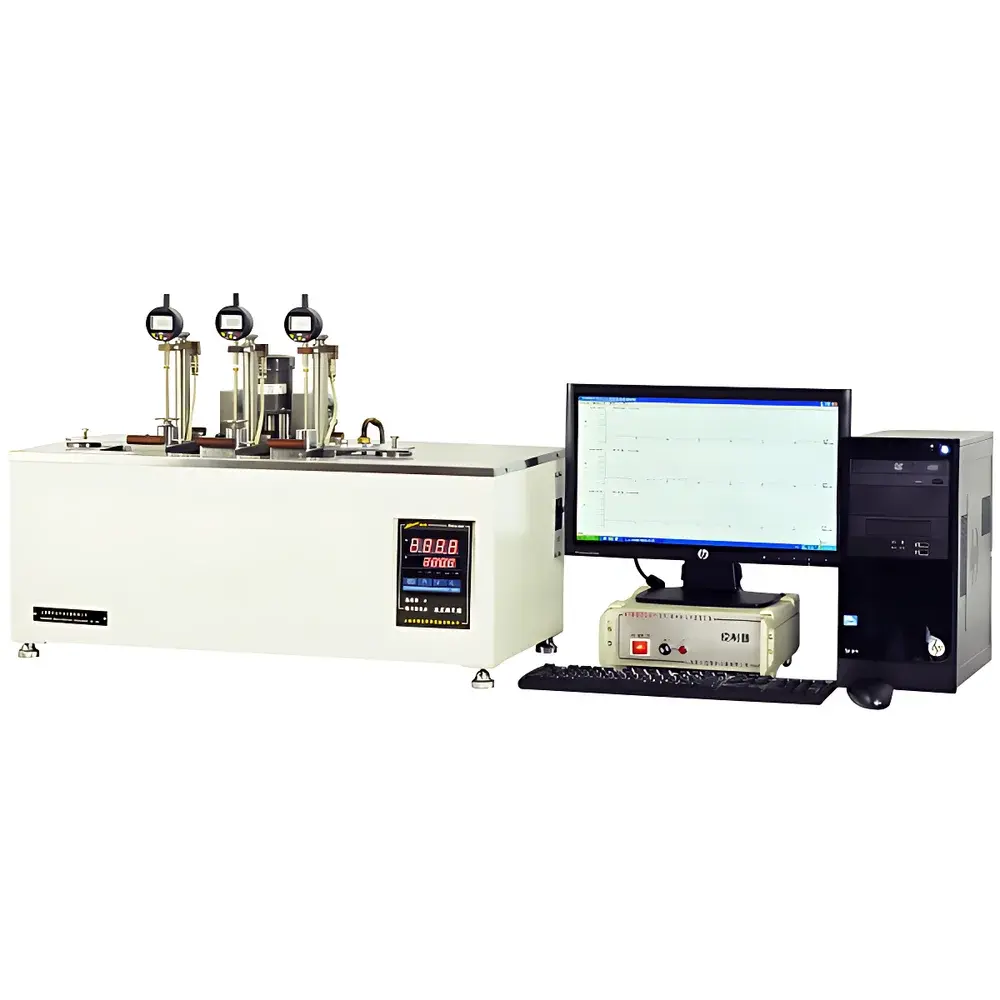
SRD SWB-300A/B Vicat Softening Point & Heat Deflection Temperature Tester
| Brand | SRD |
|---|---|
| Origin | Shanghai, China |
| Model | SWB-300A/B |
| Temperature Range | Ambient to 300 °C |
| Heating Rate Options | 5 ± 0.5 °C/6 min or 12 ± 1.0 °C/6 min |
| Temperature Accuracy | ±0.5 °C |
| Temperature Uniformity | ±0.5 °C across bath |
| Bath Volume | 25 L |
| Test Stations | 3 |
| Deformation Measurement | Dial Gauge (0.01 mm resolution) |
| HDT Indenter Radius | R = 3.0 ± 0.2 mm |
| HDT Span Length | 100 ± 0.5 mm |
| Load Rod Mass | 88.35 g |
| Vicat Needle Cross-Sectional Area | 1.000 ± 0.015 mm² (d = 1.128 ± 0.0085 mm) |
| Thermal Expansion of Test Frame | ≤ 0.01 mm (with correction value provided if exceeded) |
| Heating Power | 4 kW |
| Power Supply | 220 VAC, 20 A |
| Dimensions (L×W×H) | 830 × 500 × 540 mm |
| Net Weight | SWB-300A — 58 kg |
| Optional Feature | Motorized Lift Mechanism (SWB-300B only) |
Overview
The SRD SWB-300A/B Vicat Softening Point & Heat Deflection Temperature (HDT) Tester is a precision thermal analysis instrument engineered for standardized determination of two critical thermomechanical properties of thermoplastic polymers: the Vicat Softening Temperature (VST) and the Heat Deflection Temperature under Load (HDT). Both parameters are defined in internationally harmonized test standards—including ISO 306, ISO 75-1/2/3, ASTM D1525, ASTM D648, and GB/T 1633 and GB/T 1634—and serve as quantitative indicators of a material’s resistance to deformation under thermal stress and specified mechanical load. The instrument operates on the principle of controlled isothermal or linear heating of polymer specimens immersed in a thermostatically regulated silicone oil bath, while applying standardized axial loads via calibrated indenters or bending fixtures. Real-time deformation is measured using high-stability mechanical dial gauges with 0.01 mm resolution, ensuring traceable, repeatable results compliant with GLP and quality assurance requirements in R&D, QC, and certification laboratories.
Key Features
- Triple independent test stations enable parallel evaluation of up to three specimens—increasing throughput without compromising inter-test consistency.
- Dual-mode operation: Interchangeable test fixtures allow seamless transition between Vicat softening point measurement (using a 1.000 mm² needle) and heat deflection temperature testing (using a 3 mm-radius bending indenter and 100 mm support span).
- Precise thermal control: PID-regulated oil bath maintains uniform temperature distribution (±0.5 °C) across the 25 L working volume, with selectable heating rates of 5 ± 0.5 °C/6 min (for VST) or 12 ± 1.0 °C/6 min (for HDT), aligned with ISO and ASTM protocols.
- Structural compensation: Integrated thermal expansion correction algorithm accounts for frame drift (≤0.01 mm), delivering net specimen deformation data per standard requirements.
- SWB-300B variant includes motorized lift mechanism for automated positioning of the load train—reducing operator variability and enhancing repeatability during repetitive loading cycles.
- Comprehensive calibration support: Supplied with certified reference rods and blocks traceable to national metrology institutes, enabling in-house verification of thermal and mechanical performance prior to each test series.
Sample Compatibility & Compliance
The SWB-300A/B accommodates standard rectangular bars (e.g., 10 mm × 10 mm × ~80–120 mm) and cylindrical specimens per ISO 306 and ISO 75. It supports common thermoplastics including polyethylene (PE), polypropylene (PP), polyethylene terephthalate (PET), nylon (PA6/PA66), polycarbonate (PC), ABS, and PVC. All mechanical and thermal subsystems conform to the dimensional, load, and timing tolerances specified in ISO 306:2023, ISO 75-2:2013, ASTM D1525-22, and ASTM D648-22. The instrument design facilitates full audit readiness for ISO/IEC 17025-accredited laboratories, supporting documented calibration records, environmental monitoring logs, and user-accessible uncertainty budgets for both VST and HDT measurements.
Software & Data Management
While the SWB-300A/B operates via analog-digital hybrid control (with digital temperature readout and mechanical deformation sensing), it is fully compatible with external PC-based data acquisition systems via RS-232 or optional USB interface. Users may integrate real-time temperature and displacement logging into LIMS or ELN platforms using ASCII-structured output. For regulatory environments governed by FDA 21 CFR Part 11, the system supports third-party compliant software solutions that provide electronic signatures, audit trails, and role-based access control—ensuring integrity of raw test data, calibration entries, and result reports. All test parameters—including start time, target load, heating rate, and pass/fail thresholds—are configurable and stored with timestamped metadata.
Applications
- Quality control of incoming polymer resins and compounded pellets against supplier specifications.
- Formulation development: Correlating plasticizer content, filler loading, or copolymer ratio with thermal stability metrics.
- Process validation: Verifying extrusion or injection molding parameters that influence crystallinity and heat resistance.
- Regulatory submission support: Generating standardized test reports for CE marking, UL recognition, or automotive OEM material approval (e.g., VW TL 52209, GMW15635).
- Educational use in polymer science curricula for hands-on instruction in thermomechanical behavior and standard test methodology.
FAQ
What heating medium is required, and how much is needed?
The instrument requires 20 liters of thermally stable, low-volatility silicone oil (e.g., KF-90–50 for operation up to 300 °C). Oil selection must comply with flash point, viscosity, and oxidation resistance criteria specified in ISO 75-1 Annex A.
Is the instrument supplied with calibration certificates?
Yes—each unit ships with factory-verified calibration reports for temperature uniformity, heating rate accuracy, and mechanical zero-point stability. Traceability to CNAS-accredited standards is provided.
Can the SWB-300A be upgraded to SWB-300B functionality?
No—the motorized lift assembly is structurally integrated into the SWB-300B chassis and cannot be retrofitted to the SWB-300A due to differences in base frame reinforcement and drive coupling design.
How is compliance with ISO/ASTM heating rate verified?
Users perform rate verification using a calibrated platinum resistance thermometer (PRT) and stopwatch, measuring temperature rise over six minutes at mid-bath location—per procedures outlined in ISO 17025 Clause 6.5.2.
What maintenance intervals are recommended for long-term accuracy?
Oil bath fluid should be replaced annually or after 2000 operating hours; dial gauge calibration verified quarterly; thermal sensors recalibrated biannually by an accredited service provider.





