
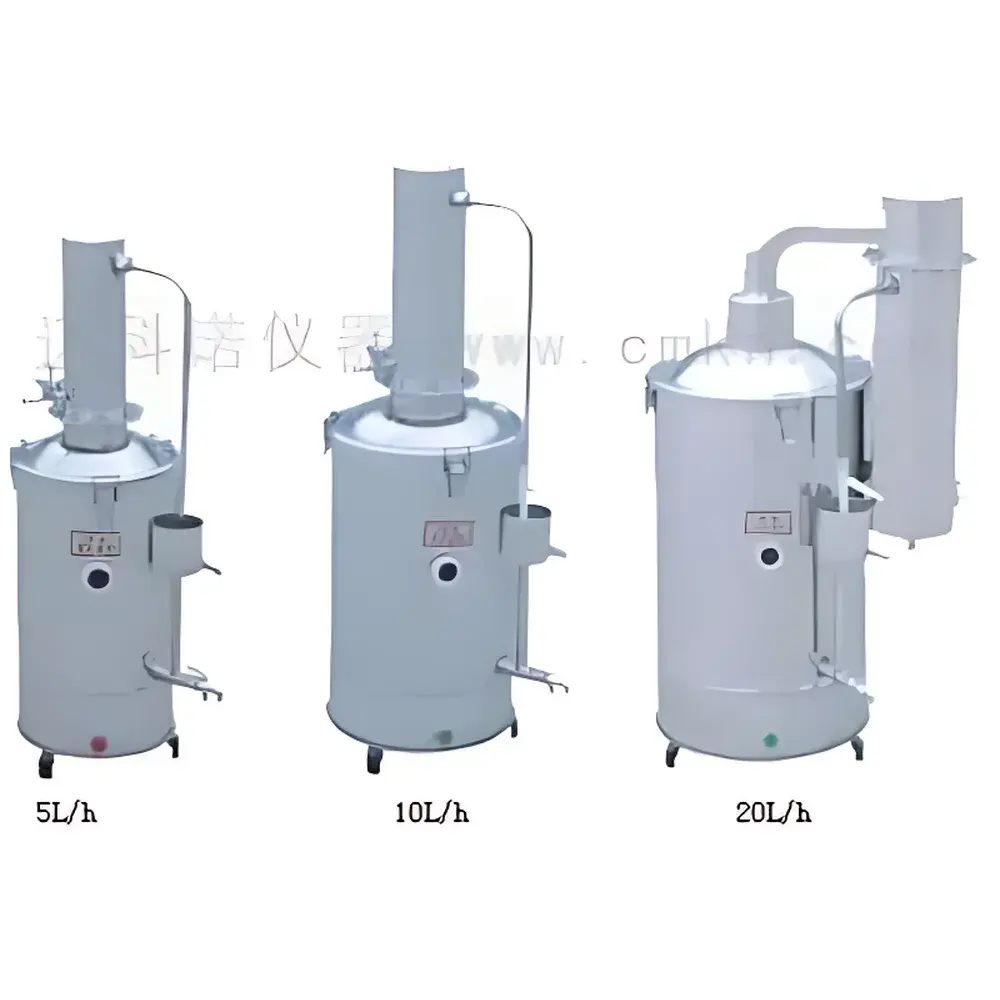
HSZ Stainless Steel Distillation Apparatus
| Origin | Jiangsu, China |
|---|---|
| Manufacturer Type | Authorized Distributor |
| Model | HSZ-5 / HSZ-10 / HSZ-20 |
| Capacity | 5 L/h / 10 L/h / 20 L/h |
| Power Consumption | 5 kW / 7.5 kW / 15 kW |
| Input Voltage | 220 V (HSZ-5) / 380 V (HSZ-10 & HSZ-20) |
| Construction Material | AISI 304 Stainless Steel |
| Compliance | Meets GB/T 11417–2015 (Chinese Standard for Laboratory Distillation Equipment) |
Overview
The HSZ series stainless steel distillation apparatus is a robust, bench- or floor-standing laboratory-scale water purification system engineered for continuous production of high-purity distilled water. Based on the principle of thermal vaporization and condensation, the unit operates via electrically heated boiling of feed water in a stainless steel evaporation chamber, followed by efficient condensation of steam within a concentric, air-cooled or water-jacketed condenser. Designed for stable, low-maintenance operation under standard laboratory conditions, the HSZ apparatus delivers consistent distillate quality suitable for analytical reagent preparation, buffer formulation, autoclave feed, and general-purpose purified water requirements in pharmaceutical QC labs, chemical synthesis workflows, and academic research environments.
Key Features
- Full AISI 304 stainless steel construction—including evaporator chamber, condenser body, collection vessel, and structural frame—ensuring long-term resistance to corrosion, scaling, and thermal fatigue.
- Modular design with three standardized capacity variants (HSZ-5, HSZ-10, HSZ-20), each calibrated to deliver nominal output rates of 5 L/h, 10 L/h, and 20 L/h respectively, with ±5% volumetric repeatability under steady-state operation.
- Integrated overheat protection, automatic water-level monitoring, and dry-run prevention circuitry compliant with IEC 61000-6-3 (EMC immunity) and IEC 60335-1 (household and similar electrical appliance safety).
- Electropolished internal surfaces and welded seam finishing reduce nucleation sites for mineral deposition, facilitating routine cleaning and minimizing carryover risk.
- Low-noise operation (<65 dB(A) at 1 m distance) and compact footprint optimized for integration into ISO 14644-1 Class 7/8 cleanroom-adjacent lab spaces or shared instrument rooms.
Sample Compatibility & Compliance
The HSZ apparatus accepts municipal tap water, deionized water, or softened feed water as input; it is not intended for direct use with seawater, high-TDS industrial effluents, or organic solvent mixtures. Distillate conductivity remains ≤1.0 µS/cm at 25 °C when operated with feed water <500 µS/cm and maintained per manufacturer’s service schedule. The system conforms to GB/T 11417–2015 for laboratory distillation equipment and supports GLP-compliant documentation through optional external data loggers (e.g., calibrated temperature and flow sensors). While not certified to USP or ASTM D1193 Type II specifications out-of-the-box, its performance meets or exceeds Type IV water requirements for non-critical applications per ISO 3696:1987.
Software & Data Management
The HSZ series operates via analog control architecture—no embedded firmware, touchscreen interface, or network connectivity is included. All operational parameters (heating status, level indication, fault alerts) are conveyed via LED indicators and mechanical float switches. For laboratories requiring audit-ready records, third-party USB or 4–20 mA-compatible data acquisition systems may be interfaced with the unit’s auxiliary terminals (available upon request) to capture runtime duration, cumulative output volume, and heater duty cycle. This analog-first design ensures electromagnetic compatibility in sensitive instrumentation zones and eliminates cybersecurity vulnerabilities associated with connected devices.
Applications
- Preparation of distilled water for HPLC mobile phase dilution, spectrophotometric blanking, and titrant standardization in ISO/IEC 17025-accredited testing labs.
- Feed water supply for autoclaves, glassware washers, and ultrapure water (UPW) pretreatment stages where residual ions must be minimized prior to subsequent deionization or UV oxidation.
- Teaching laboratories conducting fundamental thermodynamics experiments—e.g., latent heat of vaporization measurement, boiling point elevation studies, or fractional distillation process demonstrations.
- Small-scale GMP-support environments where distilled water is required for equipment rinsing, component cleaning validation, or non-sterile formulation intermediates.
FAQ
What feed water quality is recommended for optimal HSZ performance?
Feed water with total dissolved solids (TDS) below 300 ppm and free chlorine <0.5 mg/L is strongly advised to extend descaling intervals and maintain condensate purity.
Can the HSZ apparatus be integrated into a centralized purified water distribution system?
No—it is a standalone, batch-mode distiller without pressure-rated outlet piping or sanitary tri-clamp connections; integration requires external booster pumps and stainless steel storage tanks with recirculation loops.
Is the distillate compliant with pharmacopeial standards such as USP or EP?
Not inherently; while the distillate meets basic Type IV purity per ISO 3696, compliance with USP or Ph. Eur. 2.2.42 requires additional post-distillation polishing (e.g., 0.22 µm filtration, TOC reduction, and real-time conductivity monitoring) and full system qualification (IQ/OQ/PQ).
What maintenance intervals are specified for the HSZ series?
Descaling every 100–150 operating hours (depending on feed water hardness), visual inspection of gasket integrity biannually, and annual verification of thermostat calibration using NIST-traceable reference thermometers.
Does the HSZ support 24/7 unattended operation?
Yes—when equipped with an automatic feed water reservoir and level-controlled solenoid valve (optional accessory), the unit can operate continuously for up to 72 hours without manual intervention, provided ambient temperature remains between 10–35 °C and ventilation meets minimum 0.5 ACH requirements.



