
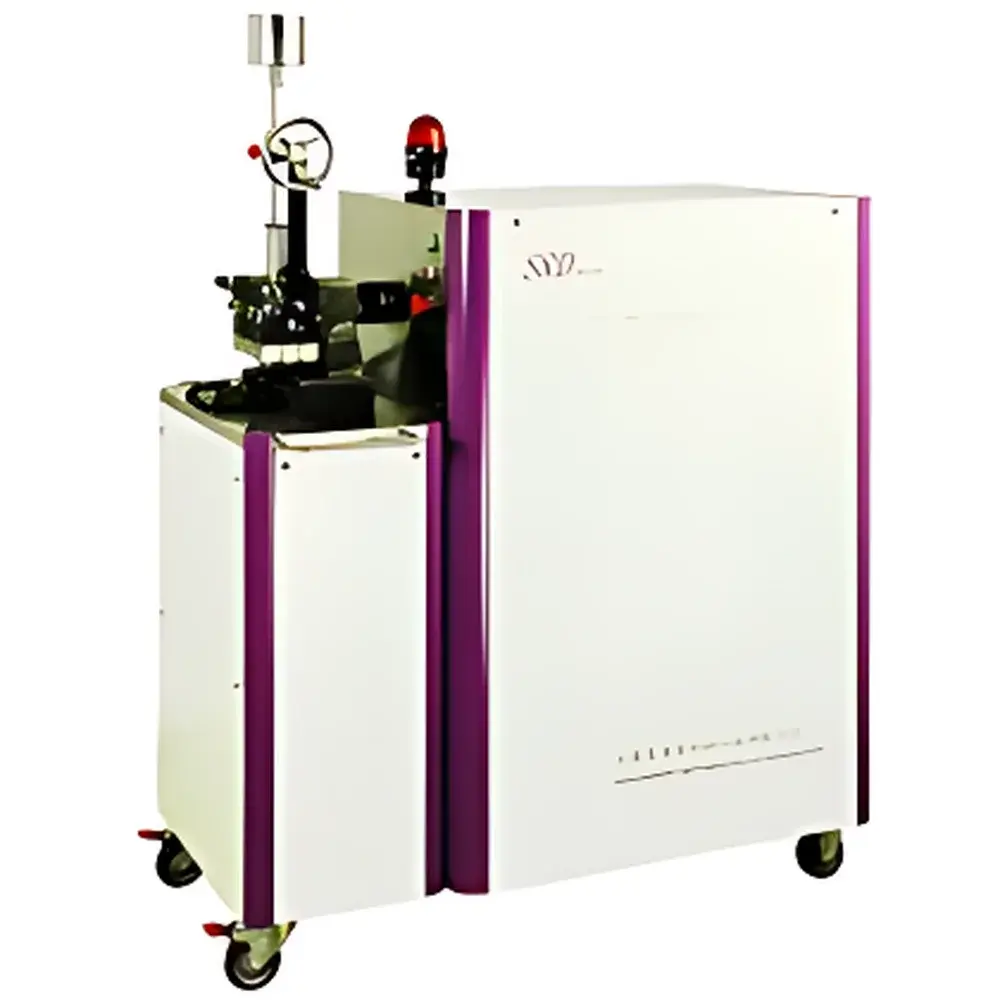
Shanghai SRD LB-100 Torque Rheometer
| Brand | SRD |
|---|---|
| Origin | Shanghai, China |
| Model | LB-100 |
| Application Scope | Polymer Processing Simulation (Compounding, Extrusion, Molding) |
| Core Function | Real-time Torque, Temperature & Pressure Monitoring During Dynamic Shear Processing |
| Measurement Principle | Couette-type Rotational Rheometry with Intensified Shear History Simulation |
| Compliance Context | Designed for ASTM D3835, ISO 11443, ISO 25577, and GLP-aligned R&D workflows |
Overview
The Shanghai SRD LB-100 Torque Rheometer is an engineered laboratory-scale processing simulator designed to replicate the thermomechanical history experienced by polymeric materials during industrial compounding, extrusion, and injection molding. Unlike conventional capillary or rotational rheometers that isolate single material functions, the LB-100 integrates a precision-controlled twin-screw or single-screw mixing chamber (configurable per application), enabling simultaneous measurement of torque, melt temperature, pressure, and time-resolved viscoelastic response under realistic shear rates (0.1–1000 s⁻¹), residence times (5–300 s), and thermal profiles (20–400 °C). Its architecture follows the fundamental principle of process-integrated rheology: by subjecting polymer melts to controlled mechanical work in a geometrically scaled-down version of production equipment—complete with instrumented screws, barrels, and die systems—it delivers dynamic flow curves (torque vs. time), plastication onset points, gelation kinetics, thermal degradation thresholds, and shear-induced structural evolution. This enables direct correlation between lab-scale data and full-scale process parameters such as screw speed, barrel zone temperatures, feed rate, and backpressure.
Key Features
- Modular configuration supporting both batch-type mixing (torque rheometry mode) and continuous extrusion (mini-extruder mode) via interchangeable screw assemblies and die kits
- High-resolution torque transducer (±0.02 N·m accuracy) synchronized with RTD-based melt temperature sensors (±0.5 °C) and strain-gauge pressure transducers (0–50 MPa range)
- Programmable multi-zone heating/cooling control (up to 6 independent zones) with PID tuning and ramp-hold profiles compliant with ISO 25577 Annex A
- Real-time data acquisition at 100 Hz sampling rate, capturing transient events including melt fracture onset, filler dispersion lag, and crosslinking exotherms
- Robust stainless-steel barrel and corrosion-resistant screw alloys suitable for PVC, filled PP/PE, engineering thermoplastics, thermosets, and elastomer compounds
- Integrated safety interlocks including over-torque cutoff, thermal runaway protection, and emergency stop with hardware-level circuit isolation
Sample Compatibility & Compliance
The LB-100 accommodates solid, powder, pellet, and pre-compounded feedstocks ranging from 10 g to 500 g per batch (mixing mode) or continuous throughput up to 5 kg/h (extrusion mode). It supports thermoplastics (e.g., PVC, PE, PP, PET, PC), thermosets (epoxy, phenolic, unsaturated polyester), elastomers (EPDM, SBR, TPU), and filled systems containing CaCO₃, talc, glass fiber, carbon black, or nanoclays. All operational protocols align with ASTM D3835 (Standard Test Method for Determining the Melt Flow Rate of Thermoplastics), ISO 11443 (Plastics — Determination of the Melt Mass-Flow Rate and Melt Volume-Flow Rate), and ISO 25577 (Plastics — Torque Rheometry — General Principles). Data logging meets GLP traceability requirements, with timestamped metadata, user authentication logs, and audit trail export capability compatible with FDA 21 CFR Part 11–ready LIMS integration.
Software & Data Management
The proprietary SRD RheoControl™ software provides real-time visualization of torque–time, temperature–time, and pressure–time curves, with overlay functionality for comparative analysis across formulations. It calculates derived parameters including apparent viscosity (ηapp), specific mechanical energy (SME), plastication time, gel point (via inflection detection), and thermal stability index (TSI = time-to-torque-drop-at-fixed-temp). Export formats include CSV, XML, and PDF reports with embedded calibration certificates. Raw binary data files retain full sensor resolution and are structured for post-processing in MATLAB, Python (via Pandas/NumPy), or third-party rheological modeling platforms (e.g., POLYFLOW, Moldflow). Software validation documentation (IQ/OQ protocols) is provided for regulated environments requiring GMP-compliant instrument qualification.
Applications
- Formulation development: Quantifying stabilizer efficiency in PVC dry-blends, antioxidant performance in polyolefins, and pigment dispersion quality in masterbatches
- Process optimization: Mapping screw design effects on SME distribution, identifying optimal barrel temperature gradients for minimal thermal degradation, and validating die swell predictions
- Quality assurance: Batch-to-batch consistency monitoring of recycled content blends, incoming raw material verification against rheological specifications, and shelf-life assessment of reactive systems
- Failure analysis: Diagnosing melt fracture origins, detecting premature crosslinking in rubber compounds, and correlating torque hysteresis with filler-matrix interfacial failure
- Cross-industry extension: Rheological screening of ceramic slurries (for tape casting), pharmaceutical hot-melt extrusion candidates, food-grade starch gels, and construction-grade polymer-modified mortars
FAQ
What distinguishes torque rheometry from capillary rheometry?
Torque rheometry captures integrated thermomechanical history—including heat generation from viscous dissipation, residence time distribution, and progressive structural change—whereas capillary rheometry isolates steady-state shear viscosity at defined wall shear stresses.
Can the LB-100 simulate twin-screw extrusion conditions?
Yes—when equipped with the optional co-rotating twin-screw module, it replicates conveying, melting, mixing, and devolatilization zones using geometrically scaled screw elements matching industrial L/D ratios and pitch configurations.
Is the system compliant with FDA 21 CFR Part 11 for electronic records?
While the base system meets ALCOA+ data integrity principles, full Part 11 compliance requires deployment within a validated IT infrastructure with electronic signatures, role-based access control, and audit trail review tools—available through SRD’s GxP Support Package.
What maintenance intervals are recommended for long-term calibration stability?
Torque sensor recalibration every 12 months; thermal sensor verification before each high-temperature campaign (≥300 °C); screw/barrel wear inspection after every 500 operating hours or when torque repeatability exceeds ±3% across identical batches.
Does SRD provide application support for method development?
Yes—SRD offers remote and on-site application engineering services, including ASTM/ISO method adaptation, DOE-based experimental design, and interpretation of complex rheological signatures (e.g., Payne effect in filled elastomers, thixotropic recovery in thermosets).






