
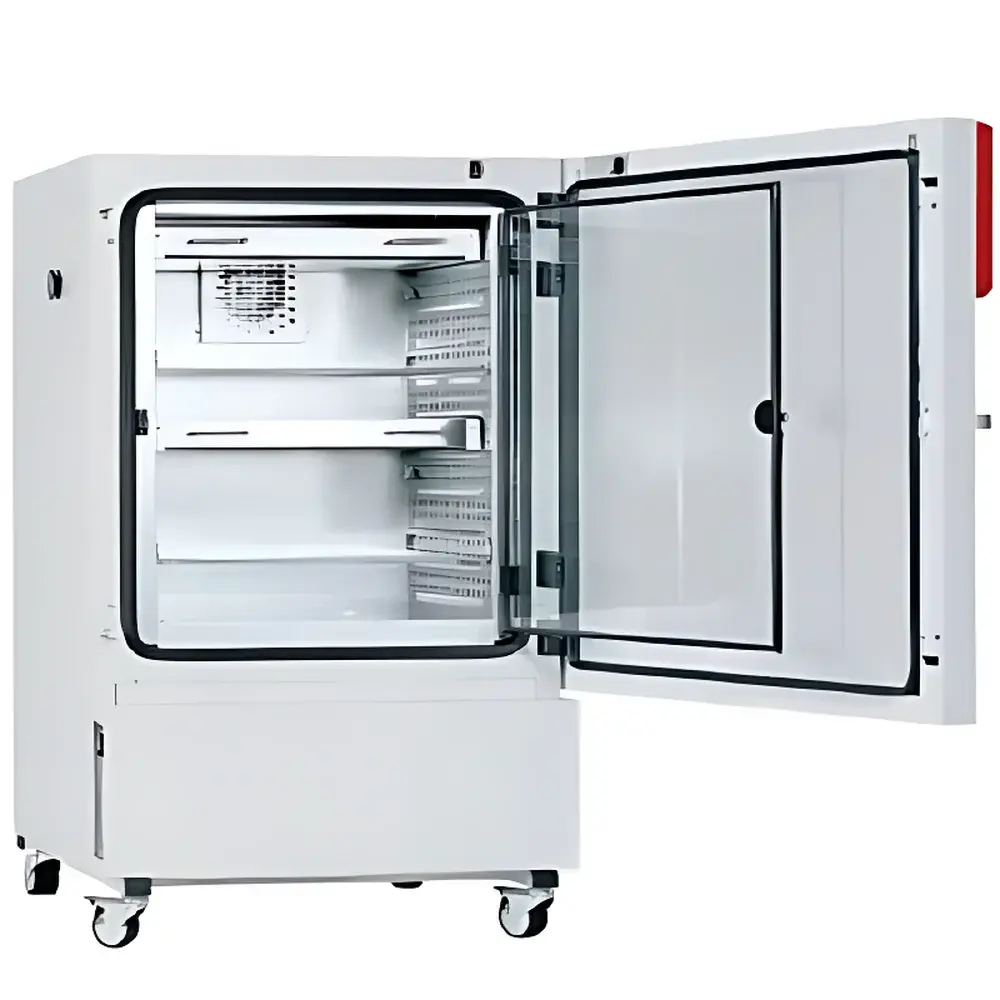
BINDER KBF P / KBF LQC Series Photostability Chambers
| Brand | BINDER |
|---|---|
| Origin | Germany |
| Model Series | KBF P / KBF LQC |
| Compliance | ICH Q1B Option 2 |
| Temperature Range | 0–70 °C (dark, dry) |
| Humidity Range | 10–80 % r.H. (dark) |
| Illumination System | Dual Q1B Synergy Light™ Lamp Cartridges (3 × cool-white + 2 × Q1B-balanced fluorescent tubes per cartridge) |
| Light Monitoring | KBF LQC — dual spherical 3D sensors for simultaneous visible & UV irradiance measurement |
| Control Software | APT-COM® v4.x with audit trail, data export, and test protocol archiving |
| Regulatory Alignment | Designed for GLP/GMP environments |
Overview
The BINDER KBF P and KBF LQC Series Photostability Chambers are precision-engineered environmental test systems designed exclusively for pharmaceutical photostability testing in full compliance with the International Council for Harmonisation (ICH) Q1B guideline, Option 2. These chambers replicate controlled artificial daylight conditions—including both visible and near-UV spectral components—to assess photochemical degradation pathways of active pharmaceutical ingredients (APIs) and final drug products. Unlike general-purpose climate chambers, the KBF P and KBF LQC integrate a purpose-built illumination architecture grounded in photobiological metrology principles: the patented Q1B Synergy Light™ system delivers a spectrally stable output matching the ICH-specified 320–400 nm UV–visible band, with rigorous spatial uniformity (< ±5% irradiance deviation across the working volume) validated per ISO/IEC 17025-accredited protocols. The chamber’s thermohygrometric control—featuring high-stability Pt100 sensor arrays, triple-wall insulation, and adaptive vapor compression cooling—ensures simultaneous regulation of temperature (±0.1 °C stability under dark/dry conditions) and relative humidity (±1.5 % r.H. accuracy), even during concurrent illumination and humidity cycling.
Key Features
- ICH Q1B Option 2–compliant illumination spectrum generated by dual lamp cartridges, each housing three cool-white fluorescent tubes and two proprietary BINDER Q1B-balanced fluorescent tubes optimized for spectral fidelity and long-term radiometric stability.
- KBF LQC variant includes an integrated intelligent photometric monitoring system with two omnidirectional 3D spherical sensors that independently quantify irradiance in both visible (320–400 nm) and UV-A (315–400 nm) bands—enabling real-time dose accumulation tracking against user-defined exposure targets (e.g., 1.2 million lux·hr visible + 200 kJ/m² UV-A).
- Automated exposure termination: upon reaching the configured radiant exposure threshold, the system de-energizes all lamps and logs timestamped completion metadata—eliminating operator-dependent timing errors and ensuring inter-laboratory reproducibility.
- APT-COM® software platform provides full lifecycle data management: test setup configuration, live parameter visualization, automated report generation (PDF/CSV), electronic signature support, and secure archival with configurable retention policies.
- Robust stainless-steel interior (AISI 304), seamless welds, and HEPA-filtered recirculation airflow minimize particulate contamination—critical for sterile product stability studies under GMP Annex 1-aligned practices.
Sample Compatibility & Compliance
The KBF P/LQC series accommodates standard pharmaceutical packaging formats—including blister cards, amber vials, HDPE bottles, and aluminum-laminated pouches—across three internal volume options (115 L, 240 L, and 720 L). All models meet DIN EN 60068-2-5 (artificial light testing) and are validated to support regulatory submissions per ICH Q5C (stability testing of biotechnological/biological products) and USP (Photostability Testing). The KBF LQC’s photometric subsystem is traceable to PTB (Physikalisch-Technische Bundesanstalt) reference standards, and its software architecture supports 21 CFR Part 11 compliance when deployed with APT-COM® Validation Package (including role-based access control, electronic audit trails, and immutable data logging). Chamber qualification documentation—including IQ/OQ/PQ templates, uncertainty budgets for irradiance and RH measurements, and temperature mapping reports—is provided as part of BINDER’s GxP Support Service.
Software & Data Management
APT-COM® v4.x serves as the central interface for method development, execution, and reporting. Users define multi-step test profiles specifying temperature setpoints, humidity ramps, lamp on/off sequences, and photometric endpoints—all synchronized with internal clock and external NTP time servers. During operation, the software displays real-time irradiance integrals (lux·hr, J/m²), chamber deviation alarms, and sensor health status. Post-run, raw datasets—including second-by-second irradiance, temperature, and humidity values—are exported in machine-readable CSV format compatible with statistical process control (SPC) platforms such as JMP or Minitab. Audit trails record all user actions (login/logout, parameter changes, report exports) with SHA-256 hashing and digital timestamps, satisfying ALCOA+ data integrity requirements for FDA, EMA, and PMDA inspections.
Applications
- ICH-mandated forced degradation studies for new molecular entities (NMEs) and generic drug applications.
- Comparative photostability assessment of alternative packaging configurations (e.g., glass vs. polymer vials under identical irradiance dosing).
- Accelerated stability testing of ophthalmic solutions, topical creams, and lyophilized biologics where light-induced oxidation or hydrolysis dominates degradation kinetics.
- Reference standard qualification per USP and Ph. Eur. 5.20.3, including photostability bracketing for retest date assignment.
- Environmental stress screening of excipients (e.g., titanium dioxide, iron oxides) for catalytic photoactivity in solid dosage forms.
FAQ
What distinguishes the KBF P from the KBF LQC model?
The KBF P is optimized for manual photostability execution with fixed illumination geometry and pre-validated Q1B spectra, while the KBF LQC adds closed-loop photometric feedback, automated exposure control, and real-time irradiance quantification—enabling precise dose-based endpoint determination.
Can the chamber be used for non-ICH photostability protocols?
Yes—user-defined spectral profiles, irradiance limits, and temporal sequences can be programmed via APT-COM®, supporting ASTM G154, ISO 4892-3, and custom internal SOPs.
Is humidity control maintained during active illumination?
Yes—advanced dew point modulation and condensate management ensure stable 10–75% r.H. operation under lit conditions without compromising lamp lifespan or spectral output.
How is calibration traceability documented?
Each unit ships with a factory calibration certificate referencing PTB-traceable irradiance meters and accredited hygrometers; annual recalibration services include uncertainty statements compliant with ISO/IEC 17025.
Does BINDER provide validation support for GMP environments?
Yes—BINDER offers IQ/OQ/PQ documentation packages, URS templates, risk assessments (per ISO 14971), and on-site qualification assistance through certified field service engineers.




