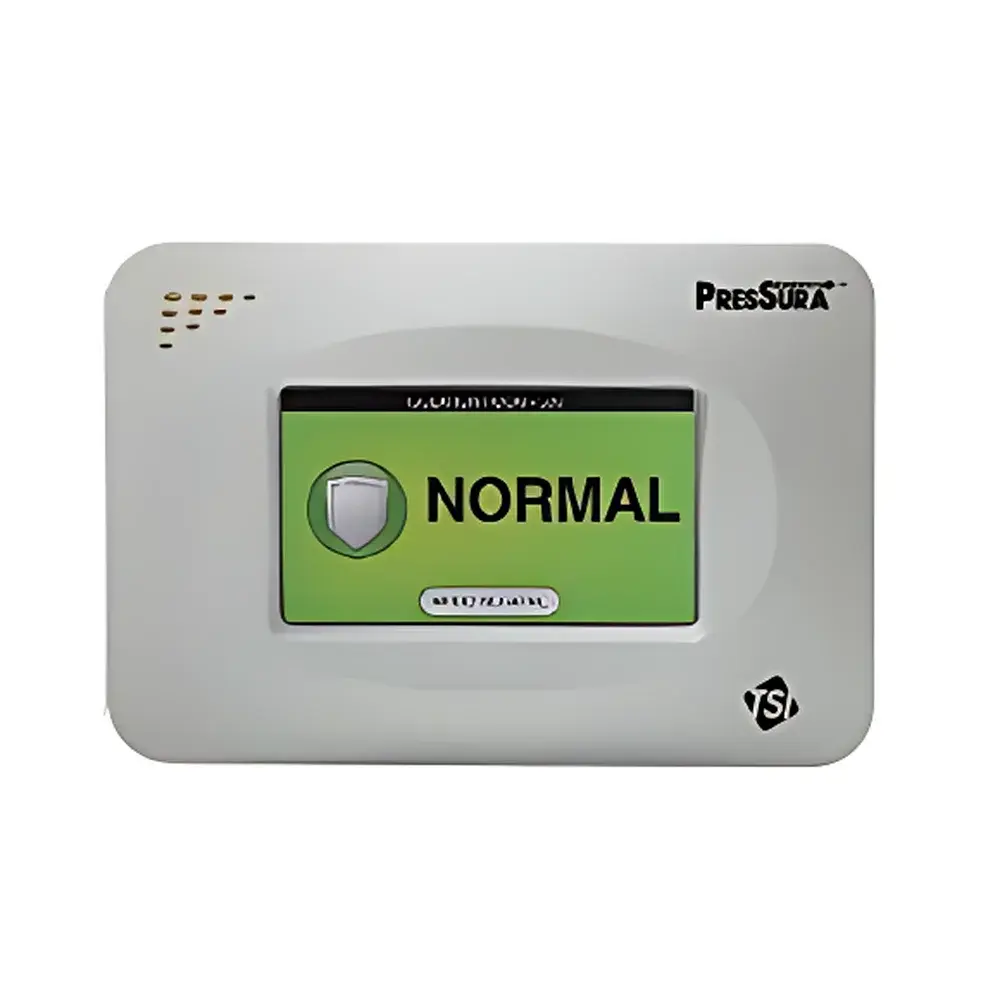
TSI PresSura RPM20 Room Pressure Monitor
| Brand | TSI |
|---|---|
| Origin | USA |
| Model | RPM20 |
| Sensor Technology | Thermal Anemometer–Based Differential Pressure Sensing |
| Compliance | ANSI/ASHRAE/ASHE Standard 170-2008, FGI Guidelines 2010, CDC Environmental Infection Control Recommendations |
| Alarm Logic | Adjustable Delay, Dual-Stage Visual & Audible Alert |
| Display | Color Touchscreen with Status-Color-Coded Interface |
| Connectivity | BACnet MS/TP, Modbus RTU, Ethernet (Optional) |
| Input Channels | 2 Differential Pressure Ports + Optional Temp/RH Inputs |
| Configuration | Local Keypad + Password-Protected Setup |
| Operating Modes | Isolation (Negative/Positive), Neutral, Non-Isolation |
| Max Monitoring Zones | 2 Isolation Rooms + 1 Anteroom |
Overview
The TSI PresSura RPM20 Room Pressure Monitor is an engineered solution for continuous, high-reliability differential pressure monitoring in critical healthcare environments. Designed specifically for compliance-driven applications, the RPM20 employs TSI’s proprietary thermal anemometer–based sensing architecture to deliver stable, drift-resistant measurements of static pressure differentials across doors, walls, and air barriers. Unlike traditional piezoresistive or capacitive transducers, this thermal-based method provides inherent immunity to long-term zero drift and condensation-induced signal degradation—key concerns in humid, high-turnover clinical spaces. The device continuously verifies directional airflow integrity by measuring pressure gradients between adjacent zones (e.g., anteroom-to-isolation room, corridor-to-OR), ensuring adherence to mandated minimum differentials (e.g., ≥0.01 in. w.c. for AII rooms per ASHRAE 170). Its real-time validation supports infection control protocols required in Airborne Infection Isolation (AII), Protective Environment (PE), and Operating Room (OR) settings, directly contributing to Joint Commission EC.02.05.01 and CMS Condition of Participation compliance.
Key Features
- Thermal anemometer–derived differential pressure sensing with <0.001 in. w.c. resolution and ±0.002 in. w.c. accuracy over 0–±0.2 in. w.c. range
- Configurable dual-stage alarm system: visual status indicators (red/amber/green LED ring + on-screen color coding) plus programmable audible alert with user-defined delay (0–300 seconds) to suppress transient false positives
- Integrated local interface featuring a 4.3-inch color touchscreen with intuitive icon-based navigation and password-protected configuration (admin/user access levels)
- Multi-zone capability supporting simultaneous monitoring of two isolation rooms and one anteroom via dedicated DP inputs
- Optional analog or digital temperature and relative humidity inputs for environmental correlation and dew point calculation
- BACnet MS/TP and Modbus RTU native support for seamless integration into existing BAS/BMS platforms; optional Ethernet module available for IP-based supervision
- Mode-switching functionality via front-panel keys: enables rapid transition between Negative Isolation, Positive Isolation, Neutral, and Non-Isolation states without reconfiguration
Sample Compatibility & Compliance
The RPM20 is validated for use in all pressure-critical healthcare zones defined under ANSI/ASHRAE/ASHE Standard 170-2008, including Airborne Infection Isolation Rooms (AII), Protective Environment (PE) rooms, Operating Rooms (ORs), Pharmacy Cleanrooms, Burn Units, and Animal Research Facilities. It meets the functional requirements outlined in the Facility Guidelines Institute (FGI) 2010 Guidelines for Design and Construction of Health Care Facilities and aligns with CDC’s 2003 Guidelines for Environmental Infection Control in Healthcare Facilities. The unit’s measurement traceability follows NIST-traceable calibration protocols, and its firmware architecture supports audit-ready event logging—including alarm activation timestamps, mode changes, and sensor health diagnostics—for GLP/GMP-aligned documentation workflows.
Software & Data Management
Configuration and monitoring are performed locally via the embedded touchscreen interface; no external PC software is required for basic operation. All system parameters—including alarm thresholds, delay intervals, display brightness, and communication settings—are stored in non-volatile memory with write-protection enabled by default. Event logs retain up to 10,000 timestamped entries (alarm triggers, mode switches, sensor faults) with configurable retention policies. When integrated into a BACnet network, the RPM20 publishes real-time pressure values, alarm status, and diagnostic flags as standard BACnet objects (AV, BI, BO), enabling centralized dashboards and automated reporting. Firmware updates are performed via USB or network download and include cryptographic signature verification to ensure integrity.
Applications
- Airborne Infection Isolation Rooms (AII): Continuous verification of ≥0.01 in. w.c. negative pressure relative to anteroom and corridor
- Protective Environment (PE) Rooms: Monitoring of ≥0.01 in. w.c. positive pressure relative to surrounding areas to prevent ingress of airborne pathogens
- Operating Rooms (ORs): Validation of unidirectional airflow stability during surgical procedures
- Pharmacy Compounding Areas (ISO Class 5/7): Pressure cascade assurance across buffer rooms and ante-areas
- Burn Unit Isolation Chambers: Real-time feedback for dynamic pressure adjustment during patient transport or equipment entry
- Research Animal Housing: Compliance with AAALAC International standards for barrier facility pressure zoning
FAQ
Does the RPM20 require annual recalibration?
Yes—TSI recommends annual NIST-traceable calibration using certified reference standards. Field verification with a handheld manometer is advised quarterly.
Can the RPM20 operate without a building automation system?
Yes—the device functions autonomously with full local alarm, display, and mode control. BAS integration is optional and enhances data aggregation and remote oversight.
What is the maximum cable length for pressure tubing connections?
For optimal response time and accuracy, TSI specifies ≤30 ft (9 m) of ¼-inch OD polyurethane tubing per channel, with minimal bends and no liquid traps.
Is the RPM20 suitable for outdoor or non-clinical industrial applications?
No—it is designed exclusively for indoor, temperature-controlled healthcare environments (operating range: 10–40°C, 10–90% RH non-condensing) and does not meet IP or hazardous location ratings.
How does the RPM20 handle sensor drift compensation?
The thermal sensor undergoes automatic zero-stabilization during periods of static pressure (detected via variance threshold), and firmware includes adaptive baseline correction algorithms trained on multi-year field performance data.