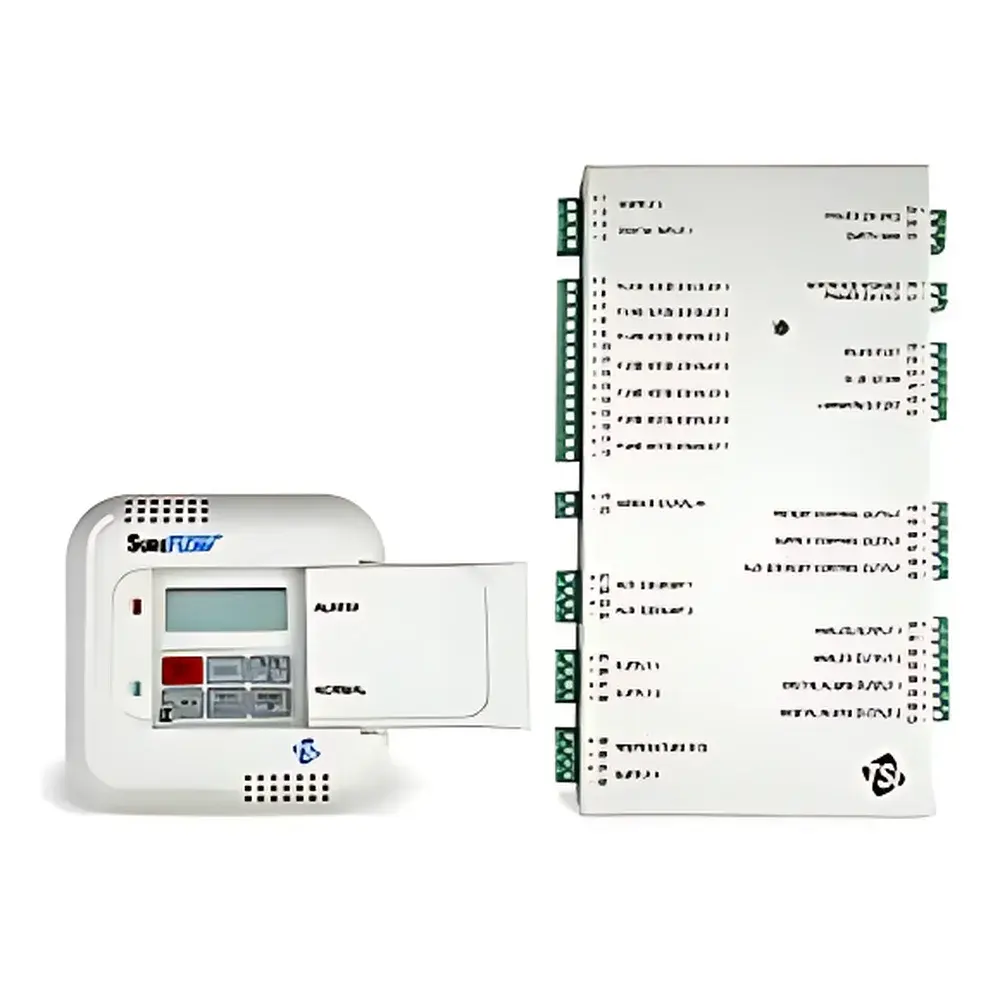
TSI SureFlow™ 8682 Adaptive Compensation Controller
| Brand | TSI |
|---|---|
| Origin | USA |
| Model | 8682 |
| Communication Protocol | Modbus RTU (Open Standard) |
| Power Input | 120 VAC to 24 VAC, 25 VA |
| Control Outputs | Relay Alarm + Analog/Digital Interface |
| Sensor Compatibility | External Room Pressure Transducer (Optional) |
| Compliance | NFPA 45-2000, ANSI Z9.5-2003 |
| Integration | BMS via Modbus or LonWorks (Optional) |
Overview
The TSI SureFlow™ 8682 Adaptive Compensation Controller is an engineered solution for precision laboratory pressure and thermal environment management in variable-air-volume (VAV) fume hood and general lab ventilation systems. Operating on the principle of differential pressure control with adaptive feedback compensation, the 8682 continuously monitors and dynamically adjusts exhaust airflow relative to supply air to maintain a stable negative pressure gradient—typically −0.01 to −0.05 in. w.g. (−2.5 to −12.5 Pa)—between the laboratory space and adjacent corridors or non-hazardous zones. This controlled negative pressure envelope prevents uncontrolled migration of hazardous vapors, particulates, or bioaerosols beyond the lab boundary. Unlike fixed-setpoint controllers, the 8682 implements real-time adaptive compensation by integrating inputs from optional room pressure transducers, thereby correcting for long-term building envelope drift, seasonal HVAC load shifts, or static pressure changes induced by damper wear or filter loading. Its architecture supports dual-loop control: one dedicated to pressure balance, and a secondary loop managing space temperature via coordinated modulation of heating elements and supply air volume.
Key Features
- Adaptive compensation algorithm that auto-adjusts setpoints based on continuous room pressure sensor feedback, ensuring long-term stability without manual recalibration.
- Integrated temperature control logic synchronized with ventilation demand—reducing thermal overshoot and minimizing energy waste during low-occupancy periods.
- Dual communication capability: native Modbus RTU (RS-485) for interoperability with enterprise-level Building Management Systems (BMS); optional LonWorks module available for legacy or proprietary network integration.
- Local HMI with backlit LCD display and membrane keypad enables full configuration, alarm acknowledgment, and real-time status monitoring without external software.
- Programmable relay outputs for audible/visual alarms, fan shutdown interlocks, or emergency purge activation—configured per NFPA 45 and ANSI Z9.5 fault-response requirements.
- User-access level protection via configurable password authentication, restricting modification of critical control parameters to authorized personnel only.
Sample Compatibility & Compliance
The SureFlow 8682 is designed for use in chemical, pharmaceutical, academic, and biosafety laboratories where containment integrity and environmental accountability are governed by strict regulatory frameworks. It supports connection to industry-standard differential pressure transducers (e.g., 0–100 Pa or ±50 Pa range, 0.5% FS accuracy) and integrates seamlessly with common VAV box actuators and chilled-beam terminal units. The controller complies with NFPA 45-2000 (Standard on Fire Protection for Laboratories Using Chemicals) and ANSI Z9.5-2003 (Laboratory Ventilation), both of which mandate sustained negative pressure, minimum air change rates, and fail-safe response protocols. While not a medical device, its audit-ready operational logs and deterministic control behavior support GLP-compliant facility documentation and FDA 21 CFR Part 11–aligned validation when deployed in regulated GMP environments.
Software & Data Management
The 8682 operates as a standalone embedded controller with no dependency on cloud services or proprietary host software. All configuration, calibration, and alarm history are stored locally in non-volatile memory. Event logs—including pressure excursions, temperature deviations, relay activations, and user login attempts—are timestamped and retain up to 1,000 entries. Modbus register mapping provides direct read/write access to all operational variables (e.g., measured room pressure, setpoint deviation, output percent, alarm status), enabling integration into SCADA platforms for centralized dashboards and automated reporting. No firmware updates require factory service; field-upgradable via RS-232 serial interface using TSI-provided configuration utility (Windows-compatible, offline operation supported).
Applications
- Continuous negative pressure maintenance in chemistry teaching labs and research facilities handling volatile organic compounds (VOCs).
- Dynamic balancing of multi-zone lab buildings where cross-talk between adjacent spaces must be mitigated under varying occupancy and equipment exhaust loads.
- Integration with demand-controlled ventilation (DCV) strategies to reduce annual HVAC energy consumption while preserving safety margins.
- Backup pressure control layer in redundant safety systems—deployed alongside primary BMS controllers to meet Tier-2 reliability requirements per ASHRAE Guideline 1.
- Commissioning and retro-commissioning support: used to validate pressure decay rates, verify sash interlock response times, and document baseline performance prior to regulatory audits.
FAQ
Does the SureFlow 8682 require a dedicated room pressure sensor to function?
No—it operates in default mode using internal airflow-derived differential pressure estimation. However, for long-term accuracy and adaptive compensation, connection to an external calibrated room pressure transducer is strongly recommended.
Can the 8682 replace an existing BMS controller without rewiring?
Yes—its Modbus RTU interface allows drop-in integration with most modern BMS via existing RS-485 infrastructure. Analog I/O terminals also support 0–10 VDC or 4–20 mA signal bridging where protocol translation is needed.
Is the device suitable for cleanroom applications?
It is not designed for positive-pressure cleanrooms. Its control logic and compliance framework are optimized for negative-pressure containment environments, such as chemical labs and biosafety level 2 (BSL-2) facilities.
What is the expected service life and maintenance interval?
Rated for continuous operation at 25°C ambient; mean time between failures (MTBF) exceeds 100,000 hours. No scheduled maintenance is required—only periodic verification of sensor calibration and relay functionality per institutional preventive maintenance protocols.