
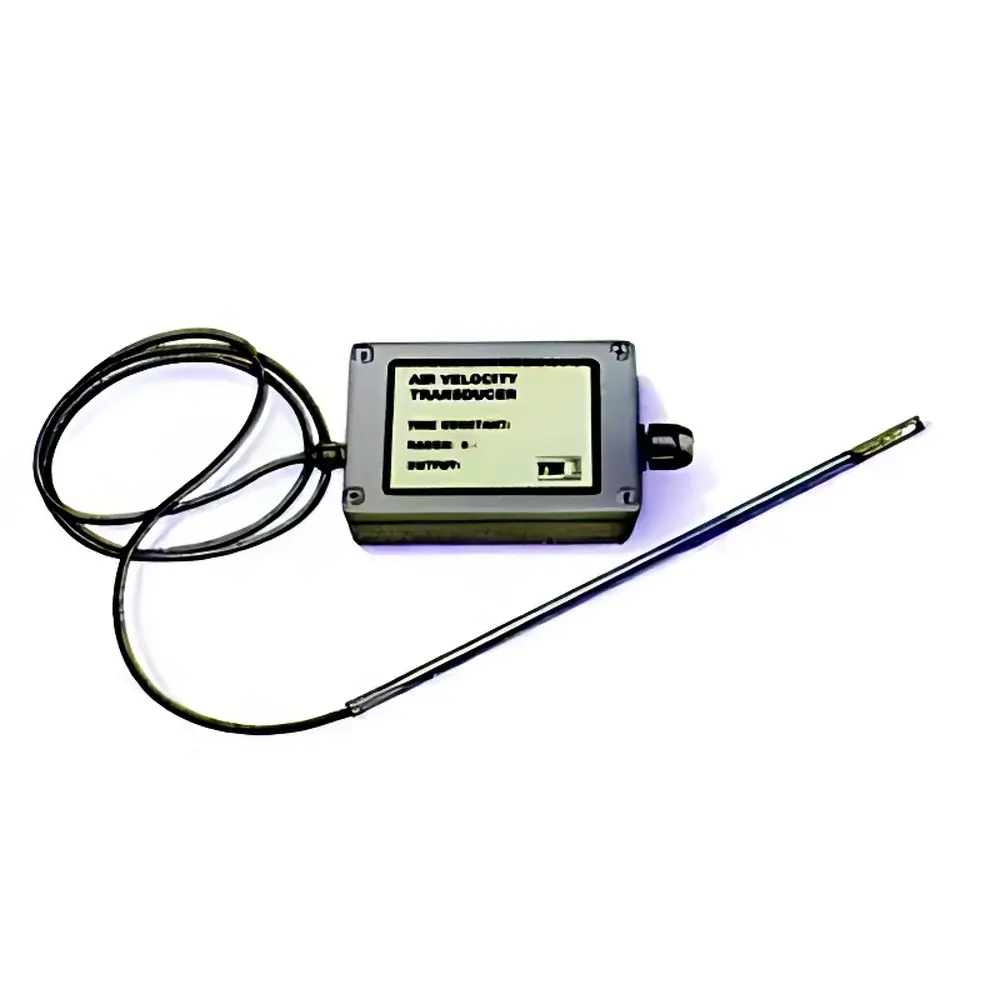
TSI 8455/8465/8475 Hot-Wire Anemometer Sensors
| Origin | USA |
|---|---|
| Manufacturer Type | Authorized Distributor |
| Origin Category | Imported |
| Model Numbers | 8455, 8465, 8475 |
| Pricing | Available Upon Request |
Overview
The TSI 8455, 8465, and 8475 hot-wire anemometer sensors are precision-engineered instruments for quantitative air velocity measurement in research, industrial hygiene, HVAC commissioning, cleanroom validation, and environmental monitoring applications. These sensors operate on the principle of constant-temperature anemometry (CTA), where a fine platinum or tungsten wire is electrically heated to a fixed temperature above ambient; convective heat loss from the wire—directly proportional to local airflow velocity—is measured via bridge circuitry to yield highly responsive and repeatable velocity data. Unlike cup or vane anemometers, hot-wire technology enables sub-second temporal resolution and sensitivity down to 0.05 m/s, making it suitable for laminar flow characterization, turbulence profiling, and low-velocity air distribution studies in controlled environments.
Key Features
- 8455 General-Purpose Probe: Features a robust ceramic-sheathed sensing element housed in a protective stainless-steel probe body; optimized for durability in routine industrial and laboratory settings with minimal drift over extended operation.
- 8465 Windowless Probe: Eliminates aerodynamic obstruction by omitting protective mesh or screens, reducing flow disturbance and enabling high-fidelity measurements in confined or sensitive zones—including ISO Class 5–8 cleanrooms and biological safety cabinets.
- 8475 Omnidirectional Probe: Incorporates three orthogonal hot-wire elements arranged in a spherical geometry to resolve vector magnitude independent of incident flow direction; ideal for turbulent, multidirectional, or poorly defined airstreams such as those found in ductwork transitions, fume hood face velocities, and ventilation system commissioning.
- All models integrate low-noise analog signal conditioning and are compatible with TSI’s legacy and current-generation readout systems—including the VelociCalc® Plus (9565-P), AirFlow™ Touch (9585), and AM520/AM510 real-time monitoring platforms.
- Each sensor exhibits thermal stability across ambient temperatures from 0 °C to 50 °C and relative humidity up to 95% non-condensing, supporting continuous deployment in variable environmental conditions.
Sample Compatibility & Compliance
These sensors are designed for use with clean, dry, non-corrosive air streams. They are not rated for exposure to particulates >10 µm, oil mist, condensate, or aggressive chemical vapors without upstream filtration or conditioning. For regulatory compliance, the 8455/8465/8475 series supports traceable calibration per ISO/IEC 17025-accredited procedures and meets the performance criteria outlined in ASTM D1078 (Standard Test Method for Air Velocity Measurement) and ISO 14644-3 (Cleanroom testing protocols). When integrated into validated systems, they support GLP and GMP documentation requirements including audit trails, user access controls, and electronic signature capability when paired with compliant data acquisition software.
Software & Data Management
Sensor output is delivered as a calibrated analog voltage (0–5 V or 0–10 V) or digital RS-232/RS-485 signal, enabling seamless integration into SCADA, BMS, and custom LabVIEW or Python-based acquisition frameworks. TSI’s TrakPro™ Lite and DataMaster™ software packages provide real-time visualization, time-series logging, statistical analysis (mean, RMS, standard deviation), and export to CSV, Excel, or PDF formats. All recorded datasets include embedded metadata (sensor ID, calibration date, operator ID, timestamp), satisfying FDA 21 CFR Part 11 requirements for electronic records and signatures when deployed with appropriate system validation.
Applications
- HVAC system balancing and air change rate verification per ASHRAE Standard 111
- Cleanroom airflow uniformity and velocity mapping per ISO 14644-3 Annex B
- Local exhaust ventilation (LEV) hood face velocity surveys for OSHA 1910.145 and HSE COSHH compliance
- Turbulence intensity and Reynolds stress profiling in wind tunnel and boundary layer studies
- Low-velocity airflow detection in underfloor air distribution (UFAD) systems and displacement ventilation design validation
- Environmental chamber air circulation homogeneity assessment for pharmaceutical stability testing (ICH Q1A)
FAQ
What is the recommended recalibration interval for these sensors?
TSI recommends annual recalibration against NIST-traceable standards; however, frequency may be adjusted based on usage intensity, environmental exposure, and internal quality protocols.
Can the 8475 probe measure true 3D vector velocity?
No—the 8475 provides scalar magnitude only. It resolves resultant velocity regardless of direction but does not output individual u/v/w components; for full 3D vector measurement, TSI’s IFA-300 or 3D-2000 systems are required.
Are these sensors intrinsically safe for hazardous locations?
No—none of the 8455/8465/8475 models are certified for Class I, Division 1 or ATEX Zone 0/1 environments; explosion-proof enclosures or purge systems must be implemented externally if used in such areas.
Do the probes require zero-point adjustment before each use?
No—factory-calibrated offset and gain coefficients are stored internally; zeroing is only necessary if significant ambient temperature shifts (>10 °C) occur between measurement sessions.
Is firmware upgrade support available for legacy readout instruments?
Yes—TSI provides backward-compatible firmware updates for VelociCalc® and AirFlow™ platforms through registered customer portals, ensuring continued compatibility with newer sensor generations.







