
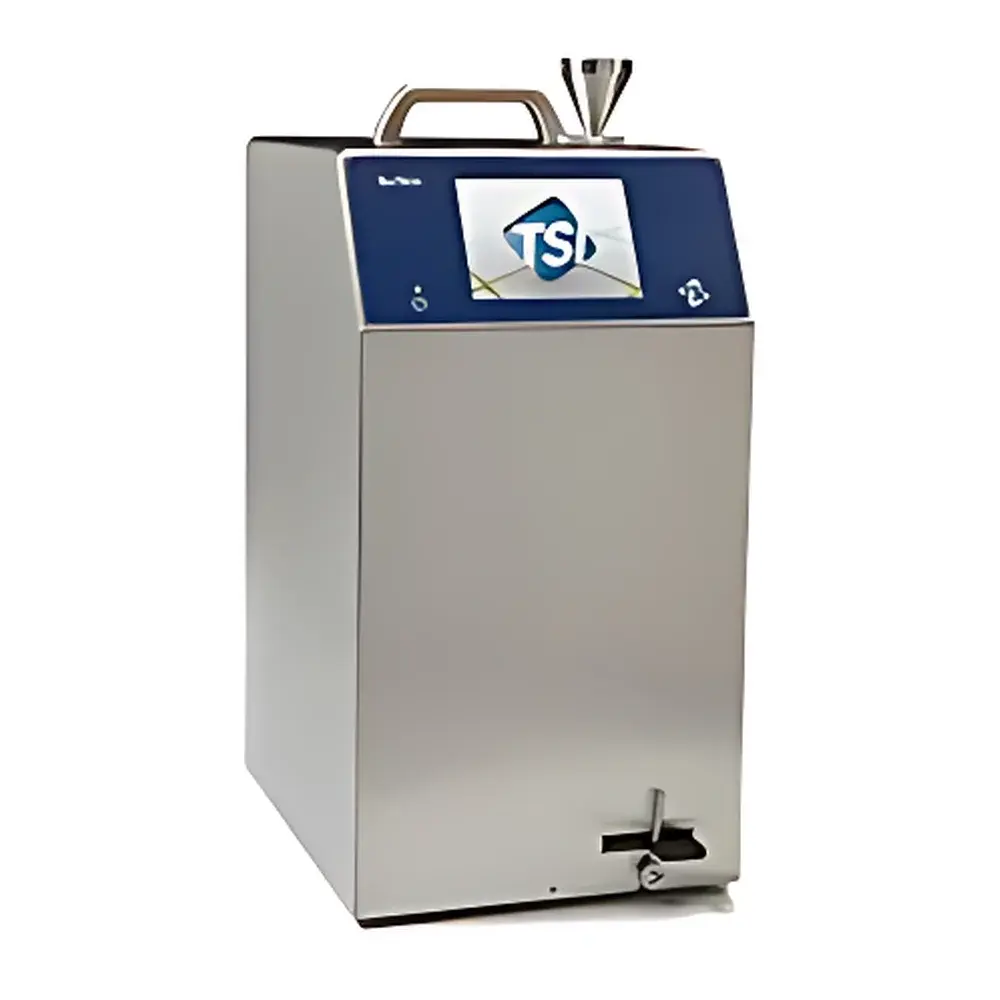
TSI BioTrak Real-Time Viable Airborne Microbial Particle Counter Model 9510-BD
| Brand | TSI |
|---|---|
| Origin | USA |
| Model | 9510-BD |
| Flow Rate | 28.3 L/min (1.0 CFM) |
| Flow Accuracy | ±5% |
| Particle Size Range | 0.5–25 µm |
| Detection Channels | 6 simultaneous size bins (0.5, 0.7, 1.0, 3.0, 5.0, 10.0 µm) |
| Viability Detection | Dual-channel laser-induced fluorescence (LIF) at 405 nm excitation with 2 fluorescence emission bands + 1 optical particle counting channel |
| Calibration Compliance | ISO 21501-4, JIS B9921, NIST-traceable |
| Housing Material | Stainless steel |
| Operating Temperature | 5–35°C (41–95°F), 20–95% RH non-condensing |
| Storage Temperature | 0–50°C (32–122°F), ≤98% RH non-condensing |
| Data Storage | 10,000 samples across up to 999 locations |
| Interface | VGA 5.7″ capacitive touchscreen, Ethernet & USB 2.0, Modbus TCP |
| Software | TrakPro Lite Secure (included), optional FMS integration |
| Standards Reporting | ISO 14644-1, EU GMP Annex 1, FS209E |
| Power | 110–240 VAC universal |
Overview
The TSI BioTrak Real-Time Viable Airborne Microbial Particle Counter Model 9510-BD is an engineered solution for continuous, quantitative monitoring of both total airborne particulate and biologically active (viable) microorganisms in critical environments. Unlike conventional optical particle counters (OPCs) or passive settle plates, the BioTrak 9510-BD employs dual-wavelength laser-induced fluorescence (LIF) — a field-proven, patented technology — to distinguish viable microbial particles from inert dust based on intrinsic autofluorescence signatures (e.g., NAD(P)H and riboflavin). This enables real-time discrimination without culturing, lysing agents, or reagents. The instrument integrates three core functions into a single air sampling stream: (1) real-time total particle counting across six calibrated size channels; (2) real-time viable particle enumeration using 405 nm excitation and dual-band fluorescence detection; and (3) simultaneous physical collection of viable particles onto a 37 mm filter membrane for downstream culture-based identification and quantification. Its 28.3 L/min (1.0 CFM) volumetric flow rate meets ISO 21501-4 requirements for high-sensitivity monitoring in Grade A/B cleanrooms and aseptic processing zones.
Key Features
- Simultaneous measurement of total particle concentration and viable microbial particle concentration from a single, co-located sample path — eliminating inter-instrument variability and enabling true correlation analysis.
- Dual-channel LIF detection architecture (two independent fluorescence emission bands) combined with a dedicated optical sizing channel provides enhanced specificity for biological activity compared to single-band or intensity-thresholded systems.
- Full compliance with ISO 21501-4 for optical particle counter performance, including counting efficiency (≥50% at 0.5 µm, ≥100% ≥0.75 µm), size resolution, and false count rate (<1 count/5 min).
- Stainless steel housing rated for routine exposure to IPA, hydrogen peroxide vapor (HPV), and chlorine-based disinfectants — suitable for use in ISO Class 5–8 environments under EU GMP Annex 1 and FDA cGMP conditions.
- Integrated HEPA-filtered exhaust and electronically regulated mass flow control ensure stable, pulsation-free aspiration across variable backpressure conditions — critical for maintaining calibration integrity during extended unattended operation.
- VGA touchscreen interface with multilingual support (English, Chinese, Japanese, German, French, Spanish, Italian), configurable alarm thresholds per channel, and intuitive menu-driven data review and export.
Sample Compatibility & Compliance
The BioTrak 9510-BD is validated for use in pharmaceutical manufacturing, biotechnology cleanrooms, hospital isolation rooms, and vaccine production facilities where real-time microbial risk assessment is required under ICH Q9 principles. It supports Good Manufacturing Practice (GMP) and Good Laboratory Practice (GLP) workflows through audit-trail-capable data logging (TrakPro Lite Secure), user-level access controls (dual-password security), and electronic record integrity compliant with FDA 21 CFR Part 11 when paired with optional FMS software. All measurements adhere to ISO 21501-4 for particle counter calibration traceability to NIST standards. The integrated 37 mm filter holder accommodates standard polycarbonate or mixed-cellulose ester membranes for subsequent colony-forming unit (CFU) enumeration per ISO 14698-1. Device certification includes CE marking and conformance to JIS B9921 for Japanese regulatory submissions.
Software & Data Management
Data acquisition, visualization, and reporting are managed via TrakPro Lite Secure — a validated, standalone application included with each instrument. It supports time-stamped storage of up to 10,000 sampling records, including full six-channel particle counts, viable particle counts, flow rate, environmental metadata, and location identifiers. Reports are auto-generated in accordance with ISO 14644-1 classification limits, EU GMP Annex 1 environmental monitoring expectations, and legacy FS209E standards. For enterprise-scale deployment, optional FMS (Facility Monitoring System) software enables centralized configuration, real-time dashboarding, alarm escalation via email/SNMP, and integration into SCADA or MES platforms via Modbus TCP over Ethernet. USB 2.0 and Ethernet interfaces allow secure data transfer without network dependency; all stored records include digital signatures and immutable timestamps to satisfy ALCOA+ data integrity criteria.
Applications
- Real-time contamination event detection and root cause investigation during aseptic filling operations.
- Trend analysis of viable particle loadings to support Process Analytical Technology (PAT) initiatives and continuous process verification.
- Validation and routine monitoring of isolators, RABS, and laminar airflow workstations per EU GMP Annex 1 §4.37–4.42.
- Assessment of personnel gowning efficacy and behavioral impact on microbiological air quality.
- Environmental monitoring program optimization by correlating viable particle spikes with HVAC interventions, material transfers, or equipment maintenance cycles.
- Support for regulatory inspections through preformatted, auditable reports demonstrating compliance with ISO 14644-1, ISO 14698, and pharmacopoeial microbial limits (e.g., USP , Ph. Eur. 5.1.6).
FAQ
How does the BioTrak 9510-BD differentiate viable from non-viable particles?
It uses dual-band laser-induced fluorescence (LIF) excited by a 405 nm diode laser. Biological particles containing fluorophores such as NAD(P)H and flavins emit characteristic fluorescence in two distinct spectral windows; inert particles exhibit negligible or non-correlated signal across both bands. This multi-parameter signature improves specificity over single-intensity threshold methods.
Is the instrument suitable for use in hydrogen peroxide vapor (HPV) decontamination cycles?
Yes. The stainless steel enclosure and internal wetted materials are compatible with standard HPV concentrations used in isolator bio-decontamination. However, the instrument must be removed or placed in bypass mode during active vapor generation per manufacturer guidelines.
Can the collected filter be used directly for MALDI-TOF or PCR analysis?
The 37 mm membrane supports standard microbiological protocols, including direct DNA extraction. While not validated for molecular assays out-of-the-box, many users successfully adapt the filter for qPCR or sequencing workflows following internal method qualification.
What is the recommended calibration frequency?
TSI recommends annual recalibration using NIST-traceable reference aerosols and certified flow meters, aligned with ISO/IEC 17025 laboratory practices and internal quality system requirements.
Does the device meet FDA 21 CFR Part 11 requirements for electronic records?
When operated with TrakPro Lite Secure or FMS software, it supports audit trails, electronic signatures, role-based access, and data immutability — fulfilling core technical controls. Full Part 11 compliance requires site-specific validation per organizational SOPs.







