
INFORS Labfors Lux Cell Photobioreactor
| Brand | INFORS |
|---|---|
| Origin | Switzerland |
| Model | Labfors Lux Cell |
| Vessel Volume | 3.6 L (cylindrical) / 1.9 L (flat-panel) |
| Aeration System | Single-gas (air) or multi-gas mixing station (Air + O₂ + N₂ + CO₂ + headspace air) |
| pH Control Range | 0.00–14.00, Accuracy: ±0.01 |
| Dissolved Oxygen (DO) Control Range | 0–100%, Accuracy: ±1% |
| Temperature Control Range | Cooling-medium temperature +5 °C to 70 °C, Accuracy: ±0.1 °C |
| Illumination | Adjustable white-light LED array (16 high-efficiency LEDs, up to ~700 µmol/m²·s) |
| Agitation | Bacterial mode: 80–1200 rpm |
| Mammalian/cell mode | 30–300 rpm |
| Standard Parameters | Temperature, pH, DO, agitation, gas flow, antifoam/level, feeding, gas composition |
Overview
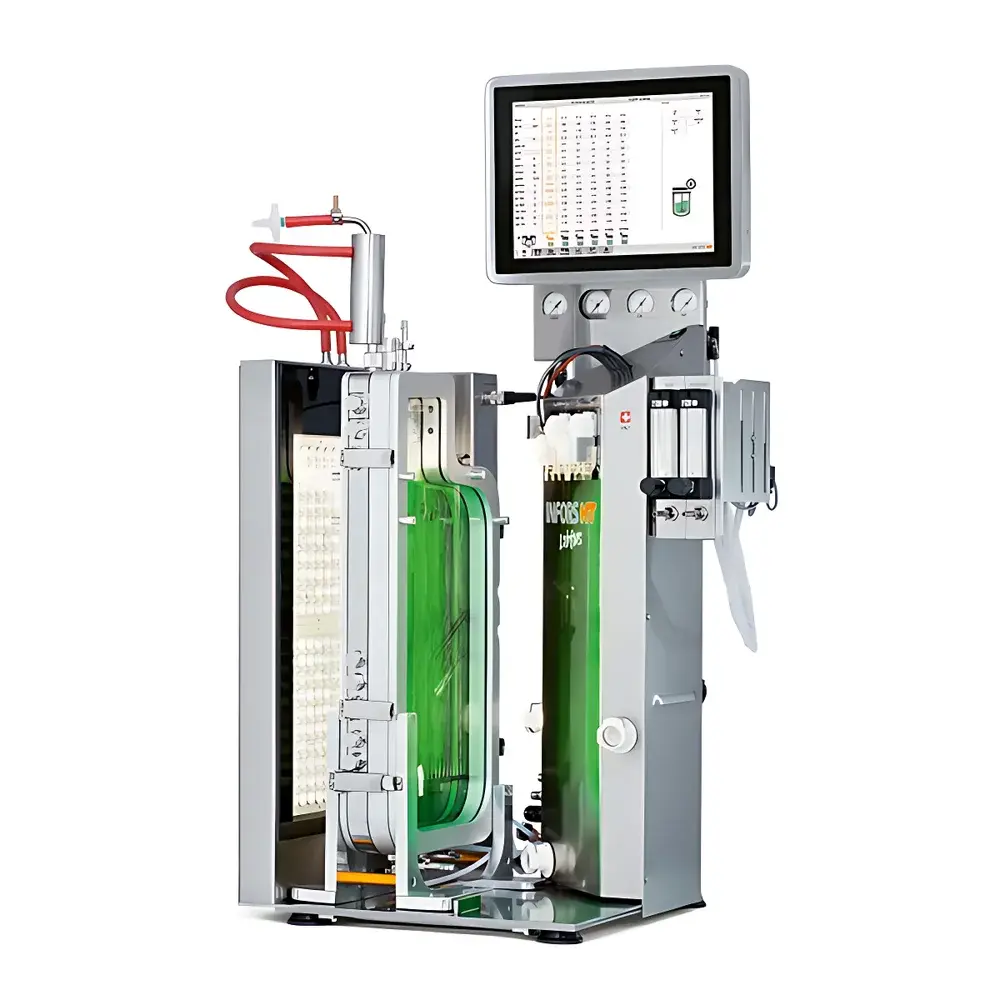
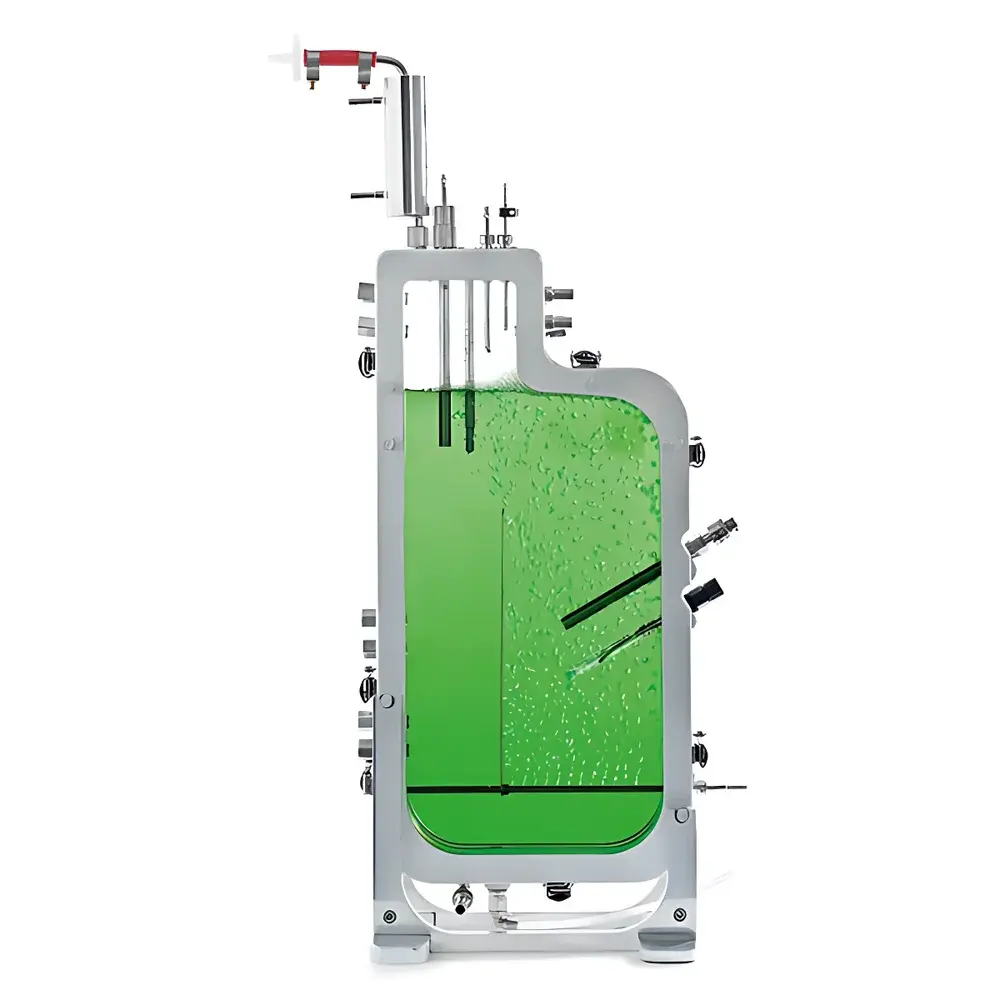
The INFORS Labfors Lux Cell Photobioreactor is a purpose-engineered platform for controlled phototrophic cultivation of microalgae, macroalgae, cyanobacteria, and photosynthetic mammalian or plant cells. Designed explicitly for light-dependent biological processes, it integrates precise environmental regulation with high-fidelity optical delivery—leveraging over two decades of INFORS’ applied research in photobioreactor engineering. Unlike conventional stirred-tank fermenters, the Labfors Lux Cell employs a dual-vessel architecture: a standard cylindrical glass-jacketed vessel (3.6 L total volume, 0.6–2.4 L working volume) and an ultra-thin flat-panel configuration (1.9 L total, 1.6–1.8 L working volume), optimized for uniform photon flux distribution and minimal optical path attenuation. Its core operational principle combines Couette-type fluid dynamics with spectrally tunable, energy-efficient LED illumination—enabling quantitative studies of photosynthetic efficiency, photoinhibition thresholds, circadian rhythm responses, and light-driven metabolic shifts under reproducible, GLP-aligned conditions.
Key Features
- Modular illumination system: Two configurations available—16 high-output white LEDs (max ~700 µmol/m²·s) for standard bench-scale applications; or 260 water-cooled, reflector-focused LEDs in the flat-panel variant (max ~3000 µmol/m²·s), delivering near-solar irradiance levels with <50 mm optical path thickness.
- Spectrally flexible light sources: Default white-light spectrum closely matches natural daylight (CIE D65), maximizing photosynthetic quantum yield; optional narrow-band modules include 450 nm (blue), 660 nm (red), 280–400 nm (UV-A/B), and 700–1000 nm (NIR) for wavelength-specific physiological interrogation.
- Independent, software-synchronized light intensity control: Illumination output adjustable from 0–100% in 0.1% increments via IRIS control software—enabling programmable diurnal cycles, pulsed lighting, ramped photostimulation, and real-time light-response profiling.
- Asymmetric impeller geometry and integrated baffle in flat-panel design: Ensures homogeneous mixing while minimizing shear stress on fragile phototrophs and suppressing foam formation without antifoam additives.
- Glass-jacketed temperature control: Maintains thermal stability across the full range (+5 °C above coolant temperature to 70 °C) with ±0.1 °C precision—critical for temperature-sensitive photosynthetic enzymes and membrane integrity.
- Dual-mode agitation: Bacterial mode (80–1200 rpm) for robust cyanobacteria; low-shear cell mode (30–300 rpm) compatible with delicate eukaryotic algae and suspension cultures.
Sample Compatibility & Compliance
The Labfors Lux Cell supports a broad spectrum of photobiological systems—including Chlorella vulgaris, Nannochloropsis oceanica, Dunaliella salina, Synechocystis sp., and engineered CHO or HEK293 cell lines expressing light-gated ion channels. Its gas mixing station delivers precise, dynamically regulated partial pressures of O₂, CO₂, N₂, and headspace air—essential for carbon-concentrating mechanisms and redox balancing. All wetted materials comply with USP Class VI and ISO 10993 biocompatibility standards; vessel construction uses borosilicate glass (DIN 28120) and electropolished 316L stainless steel. The system meets requirements for ISO 22442 (medical device biological evaluation), ASTM E2500 (pharmaceutical process validation), and supports FDA 21 CFR Part 11-compliant audit trails when configured with IRIS software’s electronic signature module.
Software & Data Management
Control and data acquisition are managed through INFORS’ IRIS software—a validated, Windows-based platform supporting real-time parameter visualization, multivariate trending, and automated protocol execution. IRIS enables closed-loop cascade control (e.g., pH-DO-light coupling), event-triggered sampling, and export of time-stamped datasets in CSV, Excel, or .mat formats. The software includes built-in compliance features: user role-based access control, electronic signatures, change history logging, and ALCOA+ compliant data integrity (attributable, legible, contemporaneous, original, accurate). Optional integration with LIMS or MES systems is supported via OPC UA and Modbus TCP protocols. All firmware updates undergo rigorous IEC 62304 medical device software lifecycle validation.
Applications
- Photobioprocess development for biofuel-grade lipid accumulation in oleaginous microalgae under dynamic light regimes.
- High-throughput screening of light-harvesting complex mutants using spectral tuning to isolate wavelength-specific growth defects.
- Pharmaceutical production of light-inducible recombinant proteins (e.g., optogenetic therapeutics) in mammalian suspension culture.
- Toxicity assessment of UV-B radiation on coral symbionts (Symbiodinium) under climate-relevant temperature and pCO₂ conditions.
- Metabolic flux analysis of carbon partitioning between starch, lipids, and secondary metabolites (e.g., halogenated terpenes) under controlled photoperiods.
- Validation of photobioreactor scale-up models by correlating local photon fluence rates (measured via calibrated quantum sensors) with biomass productivity metrics.
FAQ
What light spectra are factory-calibrated and certified?
White-light (400–700 nm, CIE D65 equivalent) is fully calibrated per DIN 5032-7; optional monochromatic modules (red, blue, UV, NIR) are supplied with NIST-traceable spectral irradiance certificates.
Can the flat-panel vessel be sterilized in place (SIP)?
Yes—the flat-panel configuration supports SIP at 121 °C for 30 minutes using steam injection into the jacket and internal vapor circulation, validated per HTM 2030 Annex C.
Is IRIS software qualified for GMP environments?
IRIS v5.2+ is IQ/OQ/PQ documented and supports 21 CFR Part 11 compliance when deployed on validated Windows Server infrastructure with domain authentication.
How is light uniformity verified across the cultivation volume?
Each unit ships with a pre-installed, traceable quantum sensor grid (Apogee MQ-510) and a spatial mapping report showing ±5% irradiance deviation across the working volume at maximum intensity.
What gas mixing accuracy is achievable for CO₂ supplementation during high-light conditions?
The mass flow controller-based gas mixing station maintains setpoint accuracy within ±0.5% of full scale for CO₂ (0–20% v/v) under dynamic DO feedback control, as verified per ISO 8573-1 Class 2 purity standards.
Related Products




