
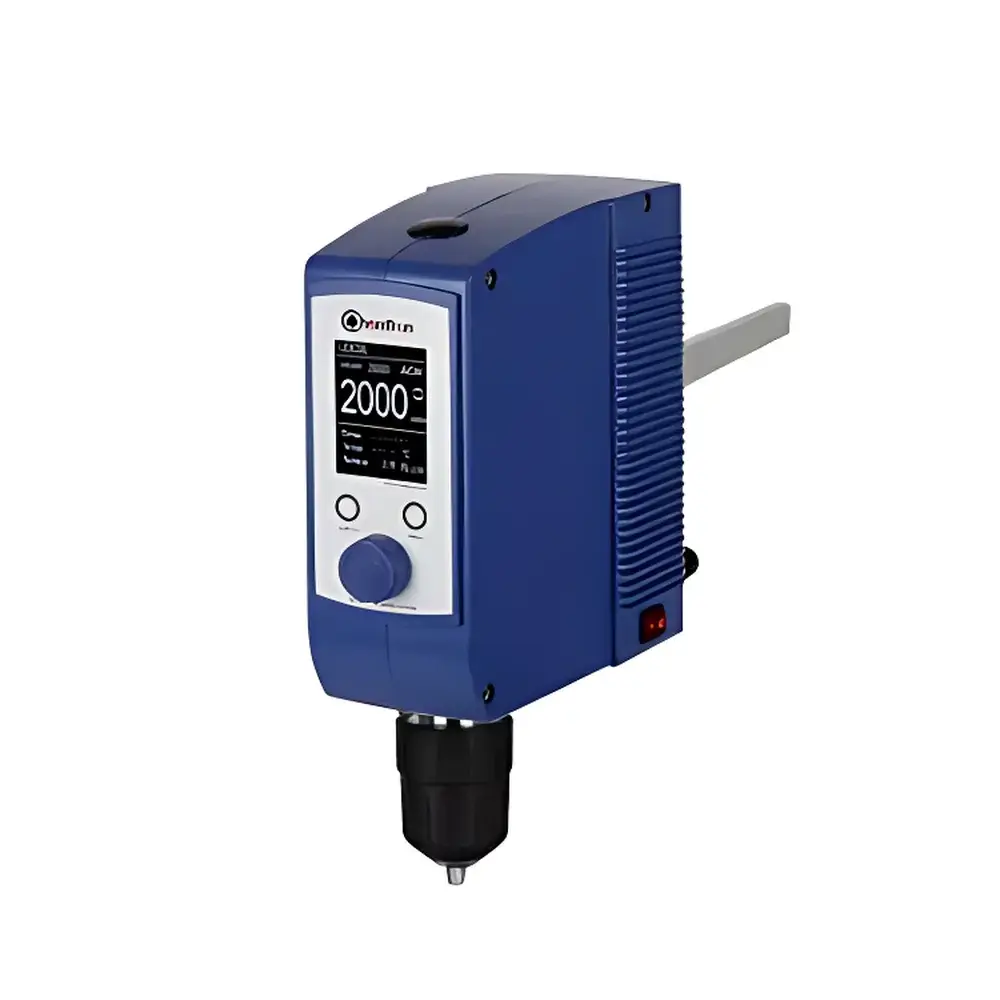
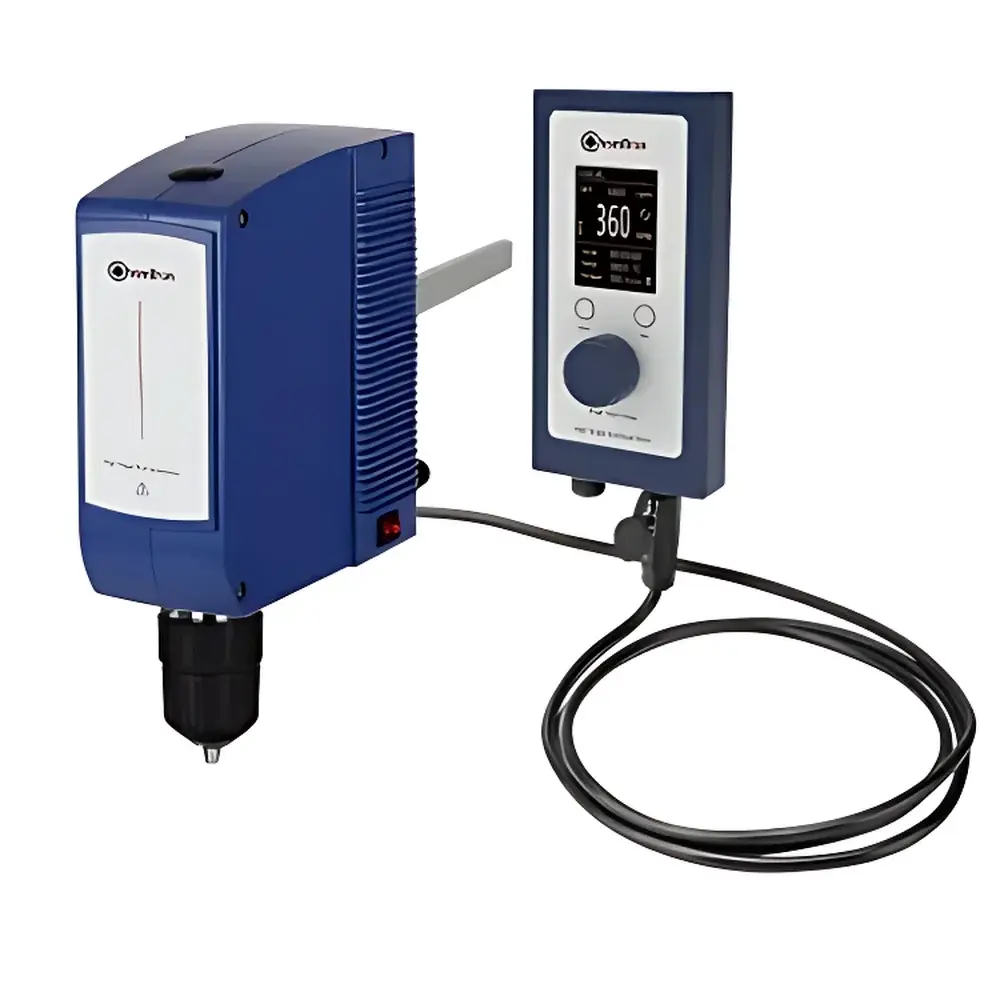
ChemTron OHS.4 / OHS.4F High-Speed, High-Torque Laboratory Stirrer
| Brand | ChemTron |
|---|---|
| Origin | Germany |
| Model | OHS.4 / OHS.4F |
| Stirrer Type | Electric Drive Stirrer |
| Max. Mixing Volume | 40 L (H₂O) |
| Speed Range | 20–1800 rpm (dual-range: 20–360 rpm / 361–1800 rpm) |
| Max. Torque | 565 N·cm (Low-Speed Range) |
| Torque at High Speed | 113 N·cm |
| Max. Viscosity Handling | 150,000 cP |
| Speed Accuracy | ±3% (n > 300 rpm) |
| Minimum Speed Increment | 1 rpm |
| Temperature Measurement Range | −10 to 350 °C |
| Temp. Resolution | 0.1 °C |
| Power Input | 100–240 VAC, 50/60 Hz |
| Motor Type | Brushless DC Motor |
| Chuck Type | Self-locking, tool-free drill chuck |
| Shaft Clamp Diameter | 0.5–10 mm |
| Hollow Shaft Inner Diameter | 10.2 mm |
| Timer Range | 99 h 59 min 59 sec |
| Display | TFT touchscreen + rotary encoder |
| Rotation Direction | Bidirectional (CW/CCW) |
| Status Indicators | Standby (blue), Operation (green), Alarm (red) |
Overview
The ChemTron OHS.4 and OHS.4F are high-performance, microprocessor-controlled laboratory stirrers engineered for demanding mixing and dispersion tasks involving medium-to-high-viscosity fluids and heterogeneous solid–liquid systems. Based on the Couette principle of rotational shear, these instruments deliver precise, reproducible agitation across a wide dynamic range—enabling consistent process scalability from lab-scale synthesis to pilot development. Designed and manufactured in Germany, the OHS series integrates a brushless DC motor architecture with dual-speed transmission logic to optimize torque delivery: low-speed mode (20–360 rpm) provides up to 565 N·cm of sustained torque—fivefold higher than high-speed mode (361–1800 rpm, 113 N·cm)—ensuring stable operation even under heavy load conditions such as polymer dissolution, catalyst slurry homogenization, or viscous emulsion preparation.
Key Features
- Brushless DC motor with integrated thermal protection and continuous-duty rating—eliminates carbon brush wear, reduces maintenance, and ensures long-term operational stability in 24/7 laboratory environments.
- Dual-range speed control: independent low- and high-speed bands allow users to select optimal shear rate profiles without compromising torque integrity or speed resolution (1 rpm step increment).
- TFT graphical display with tactile rotary encoder and touch-sensitive keypad—supports intuitive parameter entry, real-time monitoring of speed, torque trend (derived from motor current feedback), temperature (via optional Pt100 probe), and elapsed time.
- Self-locking, tool-free drill chuck accommodates stirring shafts from 0.5 to 10 mm diameter; hollow shaft design (10.2 mm inner diameter) permits integration with temperature probes or pH electrodes during active mixing.
- Bidirectional rotation capability enables controlled particle suspension, de-agglomeration, and avoidance of vortex-induced phase separation in sensitive formulations.
- Comprehensive safety system: automatic overload shutdown, overtemperature cutoff, and visual status indication (blue = standby, green = running, red = alarm) compliant with IEC 61010-1 safety standards for laboratory electrical equipment.
Sample Compatibility & Compliance
The OHS.4/OHS.4F is validated for use with aqueous, organic, and semi-solid media up to 40 L volume (water-equivalent) and viscosities up to 150,000 cP—covering applications ranging from pharmaceutical suspensions (e.g., USP suspension testing) to cosmetic gels and food-grade hydrocolloid dispersions. Its construction meets IP20 ingress protection requirements and conforms to RoHS 2011/65/EU directives. When paired with GLP-compliant accessories (e.g., calibrated Pt100 sensors, audit-trail-enabled data loggers), the system supports regulated workflows aligned with FDA 21 CFR Part 11 and ISO/IEC 17025 documentation expectations.
Software & Data Management
While the OHS series operates as a standalone instrument, its digital interface supports RS-232 and optional USB-to-serial connectivity for external data capture. Third-party software platforms—including LabVIEW-compatible drivers and ChemTron’s proprietary LogControl Suite—enable time-stamped export of speed, torque trend, temperature, and timer values in CSV format. All logged parameters include metadata (user ID, timestamp, instrument serial number) to satisfy traceability requirements under GMP Annex 11 and ISO 9001 quality management systems.
Applications
- Chemical synthesis: catalytic hydrogenation slurries, Grignard reagent preparation, and exothermic condensation reactions requiring precise shear control.
- Pharmaceutical R&D: wet granulation studies, API suspension stability testing, and viscosity profiling of topical gels per USP .
- Food & beverage: dispersing thickeners (xanthan, carrageenan), homogenizing dairy-based emulsions, and standardizing batter consistency.
- Materials science: graphene oxide dispersion in NMP, ceramic slurry deagglomeration, and battery electrode slurry mixing prior to coating trials.
- Biotechnology: cell culture media supplementation, enzyme immobilization matrix blending, and biopolymer crosslinking kinetics assessment.
FAQ
What distinguishes the OHS.4 from the OHS.4F model?
The OHS.4F includes an integrated Pt100 temperature sensor interface and firmware-enabled real-time temperature compensation logic—allowing simultaneous speed/torque control and thermal feedback during temperature-sensitive reactions.
Can the OHS stirrer be used with overhead stirrer stands from other manufacturers?
Yes—the unit features standardized M12 mounting threads and mechanical compatibility with common modular lab frame systems (e.g., ChemTron, IKA, and generic ISO 9001-certified support columns).
Is torque measurement traceable to national standards?
Torque values are derived from calibrated motor current-to-torque conversion curves, verified during factory acceptance testing against DIN 51399-1 reference methods; full calibration certificates are available upon request.
Does the device support remote start/stop via external TTL signal?
Yes—pin-assignable digital I/O ports (optional module) enable programmable triggering from PLCs, environmental chambers, or automated reactor systems.
What maintenance intervals are recommended for continuous operation?
No scheduled maintenance is required for the brushless motor; annual verification of chuck clamping force, thermal cutoff response, and display calibration is advised per ISO/IEC 17025 internal audit protocols.
Related Products



