
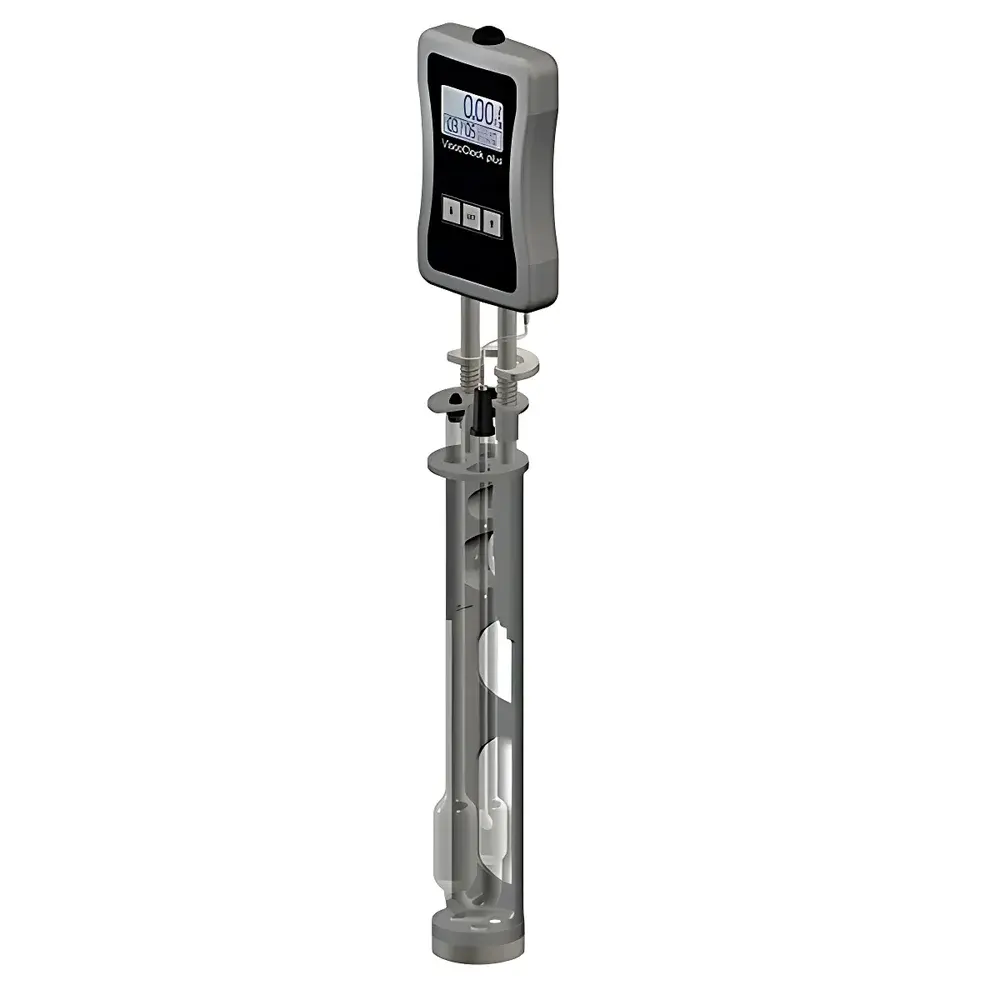
ChemTron ViscoClock Plus Automatic Capillary Viscometer Timer
| Brand | ChemTron |
|---|---|
| Origin | Germany |
| Model | ViscoClock Plus |
| Measurement Time Range | ≤999.99 s |
| Time Resolution | 0.01 s |
| Time Accuracy | ±0.01 s or ±1 digit (≤0.1% of reading) |
| Kinematic Viscosity Range | 0.35–10,000 mm²/s (cSt) |
| Display | 128×64-pixel LCD, 51×31 mm (w×h) |
| Data Interface | USB Host (for USB flash drive or TZ 3863 printer), USB OTG (for PC or printer) |
| Dimensions (H×W×D) | 515×90×30 mm |
| Weight | 450 g (without capillary) |
| Compliance | CE, RoHS, FCC, EN 61010-1:2011-07, EN 61326-1:2012, EN 50581:2013-02 |
| Compatible Viscometers | SIA Ubbelohde (DIN/ISO/ASTM/Micro), SIA Micro-Ostwald |
| Compatible Bath Systems | JULABO ME-31A, ME-16G, ME-18V |
| Operating Temperature Range | −40 °C to +150 °C |
| Housing Material | PP (electronics), PPA polymer (mounting bracket) |
| Fluid Compatibility | Water, ethanol, ethylene glycol, paraffin oil, silicone oil |
Overview
The ChemTron ViscoClock Plus is a precision-engineered automatic timing system designed exclusively for capillary viscometry using glass capillary viscometers—primarily Ubbelohde and micro-Ostwald types compliant with DIN, ISO, ASTM, and pharmacopeial standards (e.g., USP & EP). It operates on the fundamental principle of kinematic viscosity determination: measuring the efflux time of a fixed volume of liquid under gravity through a calibrated capillary at a precisely controlled temperature. Unlike manual stopwatch-based methods, the ViscoClock Plus employs dual infrared optical sensors positioned above and below the capillary’s timing marks to detect meniscus passage with sub-centisecond resolution. This eliminates human reaction-time variability and operator-dependent visual interpretation, thereby ensuring high reproducibility and traceable measurement integrity essential for GLP, GMP, and ISO/IEC 17025-accredited laboratories.
Key Features
- Dual infrared photodetector system for unambiguous, contactless detection of meniscus transit across upper and lower timing marks—enabling automatic start/stop triggering with 0.01 s resolution and ≤0.1% relative accuracy.
- Integrated sample and capillary identification: two-digit alphanumeric codes for both sample ID and viscometer ID are user-definable and embedded in every report, supporting full audit trail requirements.
- Robust mechanical architecture: PPA polymer mounting bracket ensures dimensional stability across wide thermal gradients (−40 °C to +150 °C); PP housing provides chemical resistance and electrical insulation.
- Intuitive 128×64-pixel LCD display (51×31 mm active area) shows real-time efflux time, date/time stamp, sample ID, capillary ID, and status indicators—optimized for visibility in ambient lab lighting.
- Electromagnetically actuated purge valve for Ubbelohde tubes replaces legacy mechanical seals, improving long-term leak-tightness and reducing maintenance frequency during routine cleaning cycles.
- Compliance-ready design: fully certified to EN 61010-1:2011-07 (safety), EN 61326-1:2012 (EMC), RoHS 2011/65/EU, and FCC Part 15 Subpart B—meeting regulatory expectations for instrumentation deployed in regulated QC environments.
Sample Compatibility & Compliance
The ViscoClock Plus is validated for use with standard and micro-format capillaries conforming to SIA specifications—including Ubbelohde (DIN 51562, ISO 3104, ASTM D445), micro-Ubbelohde (ISO 1628-1, USP ), and micro-Ostwald (DIN 53015). Its thermal compatibility extends across JULABO’s transparent viscosity baths (ME-31A, ME-16G, ME-18V), accommodating heat-transfer media such as water, ethanol, ethylene glycol, paraffin oil, and silicone oil. The device supports kinematic viscosity measurements from 0.35 to 10,000 mm²/s (cSt), covering low-viscosity solvents (e.g., acetone, hexane) through medium-viscosity polymers (e.g., PET melt precursors) and high-viscosity lubricants. All measurement data—including raw efflux times, timestamps, IDs, and environmental metadata—are generated in accordance with ALCOA+ principles (Attributable, Legible, Contemporaneous, Original, Accurate, Complete, Consistent, Enduring, Available) when exported or printed.
Software & Data Management
Data acquisition and reporting are handled without proprietary software dependencies. Measurement results are stored directly onto standard USB flash drives in two export formats: PDF (read-only, suitable for archival and regulatory submission) and CSV (editable, compatible with Excel, LIMS, and statistical analysis platforms). USB OTG connectivity enables direct transfer to Windows/macOS PCs for integration into laboratory informatics systems. Optional pairing with the TZ 3863 thermal printer allows on-demand hardcopy generation of reports compliant with 21 CFR Part 11 Annex 11 requirements—provided local IT validation protocols are applied. No cloud upload, remote access, or firmware-over-the-air updates are implemented, preserving data sovereignty and minimizing cybersecurity surface area—a critical consideration for pharmaceutical and contract research organizations.
Applications
- Quality control of polymer solutions (e.g., intrinsic viscosity of polyacrylamide, polyethylene oxide) per ISO 1628 series and USP monographs.
- Pharmaceutical excipient characterization, including viscosity grading of cellulose derivatives (HPMC, MC) and synthetic thickeners used in oral suspensions and ophthalmic formulations.
- Petroleum product testing (e.g., base oils, hydraulic fluids) in accordance with ASTM D445 and ISO 3104.
- Academic and industrial R&D involving solvent effects on macromolecular conformation, where repeatable efflux time is prerequisite to Mark–Houwink parameter derivation.
- Calibration verification of capillary viscometers using NIST-traceable reference oils (e.g., Cannon–Fenske certified standards).
FAQ
Does the ViscoClock Plus require calibration against reference standards?
Yes—while the timer itself is factory-calibrated for timebase accuracy (±0.01 s), absolute kinematic viscosity calculation requires capillary constant calibration using certified reference oils. The device supports both manual constant entry and automated constant derivation from multi-point calibration runs.
Can it be used with non-JULABO bath systems?
It is mechanically and thermally optimized for JULABO ME-series transparent baths; however, third-party baths may be used if they provide stable temperature uniformity (<±0.01 °C), adequate depth for full capillary immersion, and physical compatibility with the PPA mounting bracket.
Is the USB data export compliant with FDA 21 CFR Part 11?
The hardware supports Part 11–aligned workflows (electronic signatures via external LIMS, audit trails via CSV metadata, secure PDF archiving), but formal compliance requires site-specific risk assessment, procedural controls, and validation documentation per organizational SOPs.
What maintenance is required for long-term reliability?
Annual verification of infrared sensor alignment and timing accuracy using a quartz crystal oscillator reference is recommended. Optical windows should be cleaned with lint-free wipes and isopropanol; no internal servicing is required under normal operating conditions.
How does it handle bubble detection or incomplete flow events?
The dual-sensor logic includes built-in flow validation: if the lower sensor triggers without prior upper-sensor activation—or if transit time falls outside configurable min/max bounds—the event is flagged as invalid and excluded from report generation.
Related Products



