
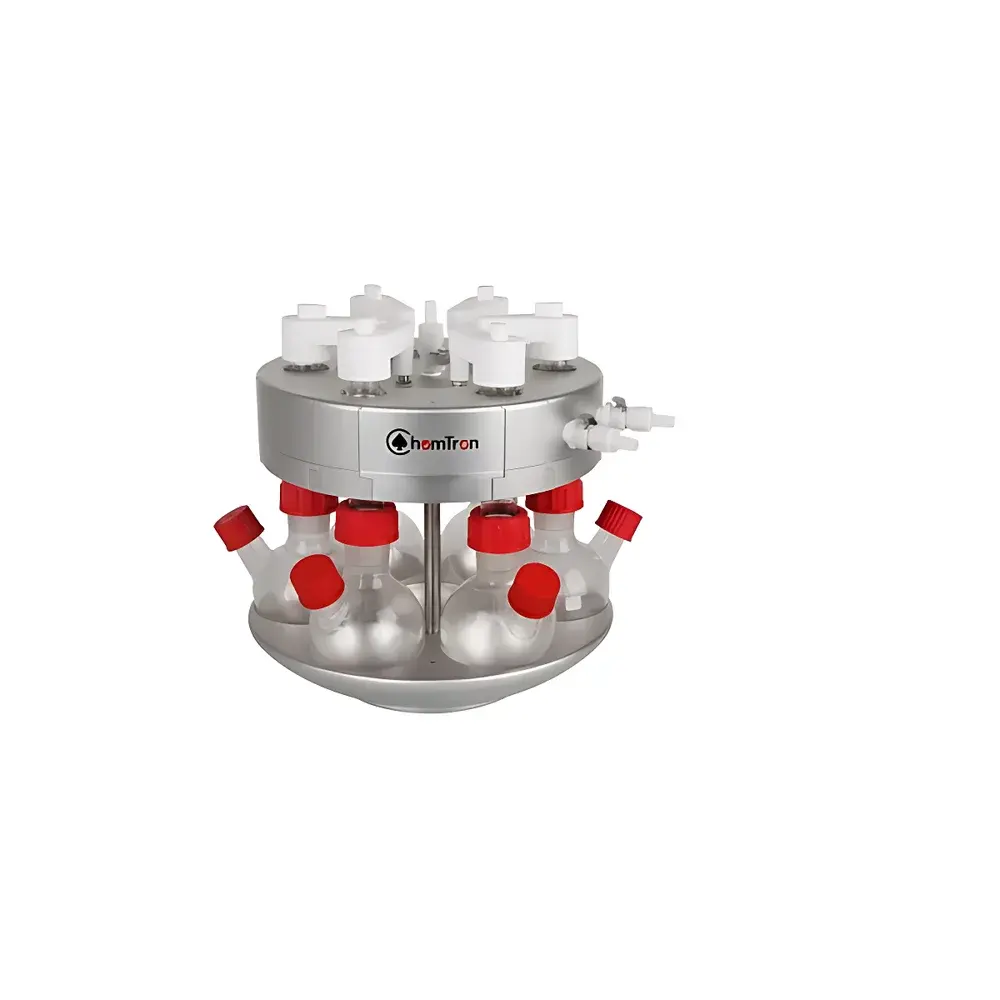
ChemTron PRS-6 Parallel Reaction Station
| Brand | ChemTron |
|---|---|
| Origin | Germany |
| Model | PRS-6 |
| Temperature Range | RT+5 to 180 °C |
| Temperature Control Accuracy | ±0.5 °C |
| Number of Positions | 6 |
| Vessel Capacities | 50 mL / 100 mL / 250 mL (interchangeable) |
| Vacuum Level | ≥20 mbar |
| Stirring Speed | 100–600 rpm |
| Wetted Materials | Borosilicate Glass 3.3 / PTFE |
| Reflux Capability | Yes |
| Inert Gas Compatibility | Yes |
Overview
The ChemTron PRS-6 Parallel Reaction Station is a precision-engineered, modular synthesis platform designed for high-throughput optimization of chemical reaction conditions under controlled thermal, atmospheric, and mechanical environments. Based on the principle of simultaneous multi-vessel conductive heating and magnetic stirring—combined with independent inert gas or vacuum routing—the PRS-6 enables reproducible, parallel execution of up to six reactions in identical or individually tuned parameter sets. Its architecture integrates fundamental requirements of modern synthetic methodology development: thermal homogeneity across positions, chemically inert fluid pathways, real-time process observability, and compliance-ready operational safeguards. Unlike conventional single-vessel reactors, the PRS-6 eliminates sequential experimental bottlenecks by allowing concurrent screening of catalysts, solvents, stoichiometries, and temperature profiles—thereby accelerating route scouting, kinetic profiling, and scalability assessment in pharmaceutical, fine chemical, and materials research laboratories.
Key Features
- Modular 6-position configuration with interchangeable borosilicate glass 3.3 reaction vessels (50 mL, 100 mL, and 250 mL options), all rated for operation from ambient +5 °C to 180 °C.
- Dual-zone thermal control: PT100-sensor feedback loop ensures ±0.5 °C accuracy at each vessel base; independent safety cutoff circuit prevents thermal runaway beyond user-defined limits.
- Centralized inert gas/vacuum manifold with individual PTFE-sealed shut-off valves per position—enabling selective pressurization, purging, or evacuation without cross-contamination.
- Ring-shaped aluminum heating plate with optimized thermal conductivity and uniform magnetic field distribution delivers consistent stirring torque (100–600 rpm) and heating rate across all positions.
- Integrated digital timer and auto-shutdown logic for unattended operation—supports overnight or extended-duration experiments while maintaining GLP-compliant procedural integrity.
- CPC quick-connect fittings for condenser coolant lines with integrated shut-off valves simplify setup and reduce risk of leakage during system reconfiguration.
- Compact footprint and open-ring geometry facilitate visual monitoring, manual sampling, and ergonomic access—eliminating routine need for fume hood confinement.
Sample Compatibility & Compliance
The PRS-6 accommodates standard round-bottom flasks and custom reactor geometries via adaptable heating modules. All wetted surfaces—including gas manifolds, valve bodies, and vessel seals—are constructed from Class VI-certified PTFE and DIN ISO 3585 borosilicate glass 3.3, ensuring compatibility with aggressive reagents (e.g., strong acids, anhydrous Lewis acids, organolithiums) and elevated temperatures. The system supports ASTM E2877-22 (standard practice for parallel reaction screening), ISO 17025-accredited method validation workflows, and aligns with core elements of FDA 21 CFR Part 11 when paired with compliant electronic lab notebook (ELN) integration. Optional documentation packages include IQ/OQ protocols and material traceability dossiers for regulated environments.
Software & Data Management
While the PRS-6 operates as a stand-alone hardware platform with intuitive front-panel controls, its analog and digital I/O interfaces support integration into centralized laboratory automation infrastructures. Temperature setpoints, stirring speed, and timer duration are manually configured but logged via external data acquisition systems (e.g., LabVIEW, DeltaV, or custom SCADA) using 4–20 mA or RS485 outputs. For audit-trail requirements, time-stamped parameter changes can be captured alongside environmental sensor readings (ambient temperature, humidity, power stability) to satisfy GLP/GMP documentation standards. No proprietary software is required—operation remains fully transparent and vendor-agnostic.
Applications
- Reaction condition screening: solvent effects, catalyst loading, stoichiometric variation, and temperature gradients.
- Process intensification studies for continuous flow precursor synthesis and batch-to-continuous translation.
- Stability testing of intermediates under controlled O2/moisture exclusion.
- High-yield small-molecule library synthesis in medicinal chemistry campaigns.
- Thermal decomposition profiling and forced degradation studies per ICH Q1 guidelines.
- Optimization of heterogeneous catalysis, hydrogenation, and cross-coupling reactions requiring inert atmospheres.
FAQ
Can the PRS-6 be used under vacuum for moisture-sensitive reactions?
Yes—the system achieves ≥20 mbar vacuum level and includes dedicated PTFE isolation valves per position to maintain sealed, anhydrous environments during distillation or solvent removal steps.
Is calibration traceable to national standards?
Temperature sensors are factory-calibrated against PTB-traceable references; users may perform field verification using certified reference thermometers per ISO/IEC 17025 procedures.
Does the unit support reflux with external condensers?
Yes—standard ground-glass joints (e.g., ISO 29/32, 24/40) accommodate common air- or water-cooled condensers; CPC coolant connectors enable rapid attachment/detachment.
What maintenance is required for long-term reliability?
No scheduled maintenance is needed—the solid-state design features no moving parts beyond stir bars; periodic inspection of PTFE valve seats and glass integrity is recommended every 12 months.
Can custom vessel configurations be integrated?
Yes—ChemTron offers OEM engineering support to adapt heating modules for non-standard flask geometries, jacketed reactors, or pressure-rated vessels (up to 2 bar gauge).



