
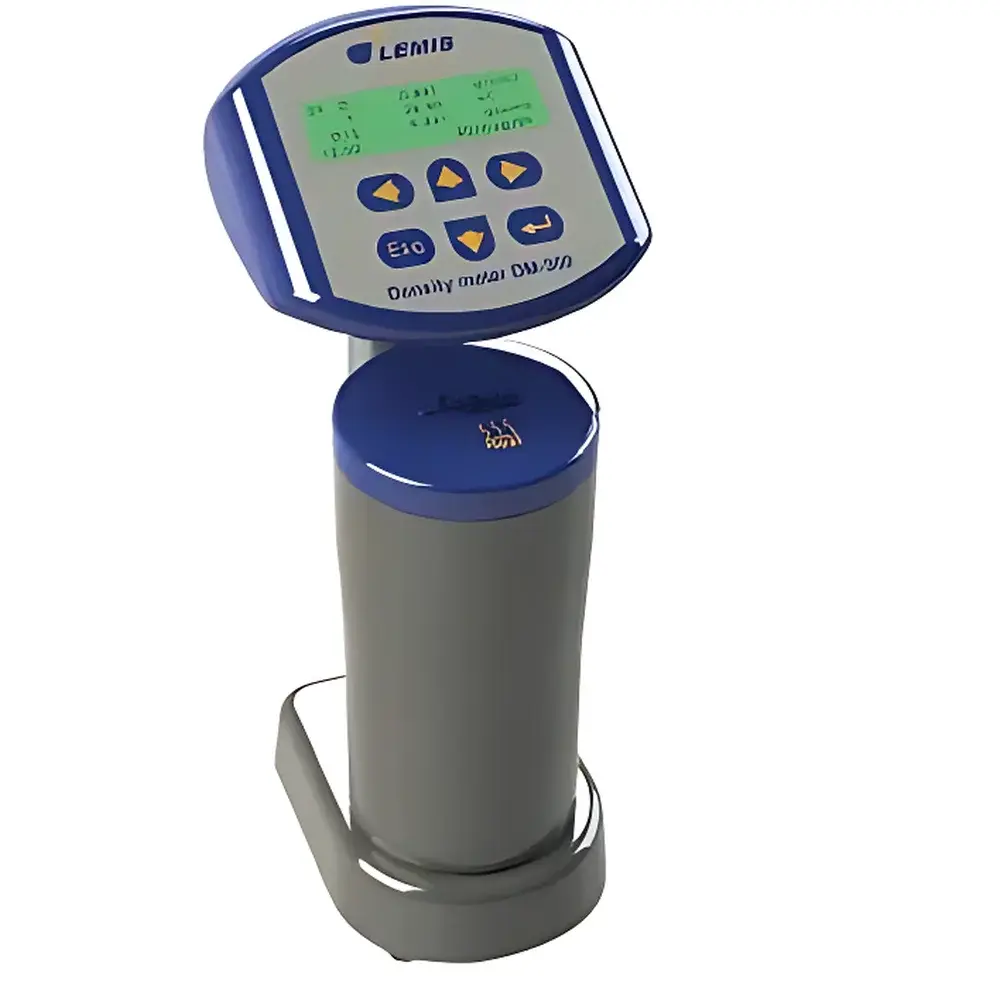
ChemTron VDM-300 heat Desktop Density and Kinematic Viscosity Meter
| Brand | ChemTron |
|---|---|
| Origin | Germany |
| Model | VDM-300 heat |
| Density Range | 0.5–3 g/cm³ |
| Density Accuracy | ±0.0002 g/cm³, ±0.0005 g/cm³, or ±0.001 g/cm³ (selectable) |
| Kinematic Viscosity Accuracy | ±1% of reading |
| Dynamic Viscosity Range | 0.2–2000 mPa·s |
| Temperature Range | up to +100 °C |
| Probe Material | 316L stainless steel, nickel-based alloy, Hastelloy C-22 |
| Dimensions | 140 × 100 × 290 mm |
| Weight | ~2 kg |
| Compliance | CE marked per EN 61326, EN 5011, EN 50082-2 |
| Connectivity | Bluetooth to PC and printer |
Overview
The ChemTron VDM-300 heat is a compact, benchtop dual-parameter instrument engineered for simultaneous, high-reproducibility measurement of density and kinematic viscosity in liquid samples. It operates on the principle of oscillating U-tube densitometry—where sample density is determined from the resonant frequency shift of a precisely machined, temperature-controlled glass or metal U-tube—and integrates capillary viscometry with real-time thermal compensation to derive kinematic viscosity (ν = η/ρ) from dynamic viscosity (η) and measured density (ρ). Designed for routine QC/QA workflows in lubricant, petroleum, and food & beverage laboratories, the VDM-300 heat supports standardized test methods including ASTM D445 (Standard Test Method for Kinematic Viscosity of Transparent and Opaque Liquids), ISO 3104 (Petroleum products — Determination of kinematic viscosity and calculation of dynamic viscosity), and IP 71 (Determination of kinematic viscosity of petroleum products). Its integrated Peltier-based heating system enables precise temperature control up to +100 °C, ensuring compliance with viscosity testing requirements at elevated temperatures—critical for evaluating high-viscosity oils, transformer fluids, and biofuels under operational conditions.
Key Features
- Simultaneous density and kinematic viscosity determination in a single automated run—eliminating manual transfer, recalibration, and inter-instrument variability.
- Selectable density accuracy modes (±0.0002 g/cm³, ±0.0005 g/cm³, ±0.001 g/cm³) optimized for application-specific traceability needs—from refinery custody transfer to R&D formulation screening.
- Dynamic viscosity range of 0.2–2000 mPa·s covers low-viscosity solvents (e.g., ethanol, acetone) through heavy fuel oils and polymer solutions.
- Robust sensor architecture featuring corrosion-resistant 316L stainless steel, nickel-based alloy, and Hastelloy C-22 wetted parts—validated for aggressive hydrocarbon, acidic, and chlorinated media.
- Over-range safety monitoring prevents mechanical stress or thermal overload during out-of-spec sample introduction or ambient drift.
- Bluetooth 4.2 wireless interface enables secure, cable-free data streaming to Windows-based laboratory PCs and networked thermal printers—reducing clutter and enhancing ergonomic workflow integration.
Sample Compatibility & Compliance
The VDM-300 heat is validated for use with transparent and mildly opaque Newtonian liquids across industrial sectors: mineral and synthetic lubricants (ISO VG 22–680), transformer and insulating oils (IEC 60296), diesel and jet fuels (ASTM D975, D1655), crude assay fractions, edible oils (AOCS Cd 1b-87), soft drinks, and ethanol blends. All measurements are performed under controlled thermal equilibrium, with automatic thermal expansion correction applied per ISO 12185 and ASTM D1250. The instrument meets electromagnetic compatibility (EMC) and electrical safety requirements per CE directives EN 61326-1 (laboratory equipment), EN 5011 (industrial radio-frequency immunity), and EN 50082-2 (electrostatic discharge tolerance). While not intrinsically rated for hazardous areas, its sealed probe design and low-energy operation support safe deployment in general-purpose analytical labs operating under GLP and ISO/IEC 17025 quality frameworks.
Software & Data Management
Instrument control, method configuration, and result export are managed via ChemTron’s proprietary VDM Control Suite (v3.x), a Windows-native application supporting multi-user role-based access, audit-trail logging, and electronic signature capability compliant with FDA 21 CFR Part 11 Annex 11 principles. Raw frequency, temperature, and pressure data are timestamped and stored with metadata (operator ID, sample ID, calibration certificate ID, environmental conditions). Export formats include CSV, PDF reports (with embedded instrument ID and calibration status), and XML for LIMS integration. Bluetooth pairing uses AES-128 encryption; no local storage of sensitive credentials occurs on the device. Firmware updates are delivered via signed .hex packages with SHA-256 hash verification.
Applications
- Quality release testing of base oils and finished lubricants against OEM specifications (e.g., SAE J300, API SP/CK-4).
- Monitoring oxidative stability of transformer oil via density drift and viscosity increase over accelerated aging cycles.
- Determining biodiesel blend ratio (B5–B20) using dual-parameter deviation analysis relative to pure petrodiesel reference curves.
- Verifying concentration of sucrose or sodium chloride solutions in food processing via density–viscosity correlation models.
- Supporting ASTM D7042 (dynamic viscosity by oscillating piston) cross-validation studies where kinematic viscosity must be derived without capillary timing errors.
FAQ
Does the VDM-300 heat require external calibration standards for daily operation?
No—factory-installed NIST-traceable density and viscosity reference points are embedded in firmware; only periodic verification using certified water and silicone oil standards (e.g., Cannon N4000 series) is recommended per ISO/IEC 17025 clause 6.6.
Can the instrument measure non-Newtonian fluids?
It reports apparent dynamic viscosity at the fixed shear rate defined by the capillary geometry and driving pressure; however, full rheological profiling (e.g., flow curves, yield stress) requires a dedicated rotational rheometer.
Is temperature ramping programmable?
Yes—users may define up to five discrete setpoints between 15 °C and 100 °C with soak times; linear ramps are not supported, as thermal equilibrium is prioritized over speed.
What maintenance intervals are specified for the oscillating tube sensor?
No scheduled replacement is required; cleaning with compatible solvents (e.g., toluene, isopropanol) after each sample batch is mandatory. Annual factory verification is advised for ISO 17025-accredited labs.
Does Bluetooth connectivity support real-time remote monitoring?
Yes—VDM Control Suite allows live parameter display and alarm triggering (e.g., temperature deviation >±0.1 °C, density outlier >3σ) when paired within 10 meters line-of-sight.



