
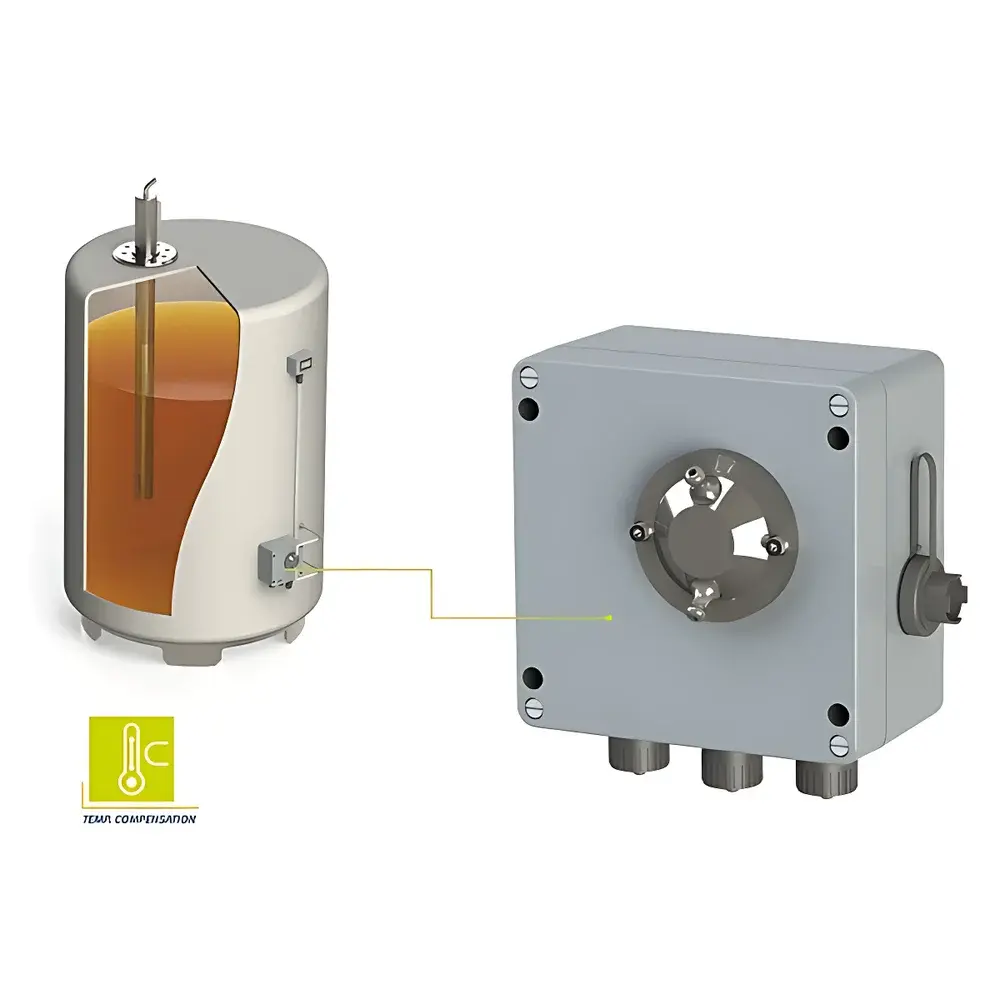
ChemTron PRB21S Bypass Refractometer
| Brand | ChemTron |
|---|---|
| Origin | Germany |
| Model | PRB21S |
| Product Type | Benchtop Bypass Refractometer |
| Temperature Control | Yes |
| Digital Display | No |
| Temperature Measurement Range | −10 to 99.9 °C |
| Temperature Accuracy | ±0.2 °C |
| Refractive Index Range (nD) | 1.3200–1.5600 |
| Brix Range | 0–95 % |
| Refractive Index Accuracy | ±0.0002 |
| Brix Accuracy | ±0.2 % |
| Refractive Index Resolution | 0.0001 |
| Brix Resolution | 0.1 % |
| Measurement Time | 3–60 s |
| Temperature Sensor | PT100 |
| Temp. Measurement Range | 10–120 °C |
| Temp. Resolution | 0.1 °C |
| Light Source | LED @ 590 nm (Lifespan > 100,000 h) |
| Output Signals | 0/4–20 mA analog, RS-232, optional PROFIBUS |
| IP Rating | IP65 |
| Dimensions (W×H×D) | 18.0 × 19.0 × 18.0 cm |
| Weight | 3 kg |
| Temperature Compensation | ICUMSA or user-definable |
Overview
The ChemTron PRB21S Bypass Refractometer is an industrial-grade inline optical analyzer engineered for continuous, real-time refractive index and Brix concentration monitoring in process streams. Unlike traditional handheld or benchtop refractometers, the PRB21S operates on the principle of critical angle measurement using total internal reflection at a solid–liquid interface—specifically, between a high-purity sapphire prism and the flowing sample. Its bypass configuration enables representative sampling without interrupting production flow, making it ideal for integration into chemical, food & beverage, pharmaceutical, and bioprocessing lines where non-invasive, interference-free measurement is required. The instrument employs a stabilized monochromatic LED light source at 590 nm (sodium D-line equivalent), ensuring compliance with standard refractometric conventions defined in ISO 21747, ICUMSA Method GS3/8-1, and AOAC Official Methods of Analysis. Built for robustness in demanding environments, its stainless-steel wetted parts and sapphire prism deliver long-term stability and resistance to mechanical abrasion, chemical corrosion, and thermal cycling.
Key Features
- High-precision sapphire prism (Mohs hardness ≥9) ensures exceptional scratch resistance and optical longevity under continuous flow conditions
- Integrated PT100 temperature sensor with ±0.2 °C accuracy across 10–120 °C range, enabling real-time temperature compensation per ICUMSA or user-defined polynomial algorithms
- Configurable measurement cycle (3–60 s), optimized for dynamic process control and compatible with PLC scan rates
- Multiple output interfaces: isolated 4–20 mA analog signal (HART-compatible), RS-232 serial communication, and optional PROFIBUS-DP for seamless integration into industrial automation architectures
- IP65-rated enclosure suitable for washdown and humid industrial environments; compact footprint (18 × 19 × 18 cm) and low mass (3 kg) facilitate mounting in space-constrained locations
- LED illumination (590 nm) with >100,000-hour operational life eliminates lamp replacement and drift associated with halogen sources
Sample Compatibility & Compliance
The PRB21S is designed for transparent to moderately turbid aqueous solutions, including sucrose, glucose, fructose, invert sugar, salt brines, glycol mixtures, and organic solvent blends. Its optical design inherently mitigates interference from sample coloration and suspended solids—unlike absorption-based techniques—ensuring stable readings even in brownish syrups or lightly opalescent fermentation broths. All wetted materials comply with FDA 21 CFR §177.2600 (food-contact plastics) and EU Regulation (EC) No. 1935/2004. The device supports audit-ready operation when connected to validated control systems, and its analog/digital outputs are compatible with GMP/GLP data integrity requirements—including timestamped value logging and traceable calibration records—when paired with compliant SCADA or MES platforms.
Software & Data Management
While the PRB21S operates as a standalone transmitter without embedded display, its digital outputs support bidirectional communication via RS-232 for configuration, diagnostics, and firmware updates. When integrated into a distributed control system (DCS) or PLC environment, measurement values—including nD, %Brix, and measured temperature—are transmitted with millisecond-level timestamp resolution. Optional PROFIBUS-DP integration allows full parameterization (e.g., compensation model selection, alarm thresholds, averaging windows) through standard engineering tools such as Siemens STEP 7 or Schneider EcoStruxure Control Expert. All calibration events, temperature deviations, and signal health metrics can be logged externally in accordance with FDA 21 CFR Part 11 requirements when implemented with electronic signature-capable historian software.
Applications
- Continuous sugar concentration monitoring in juice evaporation, syrup blending, and confectionery manufacturing per ICUMSA guidelines
- In-line Brix verification during beer wort boiling, wine must adjustment, and dairy ultrafiltration processes
- Concentration control of cleaning-in-place (CIP) solutions and acid/base titrants in pharmaceutical bioreactor skids
- Real-time density surrogate tracking in ethylene glycol/water heat-transfer fluid loops
- Process endpoint detection in crystallization, distillation, and solvent recovery units
FAQ
Does the PRB21S require recalibration during routine operation?
No—its sapphire prism and thermally stabilized LED eliminate drift mechanisms common in glass-prism or tungsten-lamp instruments. Calibration verification is recommended at scheduled intervals (e.g., per ISO/IEC 17025 internal audit cycles) using certified NIST-traceable sucrose standards.
Can the PRB21S measure non-aqueous solvents?
Yes, provided the refractive index falls within 1.3200–1.5600 and the solvent does not chemically attack stainless steel or sapphire. Compatibility should be verified against ChemTron’s chemical resistance guide prior to installation.
Is temperature compensation mandatory for accurate Brix reporting?
Yes—Brix is a temperature-dependent quantity defined at 20 °C. The built-in PT100 and ICUMSA-compliant algorithm ensure traceable, standardized reporting regardless of process temperature fluctuations.
What maintenance is required for long-term reliability?
Routine inspection of the flow cell for particulate buildup and periodic validation against reference standards constitute the primary maintenance protocol. No consumables or optical alignment procedures are required.
How is the PRB21S mounted in a bypass loop?
It is installed in a dedicated stainless-steel bypass manifold with minimum flow velocity of 0.3 m/s to ensure laminar, bubble-free contact with the prism surface. Flow direction and orientation follow ASME BPE-2022 guidelines for sanitary instrumentation.




