
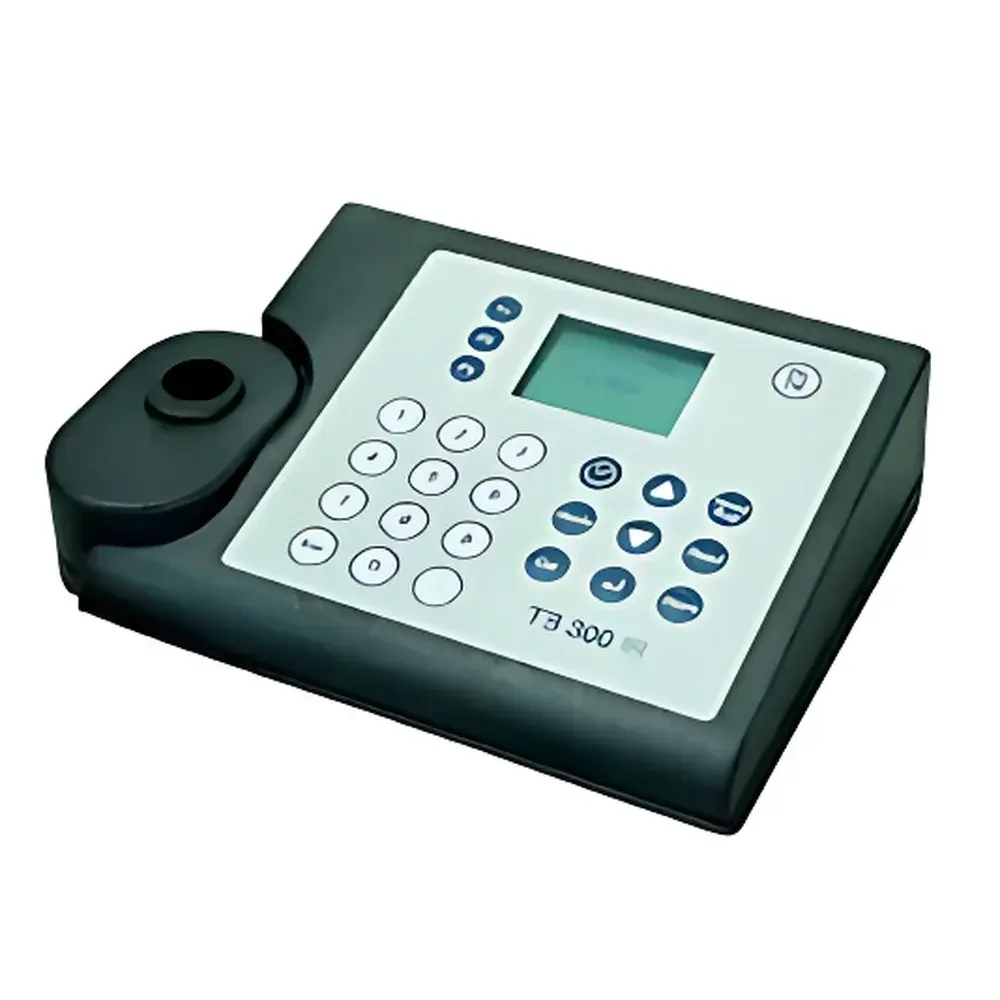
ChemTron TB 300 Infrared Desktop Turbidimeter
| Brand | ChemTron |
|---|---|
| Origin | Germany |
| Model | TB 300 |
| Measurement Principle | 90° Nephelometric Scattering |
| Light Source | Infrared LED (860 nm) |
| Calibration Standard | Formazine |
| Measurement Range | 0.01–1100 NTU (auto-ranging) |
| Resolution | 0.01 NTU (0.01–9.99), 0.1 NTU (10.0–99.9), 1 NTU (100–1100) |
| Accuracy | ±2% of reading or ±0.01 NTU (0–500 NTU) |
| Sample Volume | ~12 mL |
| Display | Graphical LCD with real-time clock |
| Data Storage | 1000 measurement records |
| Keypad | Acid- and solvent-resistant membrane keys |
| Auto Power-Off | Enabled |
| Compliance | ASTM D6508, ISO 7027, EPA Method 180.1 |
Overview
The ChemTron TB 300 Infrared Desktop Turbidimeter is a precision-engineered nephelometric instrument designed for reliable, traceable turbidity quantification in laboratory, municipal, and industrial water quality control environments. It operates on the fundamental principle of 90° scattered light detection—measuring the intensity of infrared light (860 nm) scattered by suspended particles when a collimated beam passes through a water sample. This geometry minimizes interference from color absorption and large-particle settling effects, delivering high reproducibility across diverse sample matrices. Unlike white-light turbidimeters, the 860 nm infrared source significantly reduces spectral interference from natural organic matter, humic substances, and colored dissolved solids—making the TB 300 especially suited for applications where sample chromaticity would otherwise compromise accuracy. Its adherence to ISO 7027 and ASTM D6508 ensures methodological consistency with international regulatory frameworks governing drinking water (e.g., WHO Guidelines), wastewater effluent monitoring (EPA Method 180.1), and process water validation in pharmaceutical and food manufacturing.
Key Features
- Fixed-wavelength infrared LED (860 nm) source engineered for long-term photometric stability and minimal drift over extended operation cycles
- Auto-ranging optical detection system covering 0.01–1100 NTU with three-tier resolution switching (0.01/0.1/1 NTU) optimized for low-level clarity verification and high-turbidity process monitoring
- Graphical LCD display with integrated real-time clock, enabling timestamped data logging and chronological trend analysis without external PC dependency
- Robust membrane keypad resistant to hydrochloric acid, sodium hypochlorite, ethanol, and common laboratory solvents—critical for field-deployed or pool maintenance lab use
- Onboard storage for up to 1000 measurement records, each including NTU value, date/time stamp, calibration status flag, and user-defined sample ID
- Automatic power-off function after 10 minutes of inactivity, preserving battery life during intermittent use without compromising startup readiness
Sample Compatibility & Compliance
The TB 300 accommodates standard 25 mm round glass cuvettes with a nominal sample volume of 12 mL—compatible with both reusable quartz and disposable polystyrene vials meeting ISO 7027 dimensional tolerances. It supports routine verification using certified Formazine standards traceable to NIST SRM 2134, and includes built-in calibration verification routines compliant with GLP documentation requirements. The instrument satisfies key regulatory benchmarks: ISO 7027:2016 (water quality—determination of turbidity), ASTM D6508-22 (standard test method for turbidity in water using a nephelometer), and U.S. EPA Method 180.1 (for drinking water compliance). Its design facilitates audit-ready operation in facilities operating under FDA 21 CFR Part 11-compliant data management protocols when paired with ChemTron’s optional secure export software.
Software & Data Management
While fully functional as a standalone instrument, the TB 300 supports optional USB-to-PC connectivity via ChemTron’s TurbLink™ desktop application (Windows 10/11 compatible). This software enables encrypted batch export of stored measurements—including metadata such as operator ID, calibration history, and environmental temperature logs. Audit trails are generated per session, recording all parameter changes, calibration events, and data deletions in accordance with ALCOA+ principles (Attributable, Legible, Contemporaneous, Original, Accurate, Complete, Consistent, Enduring, Available). Export formats include CSV (for LIMS integration) and PDF reports with embedded digital signatures for QA/QC sign-off.
Applications
- Drinking water treatment plants: Monitoring filtration efficiency, coagulation performance, and final distribution system clarity
- Swimming pool & spa operations: Verifying NSF/ANSI 50 compliance for filter backwash endpoints and recirculation cycle validation
- Wastewater treatment facilities: Assessing clarifier effluent quality, sludge dewatering consistency, and tertiary filtration integrity
- Pharmaceutical water systems: Supporting USP purified water and water-for-injection (WFI) qualification protocols
- Industrial cooling towers and boiler feedwater: Detecting particulate ingress, corrosion product accumulation, and pretreatment failure modes
- Environmental field labs: Conducting rapid, on-site turbidity screening prior to gravimetric or microscopic particle analysis
FAQ
What calibration standards are required for routine operation?
Formazine standard solutions (e.g., 10, 100, and 800 NTU) traceable to NIST SRM 2134 are recommended for initial setup and periodic verification. The TB 300 supports multi-point calibration with automatic gain adjustment.
Can the instrument measure colored samples without interference?
Yes—the 860 nm infrared source minimizes absorbance artifacts from yellow-to-brown chromophores, enabling accurate turbidity assessment in surface waters, treated effluents, and process streams with elevated DOC.
Is the TB 300 suitable for GLP or GMP-regulated environments?
It meets core instrumental requirements for regulated labs; full compliance requires implementation of documented procedures for calibration, maintenance, and data review—supported by TurbLink™ audit trail functionality.
How is sample cell alignment ensured during measurement?
The cuvette holder features precision-machined alignment grooves and a spring-loaded retention mechanism to maintain consistent optical path positioning across repeated insertions.
Does the device support user-defined units or alternative turbidity scales?
No—it reports exclusively in NTU (Nephelometric Turbidity Units) per ISO 7027 and ASTM D6508, ensuring metrological equivalence with reference laboratories and regulatory submissions.



