
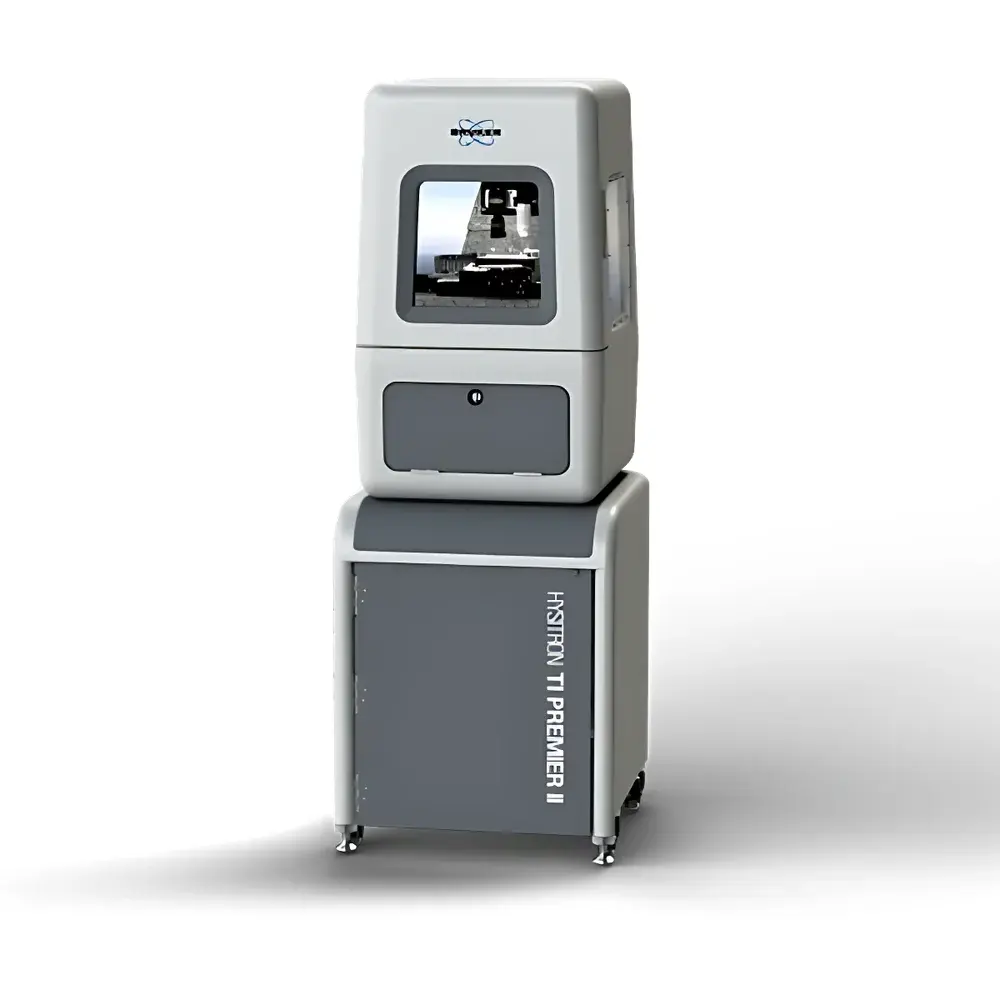
Bruker TI Premier II High-Precision Nanomechanical Testing System
| Brand | Bruker |
|---|---|
| Origin | USA |
| Manufacturer Type | Authorized Distributor |
| Origin Category | Imported |
| Model | TI Premier II |
| Instrument Type | Nanoindentation and Scratch Tester |
| Measurement Principle | Capacitive Displacement Sensing with Electromechanical Actuation |
| Compliance Framework | ASTM E2546, ISO 14577, ISO 20519, USP <1062>, GLP/GMP-Ready Data Integrity Architecture |
Overview
The Bruker TI Premier II High-Precision Nanomechanical Testing System is an advanced, modular platform engineered for quantitative mechanical characterization at the nanoscale and microscale. Built upon Hysitron’s proven capacitive displacement sensing architecture and high-stiffness electromechanical actuation, the system delivers sub-nanometer depth resolution and sub-micron Newton force sensitivity—enabling rigorous measurement of hardness, elastic modulus, creep, stress relaxation, fracture toughness, adhesion, and tribological behavior (e.g., coefficient of friction, scratch resistance). Designed for research laboratories, R&D centers, and quality control environments in semiconductors, thin-film coatings, biomedical implants, battery materials, and advanced polymers, the TI Premier II operates under controlled ambient or inert gas conditions via its integrated environmental isolation chamber. Its core architecture supports traceable, repeatable testing aligned with international standards including ASTM E2546 (nanoindentation), ISO 14577 (metallic and non-metallic materials), ISO 20519 (coating adhesion), and USP (mechanical properties of pharmaceutical solids).
Key Features
- Capacitive displacement sensor with <1 nm depth resolution and <50 nN force resolution—ensuring high fidelity in load–displacement curve acquisition.
- Modular tribo-mechanical test engine supporting nanoindentation, dynamic nanoindentation (DMA mode), quasi-static and high-strain-rate scratch testing, and micro-scale wear mapping.
- TriboScan 12 software suite with real-time feedback control, automated tip calibration routines, and built-in compliance correction algorithms per ISO 14577 Annex A.
- Integrated environmental isolation chamber with optional humidity, temperature, and inert gas control (N₂, Ar) to mitigate environmental drift and surface contamination during long-duration tests.
- Universal sample stage accommodating specimens up to 200 mm × 200 mm × 50 mm (W × L × H), compatible with conductive, insulating, and hydrated samples—including biological tissues and hydrogels.
- Automated tip qualification workflow with in situ scanning probe imaging capability (via optional SEM/AFM integration interface) for precise tip geometry verification prior to indentation.
Sample Compatibility & Compliance
The TI Premier II accommodates a broad spectrum of material classes without requiring conductive coating or vacuum preconditioning: hard ceramics (Al₂O₃, SiC), metallic alloys (Ti-6Al-4V, stainless steels), polymer films (PET, PI, PVDF), thin-film photovoltaics (CIGS, perovskites), biomaterials (collagen scaffolds, decellularized tissue), and battery electrode composites (NMC, silicon anodes). All test data are generated with full audit trail functionality compliant with FDA 21 CFR Part 11 requirements—including electronic signatures, user access controls, and immutable raw-data archiving. The system supports GLP/GMP-aligned reporting templates and integrates seamlessly with LIMS platforms via standardized API protocols (RESTful JSON).
Software & Data Management
TriboScan 12 provides a unified interface for experiment design, real-time visualization, post-test analysis, and report generation. It includes pre-validated analysis modules for Oliver–Pharr method implementation (with iterative Poisson’s ratio adjustment), contact stiffness deconvolution, pile-up/sink-in correction, and scratch failure classification (adhesive vs. cohesive delamination). Raw data files (.tdf) are stored in open-format HDF5 containers with embedded metadata (test parameters, environmental logs, calibration history), ensuring long-term readability and third-party interoperability. Data export supports CSV, MATLAB (.mat), and MTS-compatible formats for cross-platform modeling and finite element validation.
Applications
- Thin-film adhesion quantification in MEMS packaging and OLED encapsulation layers.
- Mechanical gradient mapping across graded ceramic–metal interfaces in thermal barrier coatings.
- Viscoelastic property profiling of hydrogel-based drug delivery matrices under physiological hydration.
- Nano-scale fatigue behavior assessment of lithium-ion battery cathode particles after cycling.
- Surface hardening evaluation of nitrided steel components used in aerospace actuators.
- Fracture initiation energy determination in brittle semiconductor wafers subjected to dicing-induced stress.
FAQ
What standards does the TI Premier II comply with for nanoindentation testing?
ASTM E2546, ISO 14577-1/2/3, ISO 20519, and USP —with full documentation of uncertainty budgets and traceable calibration certificates available upon request.
Can the system perform tests in liquid or humid environments?
Yes—the integrated environmental isolation chamber supports controlled humidity (10–95% RH) and optional liquid cell accessories for in-situ aqueous nanoindentation, subject to application-specific configuration.
Is TriboScan 12 software validated for regulated environments?
Yes—software validation packages (IQ/OQ/PQ) and 21 CFR Part 11 compliance documentation are provided as part of GxP deployment support.
What tip geometries are supported out-of-the-box?
Berkovich, cube-corner, spherical (R = 1–100 µm), and flat-punch indenters; custom geometries available via Bruker’s certified tip service.
How is system calibration verified between user sessions?
Automated daily calibration routines include reference material indentation (fused silica, sapphire) and electro-mechanical loop verification using NIST-traceable reference sensors.



