
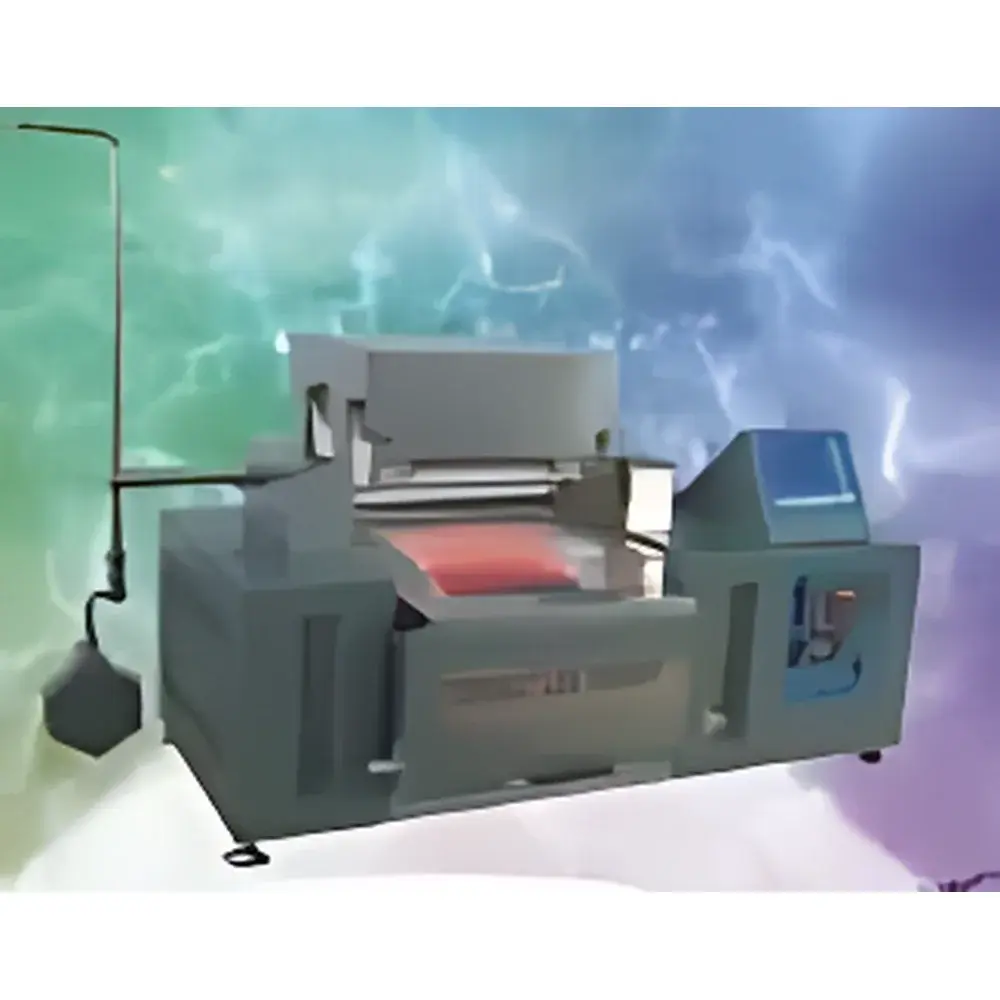
Yuso DY501 Electrothermal Fusion Machine
| Brand | Yuso |
|---|---|
| Origin | Shanghai, China |
| Model | DY501 |
| Heating Unit | 3 × double-helix single-end silicon carbide rods |
| Max Temperature | 1250 °C (continuously adjustable) |
| Temp Measurement | 2 × Pt/Rh thermocouples (up to 1600 °C) |
| Capacity | 4 samples simultaneously (expandable to 6) |
| Power Rating | 6 kW |
| Supply | 380–415 V, 50–60 Hz, 3-phase |
| Dimensions (H×W×D) | 500 mm × 1217 mm × 500 mm |
| Weight | 115 kg |
Overview
The Yuso DY501 Electrothermal Fusion Machine is an industrial-grade, microprocessor-controlled fusion system engineered for the preparation of homogeneous glass beads from powdered inorganic samples—primarily for X-ray fluorescence (XRF), inductively coupled plasma (ICP-OES/MS), atomic absorption (AA), and wet chemical analysis. It operates on the principle of high-temperature flux-assisted fusion (typically using lithium tetraborate or lithium metaborate), where sample and flux are heated under controlled inert or ambient atmosphere to form a chemically stable, isotropic glass disc. This method eliminates matrix-related interferences—including particle size effects, mineralogical heterogeneity, elemental segregation, and absorption/enhancement phenomena—that persist in pressed-powder pellets. As a result, the DY501 delivers significantly improved analytical precision (RSD < 0.5% for major elements) and accuracy across multi-element workflows, particularly for geological, metallurgical, cement, environmental, and ceramic matrices.
Key Features
- Triple-zone heating architecture with three independently mounted double-helix silicon carbide (SiC) rods, delivering uniform thermal distribution and long service life (>5,000 h at 1100 °C)
- Dual platinum-rhodium (Pt/Rh Type S) thermocouples—one integrated into the furnace chamber for process control, the second dedicated exclusively to overtemperature safety cutoff—enabling triple-redundant thermal protection (PID control loop + independent alarm circuit + mechanical fuse)
- Simultaneous fusion of up to four samples per cycle; optional six-position crucible holder available upon request for higher throughput labs
- CPU-based PID controller with intuitive menu-driven interface, supporting up to 10 fully customizable fusion programs; each program defines ramp rates (0.1–30 °C/min), hold times (1–99 min), final temperature (room temp to 1250 °C), oscillation parameters (amplitude: 5–25°, frequency: 0.5–3 Hz, duration: 1–30 min), and active cooling profiles (fan speed control, delay timing)
- High-temperature alloy crucible and mold support structure (Inconel 600 equivalent), resistant to thermal shock and chemically inert up to 1300 °C—ensuring no metal leaching or cross-contamination during repeated use
- Ergonomic chain-and-lever lid actuation mechanism enabling smooth, low-effort opening/closing of the fusion chamber—even after prolonged high-temperature operation
- Comprehensive safety suite: minimum startup temperature verification, lid-open power interlock, overcurrent detection, dual-stage overtemperature shutdown with audible/visual alarms, and automatic power disengagement upon fault condition
Sample Compatibility & Compliance
The DY501 accommodates standard 30 mL or 40 mL platinum-gold (Pt/Au) or platinum-rhodium (Pt/Rh) crucibles and corresponding graphite or stainless-steel molds. It supports all common fusion fluxes (e.g., Li₂B₄O₇, LiBO₂, NH₄NO₃ + Li₂B₄O₇ mixtures) and is compatible with sample-to-flux ratios ranging from 1:5 to 1:12. The system meets core requirements for ISO 9516-1 (XRF bead preparation), ASTM E2488 (fusion for ICP analysis), and GB/T 176-2017 (cement chemical analysis). Its programmable thermal profiles and audit-ready operational logs align with GLP and GMP environments requiring traceability; while not FDA 21 CFR Part 11 certified out-of-the-box, its parameter logging and user-access controls provide a foundation for laboratory-specific validation.
Software & Data Management
The embedded controller records full cycle metadata—including date/time stamp, selected program ID, actual vs. setpoint temperature curves, oscillation metrics, cooling fan activation status, and fault event logs—with timestamped entries stored in non-volatile memory for ≥10,000 cycles. Data export is supported via RS-232 serial interface to external PCs running custom LabVIEW or Python-based acquisition tools. Optional USB data logger module enables direct CSV export for integration into LIMS platforms. All user modifications to heating protocols require password authentication, and operator IDs can be assigned to enforce accountability in regulated settings.
Applications
- XRF quantitative analysis of ores, slags, alloys, soils, fly ash, and clinker—where fused beads eliminate mineralogical bias and improve light-element (Na–F) detection limits
- ICP-OES/MS sample introduction for refractory oxides (e.g., Al₂O₃, TiO₂, ZrO₂) and silicates that resist acid digestion
- Reference material certification workflows requiring ultra-low RSDs (<0.3%) across replicate beads
- Quality control in cement manufacturing per EN 196-2 and ASTM C114
- Environmental monitoring of heavy metals in contaminated sediments using EPA Method 6010D-compliant fusion prep
- Geochemical exploration labs performing multi-element surveys on rock powders with variable crystallinity and grain hardness
FAQ
What crucible materials are recommended for routine use with the DY501?
Platinum-gold (95% Pt / 5% Au) crucibles are standard for general-purpose fusion; platinum-rhodium (90% Pt / 10% Rh) is preferred for high-temperature, high-flux-ratio applications involving aggressive fluorides or sulfates.
Can the DY501 be integrated into an automated sample prep line?
Yes—the unit features dry-contact relay outputs and TTL-level trigger inputs for synchronization with robotic arms, auto-sampler loaders, or pneumatic mold ejectors; hardware interface documentation is provided upon request.
Is nitrogen purge capability built-in?
No, but the furnace chamber includes a dedicated 6-mm gas inlet port and pressure-relief valve; external N₂ or Ar supply lines can be connected to suppress oxidation during fusion of reducing samples (e.g., Fe-rich slags).
How often does the PID controller require calibration?
The system performs automatic zero-offset compensation during idle periods; full thermocouple calibration is recommended annually using a certified reference thermometer traceable to NIST or equivalent national metrology institute.
Does the DY501 support gradient heating profiles?
Yes—each of the 10 programmable methods allows up to three distinct ramp-and-hold segments, enabling complex profiles such as pre-oxidation (400 °C), flux homogenization (900 °C), and final fusion (1150 °C), all within a single uninterrupted cycle.



