
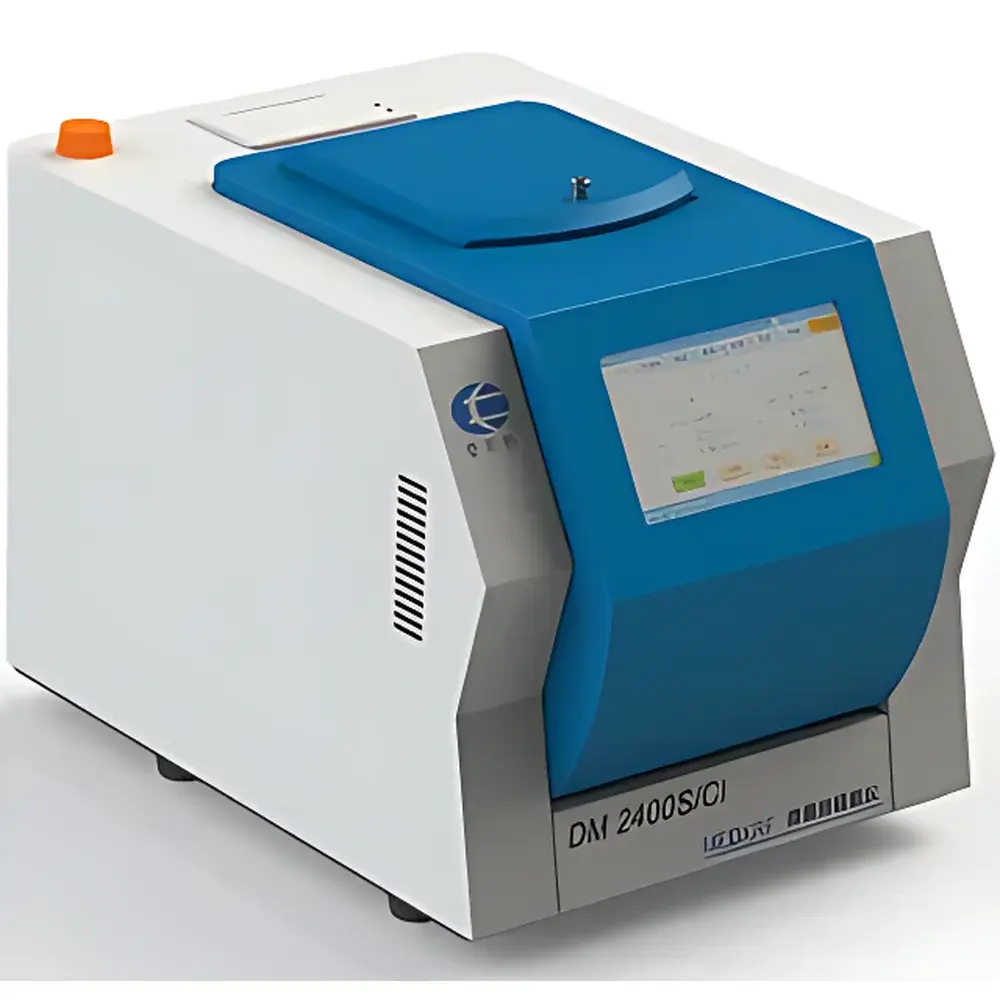
ASTEL DM2400S/Cl Monochromatic Excitation Energy-Dispersive X-Ray Fluorescence (MEDXRF) Sulfur and Chlorine Analyzer
| Brand | ASTEL / ST |
|---|---|
| Origin | Shanghai, China |
| Model | DM2400S/Cl |
| Detection Elements | Total Sulfur (S), Total Chlorine (Cl) |
| Detection Limits (300 s) | S: 0.26 ppm, Cl: 0.18 ppm |
| X-ray Tube | Ag-target, micro-focus, thin Be window, ≤50 kV / ≤2 mA / ≤50 W |
| Detector | Silicon Drift Detector (SDD), 20 mm² active area, ≤123 eV resolution at Mn Kα, ≤2 Mcps count rate |
| Primary Optic | Logarithmic Spiral Doubly Curved Crystal (LSDCC) artificial monochromator |
| Standards Compliance | GB/T 11140, ISO 20884, ASTM D2622, ASTM D7039, ASTM D7220, ASTM D4929, ASTM D7536, ISO 15597 |
| Measurement Range | 3×LOD to 9.99 wt% |
| Linear Correlation Coefficient (r) | >0.999 for both S and Cl calibration curves |
| Repeatability (r) & Reproducibility (R) | Meets or exceeds all referenced ASTM/ISO/GB standards |
| Operating Environment | 5–40 °C, ≤85% RH (at 30 °C), 220 V ±20 V, 50 Hz, <200 W |
| Dimensions & Weight | 330 × 460 × 350 mm, 25 kg |
Overview
The ASTEL DM2400S/Cl is a dedicated monochromatic excitation energy-dispersive X-ray fluorescence (MEDXRF) analyzer engineered for ultra-trace quantification of total sulfur (S) and total chlorine (Cl) in petroleum products, lubricants, process streams, and aqueous matrices. Unlike conventional EDXRF or WDXRF systems, the DM2400S/Cl employs a physics-based signal-to-noise optimization strategy: monochromatic primary beam excitation via a logarithmic spiral doubly curved crystal (LSDCC), coupled with high-resolution silicon drift detection (SDD) and optimized Ag-target microfocus X-ray optics. This architecture suppresses bremsstrahlung background by >90% while preserving peak intensity—enabling sub-ppm detection limits without chemical digestion, carrier gas, or sample combustion. The instrument operates on fundamental XRF principles governed by Moseley’s law and Beer–Lambert attenuation, delivering direct, matrix-independent quantification for S (Kα at 2.307 keV) and Cl (Kα at 2.622 keV) under standardized measurement geometries.
Key Features
- Monochromatic excitation using patented LSDCC artificial crystal (DM30L), delivering >3× higher integrated diffraction efficiency vs. natural Si/Ge crystals and enabling point-to-surface focusing with <2 mm focal spot size
- High-performance SDD detector (KETEK VITUS H20 CUBE): 20 mm² active area, ≤123 eV FWHM resolution at Mn Kα, and sustained ≤2 Mcps throughput without spectral degradation
- Ag-target microfocus X-ray tube (≤50 W) with thin 8 µm Be window and digitally optimized kV/mA settings—maximizing excitation cross-section near S and Cl absorption edges (K-edge: S = 2.472 keV, Cl = 2.822 keV)
- Digital pulse processing with real-time PHA adjustment, automatic drift correction, and spectral deconvolution algorithms for long-term stability (>12 months calibration retention)
- Integrated He-purge or self-filling atmospheric control system for light-element sensitivity enhancement and ambient O₂/N₂ interference suppression
- Touchscreen-driven workflow: single-button analysis initiation, automated cup recognition, and embedded QC flagging per ASTM D7039 Annex A1
Sample Compatibility & Compliance
The DM2400S/Cl accommodates liquid samples (gasoline, diesel, jet fuel, residual fuel oil, lubricant additives, crude fractions), aqueous chloride solutions, and solid homogenates in standard 32-mm polyethylene or quartz sample cups (10–20 mL volume). No acid digestion, combustion, or derivatization is required. All measurements comply with regulatory and industry-standard test methods including ASTM D2622 (EDXRF for S in petroleum), ASTM D7039 (S in middle distillates), ASTM D7220 (S in low-sulfur diesel), ASTM D4929 (Cl in aromatic hydrocarbons), ASTM D7536 (Cl in gasoline), ISO 20884 (S in automotive fuels), ISO 15597 (Cl in petroleum products), and GB/T 11140 (S in petroleum fractions). Instrument performance validation includes full repeatability (r) and reproducibility (R) verification per ASTM E691 protocol; certified reference materials (CRMs) from NIST, CRM-UK, and AccuStandard are supported for traceability.
Software & Data Management
ASTEL’s proprietary SpectraControl v4.2 software provides GLP-compliant data handling with 21 CFR Part 11–ready audit trails, electronic signatures, and role-based user access control. Calibration curves are generated using ≥7 certified multi-level standards (S/Cl range: 0.5 ppm–10 wt%), with linear regression coefficients (r²) consistently exceeding 0.999. Software modules include spectral overlay comparison, inter-laboratory method transfer tools, uncertainty propagation per GUM (JCGM 100:2008), and automated report generation compliant with ISO/IEC 17025 requirements. Raw spectra, processed intensities, background-subtracted net counts, and matrix-corrected concentrations are exportable in CSV, XML, and PDF formats. Optional LIMS integration via ASTM WK55777-compliant API ensures seamless laboratory workflow alignment.
Applications
The DM2400S/Cl serves as a primary or confirmatory analyzer in refinery quality control labs (QC/QA), third-party testing laboratories (e.g., SGS, Bureau Veritas, Intertek), petrochemical R&D facilities, and regulatory compliance units enforcing Tier 5/6 fuel specifications. Typical use cases include: monitoring desulfurization unit efficiency; verifying ultra-low-sulfur diesel (ULSD, ≤10 ppm S) and gasoline (≤10 ppm S) batch release; detecting catalyst-poisoning chloride species in feedstocks; quantifying additive-derived Cl in engine oils; and screening for halogen contamination in biofuels and synthetic lubricants. Its robustness supports operation in mobile labs, offshore platforms, and field-deployable environments where helium supply or high-power infrastructure is constrained.
FAQ
What is the fundamental advantage of MEDXRF over conventional EDXRF for sulfur and chlorine analysis?
MEDXRF eliminates broadband bremsstrahlung background through crystal monochromation—reducing detection limits by 1–2 orders of magnitude versus polychromatic EDXRF, without requiring kW-level X-ray sources or vacuum chambers.
Does the instrument require external helium or compressed air?
No. It features an optional internal He-purge module or ambient-air measurement mode with optimized geometry for Cl Kα detection; no external gas cylinders or regulators are needed.
How is calibration traceability maintained across instrument lifetimes?
Calibration is anchored to NIST-traceable CRMs; software enforces periodic recalibration checks using control charts per ASTM D6299, with automatic alerting when control limits exceed ±2σ.
Can the DM2400S/Cl measure other elements beyond sulfur and chlorine?
It is purpose-built for S and Cl only. The LSDCC crystal and Ag-target tube are optimized for K-shell excitation of these two elements; adding additional elements would compromise LOD performance and violate design specifications.
Is the system compliant with FDA 21 CFR Part 11 for regulated pharmaceutical or fuel additive testing?
Yes—SpectraControl v4.2 includes full electronic record/electronic signature (ERES) functionality, audit trail logging, and secure user authentication meeting Part 11 Subpart B requirements for regulated environments.





