
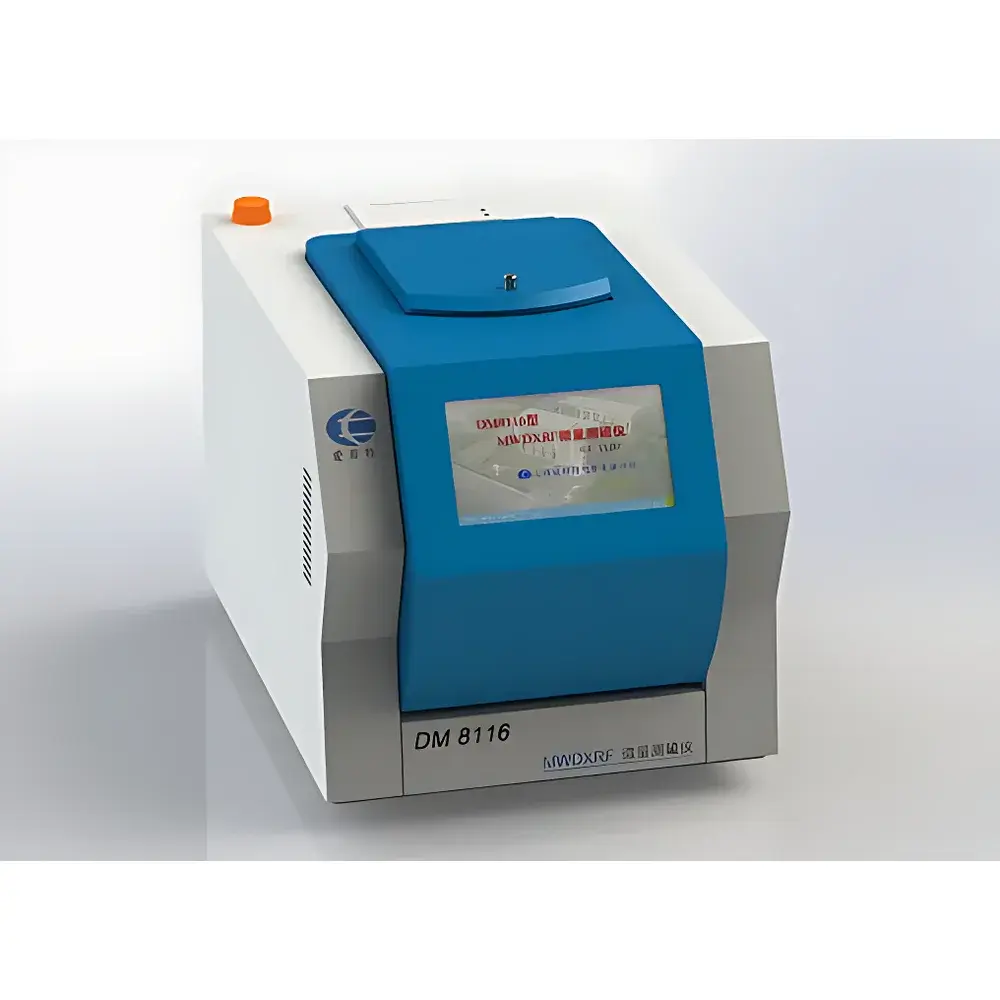
AST DM8116 Monochromatic Excitation Wavelength Dispersive X-Ray Fluorescence (MWDXRF) Sulfur Analyzer
| [Brand | AST |
|---|---|
| Origin | Shanghai, China |
| Model | DM8116 |
| Detection Target | Total Sulfur |
| Detection Limit (300 s) | 0.33 ppm |
| X-ray Tube | Ag anode, ≤50 kV / ≤2 mA / ≤50 W, micro-focus, thin Be window |
| Crystal | Logarithmic Spiral Doubly Curved Crystal (LSDCC) |
| Detector | Ultra-thin Be window proportional counter |
| Standards Compliance | GB/T 11140, ISO 20884, SH/T 0842, ASTM D2622, ASTM D7039, ASTM D7220 |
| Measurement Range | 3×LOD to 9.99 wt% |
| Analysis Time | 1–999 s (recommended: 300 s for trace, 60 s for major) |
| Operating Environment | 5–40 °C, ≤85% RH at 30 °C, 220 V ±20 V, 50 Hz, ≤200 W |
| Dimensions & Weight | 330 × 460 × 350 mm, 25 kg] |
Overview
The AST DM8116 is a benchtop monochromatic excitation wavelength dispersive X-ray fluorescence (MWDXRF) sulfur analyzer engineered for ultra-trace total sulfur quantification in petroleum liquids—specifically formulated to meet the stringent regulatory requirements of China VI, Euro 5/6, and U.S. EPA Tier 3 fuel specifications. Unlike energy-dispersive (EDXRF) or conventional high-power wavelength-dispersive (WDXRF) systems, the DM8116 employs point-to-point focused monochromatic excitation and detection optics, enabling sub-ppm sulfur detection without combustion, dilution, or chemical reagents. Its core measurement principle relies on selective excitation of sulfur Kα (2.308 keV) using a highly collimated, monochromatized Ag Kα line (22.1 keV), generated via a micro-focus Ag-target X-ray tube and filtered through a proprietary logarithmic spiral doubly curved crystal (LSDCC). This architecture suppresses bremsstrahlung background by >90% while amplifying signal intensity through three-dimensional focusing in both excitation and emission paths—resulting in a measured detection limit of 0.33 ppm at 300 s counting time (3σ, ASTM D7039 protocol).
Key Features
- Monochromatic excitation MWDXRF architecture with dual point-to-point focusing optics for optimized signal-to-background ratio
- Proprietary DM30L artificial LSDCC crystal delivering 3–10× higher integrated diffraction efficiency than natural crystals, with no grinding or拼接 required
- Ag-anode, 50 W micro-focus X-ray tube with thin beryllium window and dynamically optimized kV/mA settings for maximal S K-edge excitation efficiency
- Digital pulse height analysis (PHA) with automatic gain stabilization, real-time drift correction, and spectral baseline compensation
- Self-contained purge gas system (He or internal N₂ fill) ensuring consistent atmospheric control during measurement
- Touchscreen-driven embedded OS with one-button operation, preloaded calibration curves, and GLP-compliant audit trail logging
- Radiation shielding certified to national exemption-level requirements (GBZ 188–2014), eliminating need for external interlocks or licensing
Sample Compatibility & Compliance
The DM8116 accepts liquid hydrocarbon samples in standard 32-mm polyethylene or quartz sample cups (10–20 mL volume), requiring no digestion, ashing, or catalyst addition. It is validated for gasoline, diesel, jet fuel, naphtha, lubricant base oils, biodiesel blends, and residual fuel oils—including high-viscosity and low-volatility matrices. All performance claims (LOD, precision, accuracy) are verified per ASTM D7039 Annex A1 and ISO 20884 Annex B protocols using CRM-certified reference materials traceable to NIST SRM 2723c and IFIA standards. The instrument meets full compliance with GB/T 11140 (China), SH/T 0842 (China Petrochemical), ASTM D2622 (WDXRF sulfur), ASTM D7039 (MWDXRF sulfur), ASTM D7220 (low-sulfur diesel), and ISO 20884 (automotive fuels). Data integrity supports 21 CFR Part 11 readiness through electronic signature-capable software with user access levels, change logs, and immutable result archives.
Software & Data Management
The embedded firmware runs a deterministic real-time OS with dedicated spectral processing algorithms—including peak deconvolution, matrix correction via empirical coefficient fitting, and non-linear calibration curve generation (R² > 0.999 across 0.5–10,000 ppm range). Raw spectra, processed results, instrument parameters, and environmental metadata are stored in encrypted SQLite databases with timestamped revision history. Export options include CSV, PDF analytical reports (with QA/QC flags), and XML for LIMS integration. Optional PC-based desktop software provides advanced diagnostics, multi-instrument fleet monitoring, method transfer validation packages, and automated report generation compliant with ISO/IEC 17025 documentation requirements.
Applications
- Refinery process stream monitoring: hydrotreater feed/product, FCC slurry, coker naphtha
- Fuel quality assurance: batch release testing for gasoline, ULSD, marine distillate, and aviation turbine fuel
- Third-party certification labs: accredited testing per CNAS-CL01, UKAS, or A2LA scopes
- Lubricant additive formulation: quantification of sulfur-containing anti-wear agents (e.g., ZDDP)
- Research & development: catalyst poisoning studies, sulfur speciation correlation (via complementary GC-SCD), and alternative fuel screening (e.g., bio-oils, pyrolysis liquids)
- Regulatory enforcement: field-deployable verification of sulfur content in retail fuel dispensers and storage terminals
FAQ
What sulfur concentration ranges can the DM8116 accurately quantify?
It measures total sulfur from 0.33 ppm (3σ LOD, 300 s) up to 9.99 wt%, with optimal precision between 1 ppm and 5,000 ppm.
Does the instrument require helium or vacuum operation?
No vacuum pump is needed; it operates under ambient air, He flush, or internal N₂ purge—user-selectable based on sensitivity requirements and lab infrastructure.
How is calibration maintained over time?
Calibration stability is ensured via daily automated background check, optional internal standard monitoring, and drift-compensated spectral fitting—no manual recalibration required for ≥30 days under typical lab conditions.
Can the DM8116 analyze solid or viscous samples?
Yes—when homogenized and presented as thin films or pressed pellets (e.g., catalysts, rubber, polymers), though liquid fuel applications represent its primary validated use case per ASTM and ISO methods.
Is method validation support available for regulatory submissions?
AST provides IQ/OQ documentation templates, ASTM D7039-specific validation protocols, and technical assistance for method transfer to ISO/IEC 17025-accredited laboratories.




