
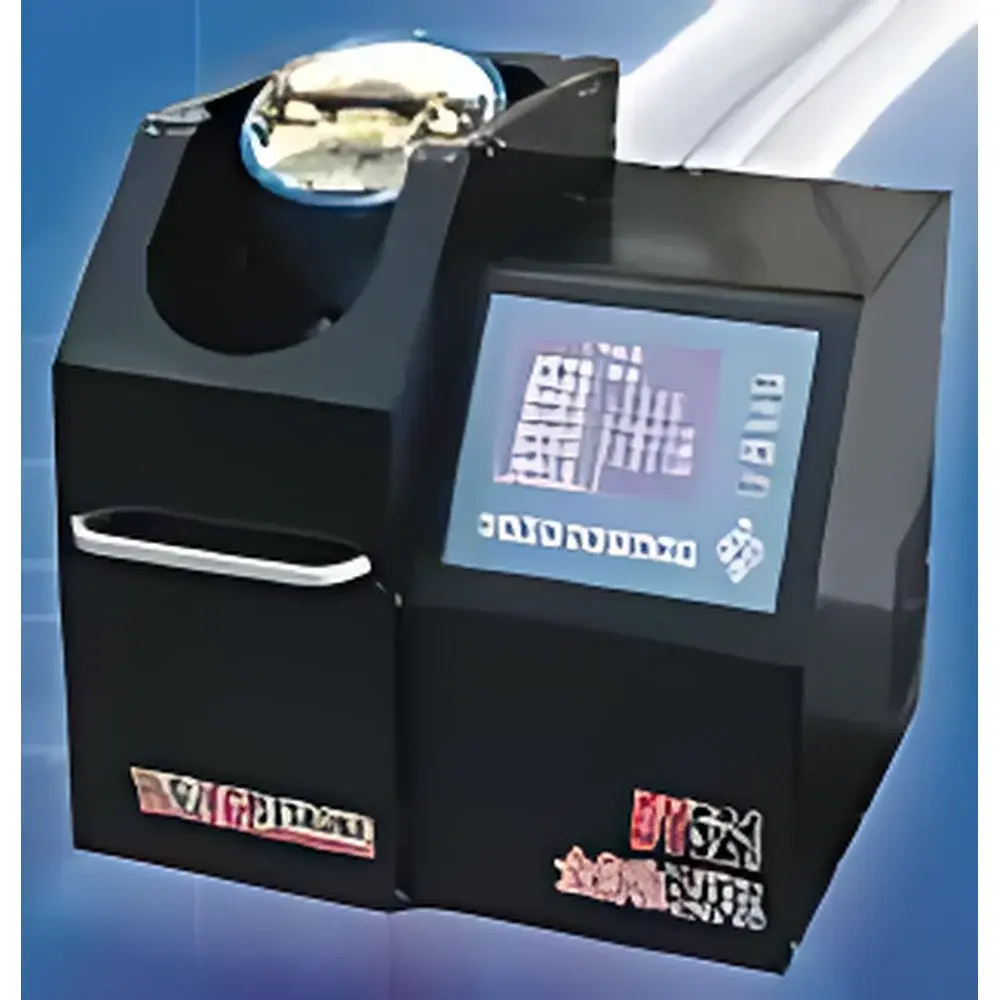
Yuso DY521 Fully Automatic XRF Fusion Machine
| Brand | Yuso |
|---|---|
| Origin | Shanghai, China |
| Model | DY521 |
| Max Operating Temperature | 1250 °C (continuously adjustable) |
| Temperature Sensing | Dual Pt-Rh thermocouples (rated to 1600 °C) |
| Sample Throughput | 5–7 samples/hour |
| Power Rating | 1200 W |
| Input Voltage | AC 220–240 V, 50–60 Hz |
| Dimensions (H×W×D) | 430 mm × 410 mm × 430 mm |
| Weight | 27 kg |
| Compliance | Designed for ISO 8289-1, ASTM E1323, and USP <731> fusion sample preparation protocols |
| Software | Embedded microcontroller with 10 programmable fusion profiles, real-time thermal monitoring, and audit-trail-capable event logging (21 CFR Part 11–ready firmware architecture) |
Overview
The Yuso DY521 Fully Automatic XRF Fusion Machine is an electric-resistance-heated, platinum-crucible-based fusion system engineered for precision glass bead preparation in wavelength-dispersive (WDXRF) and energy-dispersive (EDXRF) spectrometry laboratories. It operates on the principle of controlled high-temperature flux-assisted dissolution—typically using lithium tetraborate (Li₂B₄O₇), lithium metaborate (LiBO₂), or mixed-flux systems—to convert solid geological, metallurgical, cement, or environmental samples into homogeneous, bubble-free glass discs. Unlike high-frequency induction or gas-fired fusion units, the DY521 eliminates electromagnetic field exposure, water-cooling infrastructure, and combustion byproducts. Its Joule-effect heating architecture ensures stable thermal ramping, minimal thermal inertia, and repeatable crucible/mold temperature decoupling—critical for minimizing matrix-induced absorption/enhancement effects and achieving sub-0.5% RSD in major-element quantification across multi-sample batches.
Key Features
- Fully automated fusion cycle—including flux/sample weighing (when integrated with optional balance interface), crucible loading, pre-oxidation, fusion, homogenization, pouring, and mold cooling—executed without operator intervention.
- Dual independent heating zones: one for the Pt/Pt-Rh crucible (max 1250 °C), another for the graphite or platinum mold (temp-controlled to ±2 °C), each monitored by dedicated Pt-Rh thermocouples in direct contact.
- Inclined rotational agitation: crucible rotates at user-defined RPM (5–30 rpm) starting from 600 °C, ensuring rapid melt homogenization while minimizing volatilization loss of alkalis and halogens.
- Separate fusion and molding stages: prevents mechanical abrasion of mold surfaces during melting, preserving long-term surface finish (>3 months without polishing) and eliminating Pt loss associated with combined crucible-mold designs.
- Overlapped processing mode: initiates heating of the second sample while the first cools in the mold, increasing effective throughput by up to 50% versus sequential-only systems.
- Energy-optimized thermal design: high-efficiency ceramic fiber insulation and compact furnace geometry limit standby power draw to <15 W; full-cycle energy consumption averages 0.8–1.1 kWh per sample—less than standard laboratory hair dryers.
- Plug-and-play operation: requires only a standard 220–240 V/10 A outlet; no external chillers, gas lines, or RF shielding required.
- 10-user-programmable fusion methods stored onboard, each configurable for ramp rates (0.5–20 °C/min), hold times (0–120 min), rotation onset temperature, forced-air cooling activation, and fan speed (0–100%).
Sample Compatibility & Compliance
The DY521 supports fusion of silicates, oxides, sulfides, carbonates, and refractory metals using conventional alkaline fluxes (e.g., Li₂B₄O₇, LiBO₂, Na₂CO₃, K₂S₂O₇) as well as peroxide and pyrosulfate techniques for Cr, Ni, or Fe-rich matrices. It accommodates standard 32 mm or 40 mm Pt-Au crucibles and matching graphite or Pt molds. All operational parameters comply with ISO 8289-1:2018 (XRF fusion bead preparation), ASTM E1323 (standard practice for sampling and analysis of heterogeneous materials), and USP (inorganic elemental impurities testing). Firmware includes timestamped event logging (start/stop, temperature deviations, rotation faults) meeting GLP/GMP documentation requirements and providing traceability for FDA 21 CFR Part 11–aligned workflows.
Software & Data Management
The embedded control system features a 5.7-inch TFT-LCD touchscreen with intuitive menu navigation, real-time dual-channel temperature graphs, and dynamic status indicators (heating phase, rotation active, pour sequence, cooling progress). All 10 method programs are editable via on-screen keypad or optional USB export/import. Audit trail functionality records operator ID (via optional RFID badge reader), method selection, parameter changes, and critical thermal excursions—exportable as CSV for LIMS integration. No proprietary software installation is required; configuration files are human-readable and compatible with common laboratory data management platforms.
Applications
Primary use cases include routine preparation of fused beads for XRF analysis in mining QA/QC labs, cement plant process control, scrap metal recycling, and geochemical surveying. Secondary applications encompass dissolution of refractory samples for ICP-OES/MS analysis (e.g., zircon, chromite, bauxite), AA determination of trace metals in soils, and wet-chemistry validation studies requiring complete matrix breakdown. The system’s low thermal mass and precise mold temperature control make it especially suitable for preparing low-melting-point standards (e.g., borosilicate glasses) and certified reference materials where thermal history directly impacts stoichiometric fidelity.
FAQ
What types of fluxes are compatible with the DY521?
Lithium tetraborate, lithium metaborate, sodium carbonate, potassium pyrosulfate, and sodium peroxide—either individually or as binary/ternary mixtures—are fully supported. Flux ratios and addition sequences follow established ASTM and ISO guidelines.
Can the DY521 be integrated with an automated sample handler or balance?
Yes—RS-232 and optional Ethernet interfaces enable bidirectional communication with third-party lab automation systems and analytical balances for unattended batch processing.
Is calibration of the thermocouples required, and how often?
Factory-calibrated Pt-Rh thermocouples maintain accuracy within ±1.5 °C up to 1200 °C; annual verification against NIST-traceable reference standards is recommended per ISO/IEC 17025.
Does the system support custom mold geometries beyond standard disc formats?
Standard configurations support 32 mm and 40 mm diameter molds; custom graphite or Pt molds (e.g., rectangular, multi-cavity) can be accommodated upon mechanical specification submission.
What maintenance is required for long-term reliability?
No scheduled consumables; periodic visual inspection of heating elements and thermocouple sheaths every 6 months is sufficient. The absence of moving parts beyond the rotation motor contributes to >10,000-hour MTBF.



