
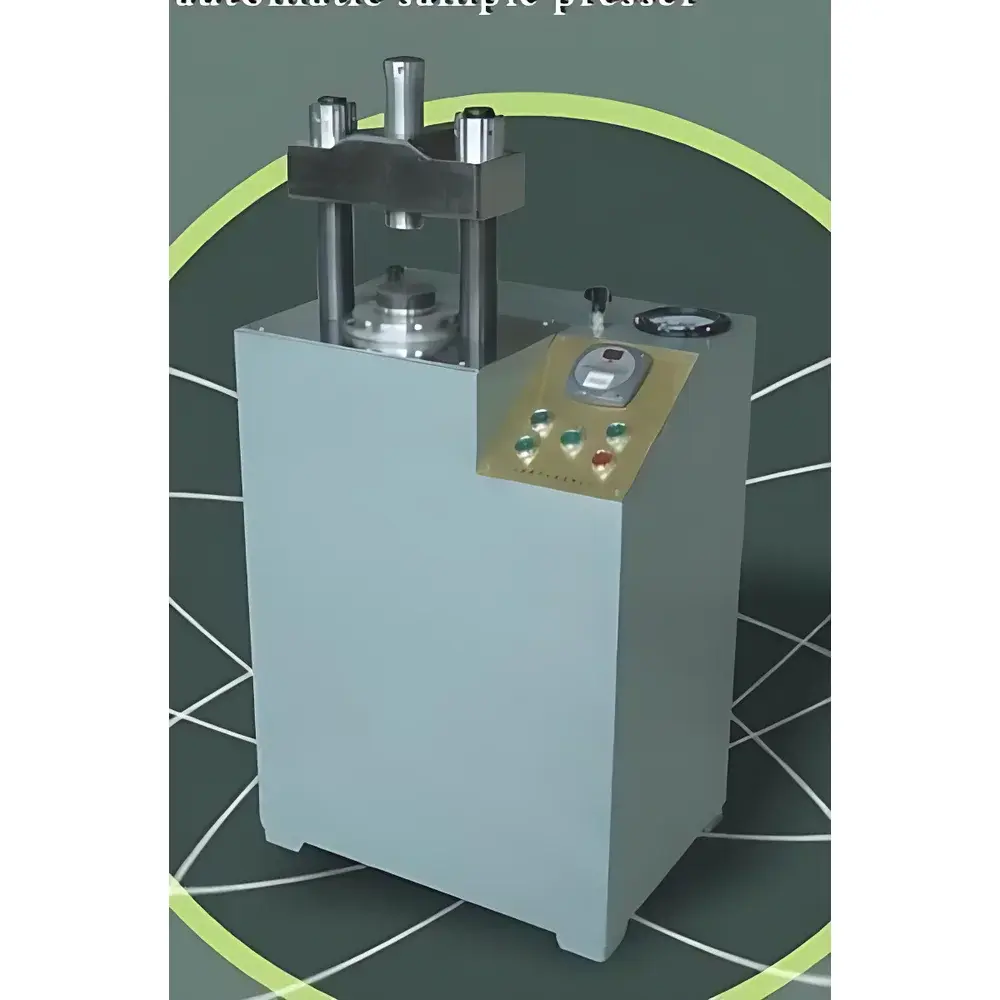
Shengli SL201 Semi-Automatic Hydraulic Pellet Press
| Key | Rated Pressure: 400 kN (600 kN for SL201A) |
|---|---|
| Pressure Holding Time | 1–999 s |
| Worktable Diameter | φ82 mm |
| Max. Travel | 50 mm |
| Pole Opening Span | 210 mm |
| Dimensions (L×W×H) | 570 × 420 × 1120 mm |
| Net Weight | 185 kg |
| Power | 1.1 kW |
| Supply | AC 380 V, 50/60 Hz, 3-phase |
Overview
The Shengli SL201 Semi-Automatic Hydraulic Pellet Press is an engineered solution for reproducible, high-integrity sample preparation in wavelength-dispersive (WDXRF) and energy-dispersive X-ray fluorescence (EDXRF) spectroscopy workflows. It operates on a closed-loop hydraulic principle with dynamic pressure regulation—ensuring true constant-force compaction during the holding phase, unlike static-pressure systems that exhibit gradual decay due to fluid compressibility and seal relaxation. Designed for routine use in certified laboratories performing elemental analysis of powdered materials, the SL201 delivers consistent pellet density, surface flatness, and mechanical stability—critical parameters influencing XRF excitation efficiency, background scatter, and quantitative accuracy per ISO 20053:2020 and ASTM E1361-22. Its integrated hydraulic manifold architecture minimizes volumetric leakage paths, enhancing long-term calibration stability and reducing maintenance intervals.
Key Features
- Dynamic pressure control system maintains set force within ±0.5% deviation throughout the full holding duration (1–999 s), enabling compliance with GLP traceability requirements for method validation.
- Modular die interface accommodates standardized pellet molds—including aluminum sample cups, polyethylene (LDPE) rings, boric acid matrix rings, plastic spacers, and patented steel-ring tooling—each designed for rapid loading, ejection, and residue-free cleaning between runs.
- Digital pressure and travel monitoring via front-panel LED display provides real-time feedback on system working pressure (MPa) and applied load (kN), supporting immediate troubleshooting and audit-ready operational logs.
- Emergency stop functionality interrupts automatic cycle progression at any stage and returns the ram to its home position, satisfying IEC 61000-6-2 electromagnetic compatibility and functional safety expectations for laboratory equipment.
- Compact footprint (570 × 420 × 1120 mm) and reduced mass (185 kg) result from fully integrated hydraulic valving and optimized structural casting—achieving >30% space savings versus conventional three-valve manifold designs without compromising rigidity or thermal drift performance.
Sample Compatibility & Compliance
The SL201 supports homogeneous powder compaction across diverse matrices: geological silicates, metallurgical slags, cement clinkers, polymer additives, catalysts, and pharmaceutical excipients. Die compatibility extends to ISO 4787-compliant 32 mm and 40 mm diameter pellets, with optional custom tooling available for non-standard geometries. All contact surfaces are passivated stainless steel or anodized aluminum to prevent cross-contamination. The unit meets CE marking requirements under Machinery Directive 2006/42/EC and EMC Directive 2014/30/EU. Its pressure control algorithm and data logging capability align with FDA 21 CFR Part 11 readiness when paired with validated third-party software, supporting audit trails for GMP-regulated environments.
Software & Data Management
While the SL201 operates as a standalone press with local HMI control, it features RS-232 and optional Ethernet connectivity for integration into centralized lab management systems (LIMS). Pressure vs. time profiles can be exported in CSV format for post-run analysis in MATLAB, Python (NumPy/Pandas), or JMP. Firmware updates are performed via USB flash drive, ensuring version control and configuration integrity. Audit trail generation—including operator ID, timestamp, setpoint values, actual force achieved, and cycle completion status—is supported through external SCADA linkage, fulfilling ALCOA+ data integrity principles.
Applications
- Routine XRF calibration standard preparation using pressed borate fusion beads or binder-free mineral powders.
- Quality control of incoming raw materials in cement and steel production, where pellet homogeneity directly impacts SiO₂, CaO, Fe₂O₃ quantification uncertainty.
- Environmental soil testing labs preparing EPA Method 6200-compliant pressed pellets for heavy metal screening (Pb, Cd, As, Cr).
- Academic research labs conducting comparative studies on compaction-induced crystallinity changes (via concurrent XRD/XRF) in battery cathode precursors.
- Contract testing facilities requiring multi-client traceability: each press cycle stores metadata for full chain-of-custody documentation.
FAQ
What is the maximum recommended pellet density achievable with the SL201 using common geological powders?
Typical densities range from 2.2–2.8 g/cm³ for silicate matrices at 300–400 kN; exact values depend on particle size distribution, moisture content, and dwell time—validated per ISO 12885 Annex B protocols.
Does the SL201 support programmable multi-step pressing sequences (e.g., pre-press → hold → re-press)?
No—SL201 implements single-stage compression with adjustable pressure, hold time, and travel limit; multi-step logic requires external PLC integration via digital I/O ports.
Are replacement dies and O-rings available as genuine spare parts with documented lot traceability?
Yes—Shengli supplies calibrated steel-ring dies with serial-numbered certificates of conformity, and all elastomeric seals comply with USP Class VI biocompatibility standards.
Can the SL201 be operated in a nitrogen-purged glovebox environment?
Yes—the unit’s electrical enclosure meets IP54 ingress protection, and hydraulic oil (ISO VG 46 anti-wear) is compatible with inert atmospheres; optional explosion-proof motor upgrade available upon request.
How frequently must the hydraulic system be serviced to maintain ±1% force accuracy?
Annual recalibration of the load cell and pressure transducer is recommended; hydraulic oil replacement every 24 months or 2,000 operating hours—whichever occurs first—per ISO 4406:2022 cleanliness code 18/16/13.



