
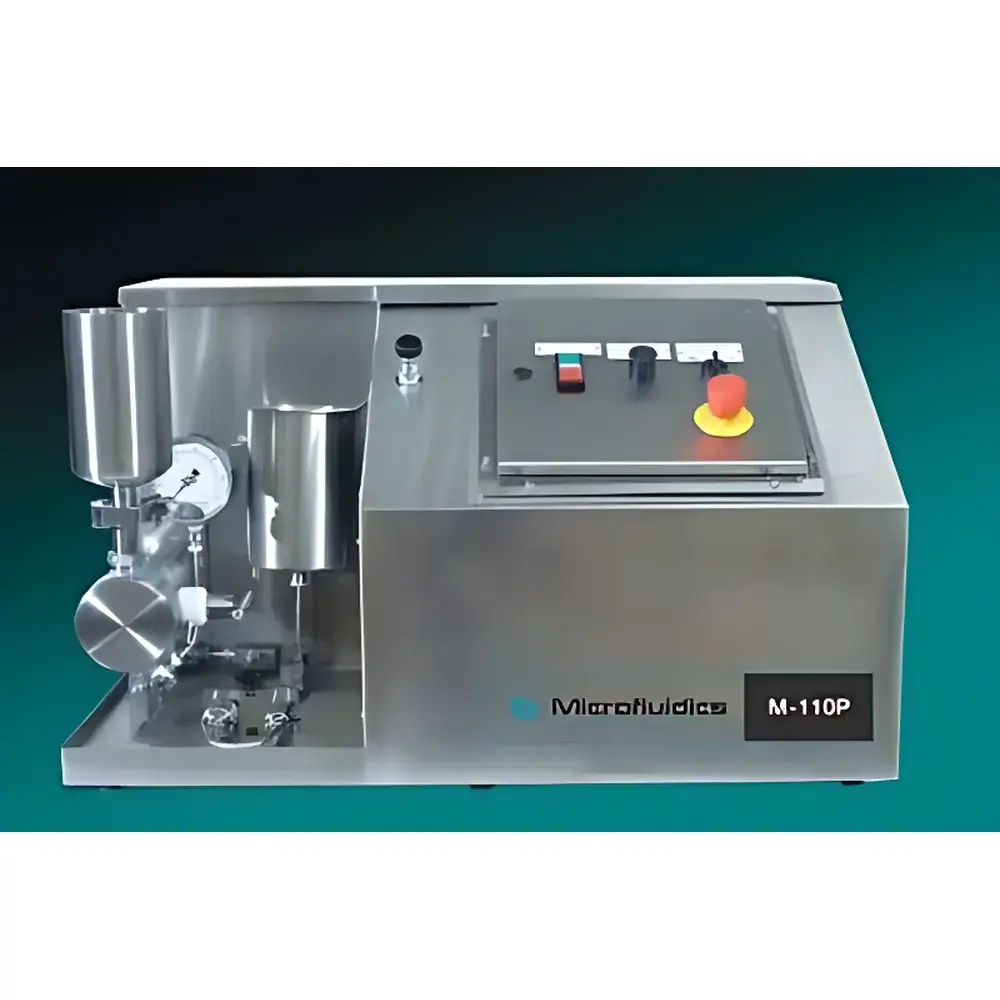
Microfluidics M-110P Benchtop High-Pressure Microfluidizer
| Origin | USA |
|---|---|
| Manufacturer Type | Authorized Distributor |
| Origin Category | Imported |
| Model | M-110P |
| Pricing | Available Upon Request |
Overview
The Microfluidics M-110P is a precision-engineered benchtop high-pressure microfluidizer designed for laboratory-scale nanoscale homogenization, dispersion, and cell disruption. It operates on the principle of microfluidization—forcing sample suspensions through fixed-geometry interaction chambers at ultra-high pressures (up to 30,000 psi), where controlled turbulent flow, shear, cavitation, and impact forces act synergistically to achieve consistent sub-200 nm particle size reduction. Unlike conventional rotor-stator or ultrasonic homogenizers, the M-110P delivers deterministic, repeatable processing outcomes due to its patented constant-pressure hydraulic drive system and rigid, non-adjustable interaction chamber geometry. This architecture eliminates pressure pulsation and ensures uniform energy input per pass—critical for reproducible nanoformulation development, especially in pharmaceutical, biotechnology, and advanced materials research.
Key Features
- Patented diamond-based interaction chamber (U.S. Patent No. US6729754B1) offering exceptional wear resistance, chemical inertness, and thermal stability—ensuring long-term dimensional integrity and consistent shear profiles across thousands of operating hours.
- Hydraulic-driven intensifier pump delivering stable, pulse-free pressure up to 30,000 psi (207 MPa), powered by standard 220 V AC supply—enabling precise control without external nitrogen or compressed air sources.
- Zirconia (ZrO₂) ceramic plunger assembly providing superior corrosion resistance against aggressive solvents, acidic/basic buffers, and biological matrices—minimizing metal leaching and cross-contamination risk.
- Integrated inline temperature monitoring and active cooling loop, allowing real-time thermal management during extended processing cycles to prevent heat-induced degradation of thermolabile biomolecules or polymers.
- Minimal process volume requirement: only 25 mL sample volume needed for full system priming and effective processing—ideal for precious or low-yield formulations such as mRNA-LNPs, viral vectors, or experimental nanocarriers.
- Processing throughput of 110–150 mL/min at maximum pressure, supporting rapid iterative optimization and scalable parameter translation to pilot- and production-scale Microfluidics systems (e.g., M-120Y, M-210).
Sample Compatibility & Compliance
The M-110P accommodates a broad range of sample types including oil-in-water and water-in-oil emulsions, polymeric nanoparticle dispersions, liposomal suspensions, protein aggregates, bacterial and mammalian cell lysates, and colloidal inorganic nanomaterials (e.g., quantum dots, metal oxides). Its all-wetted-path construction—comprising 316L stainless steel, zirconia, and synthetic diamond—meets stringent requirements for GMP-aligned lab environments. While the instrument itself is not FDA-cleared, its design supports compliance with ICH Q5A (viral clearance), USP (particulate matter), ISO 22412 (dynamic light scattering validation), and ASTM D7857 (nanomaterial dispersion stability testing). Full audit trails, user access control, and electronic signature readiness can be implemented via optional integration with validated LIMS or ELN platforms adhering to 21 CFR Part 11.
Software & Data Management
The M-110P operates via an intuitive front-panel interface with programmable pressure setpoints, total processing time, number of passes, and temperature thresholds. All operational parameters—including actual pressure trace, inlet/outlet temperature, cumulative flow volume, and motor load—are logged in timestamped CSV format for post-run analysis. Optional Ethernet connectivity enables remote monitoring and data export to centralized QA/QC databases. When deployed within regulated workflows, the system supports GLP-compliant documentation practices, including operator ID logging, method versioning, and deviation flagging—facilitating straightforward inspection readiness for internal audits or regulatory submissions.
Applications
- Nanomedicine development: Preparation of uniform lipid nanoparticles (LNPs) for siRNA/mRNA delivery; stabilization of nanocrystalline drug suspensions per USP .
- Bioprocessing: High-efficiency lysis of E. coli, yeast, and CHO cells with >95% disruption efficiency in a single pass—reducing protease exposure and improving target protein recovery.
- Materials science: Exfoliation of 2D nanomaterials (graphene, MXenes); synthesis of monodisperse metal-organic frameworks (MOFs) and perovskite nanocrystals.
- Food & cosmetics: Production of cold-emulsified nanoemulsions with enhanced bioavailability and shelf-life stability under ISO 22000-aligned protocols.
- Quality control: Batch-to-batch consistency verification for nanoscale products using dynamic light scattering (DLS), TEM, or nanoparticle tracking analysis (NTA).
FAQ
What is the minimum recommended sample volume for reliable operation?
The M-110P requires a minimum of 25 mL to ensure complete wetting of the interaction chamber and stable pressure build-up without air entrapment.
Can the system be validated for GMP manufacturing support?
Yes—while classified as a laboratory instrument, its mechanical robustness, traceable calibration paths, and data integrity features enable qualification (IQ/OQ/PQ) per ASTM E2500 and Annex 11 guidelines when integrated into controlled environments.
Is the diamond interaction chamber replaceable, and what is its typical service life?
The chamber is field-replaceable and rated for ≥500 hours of continuous operation at 25,000–30,000 psi with aqueous buffers; lifespan extends significantly with low-abrasion formulations.
Does the M-110P support sterile processing?
Sterility is achievable via pre-sterilized disposable tubing kits and SIP-compatible chamber housings—though full aseptic validation must be performed by the end user per ISO 13408-1.
How does scaling from M-110P to production equipment work?
Microfluidics’ scale-up methodology relies on constant specific energy input (kJ/L) and identical interaction chamber geometry—ensuring direct linear translation of pressure, flow rate, and pass number to larger systems such as the M-210 or industrial M-725.



