
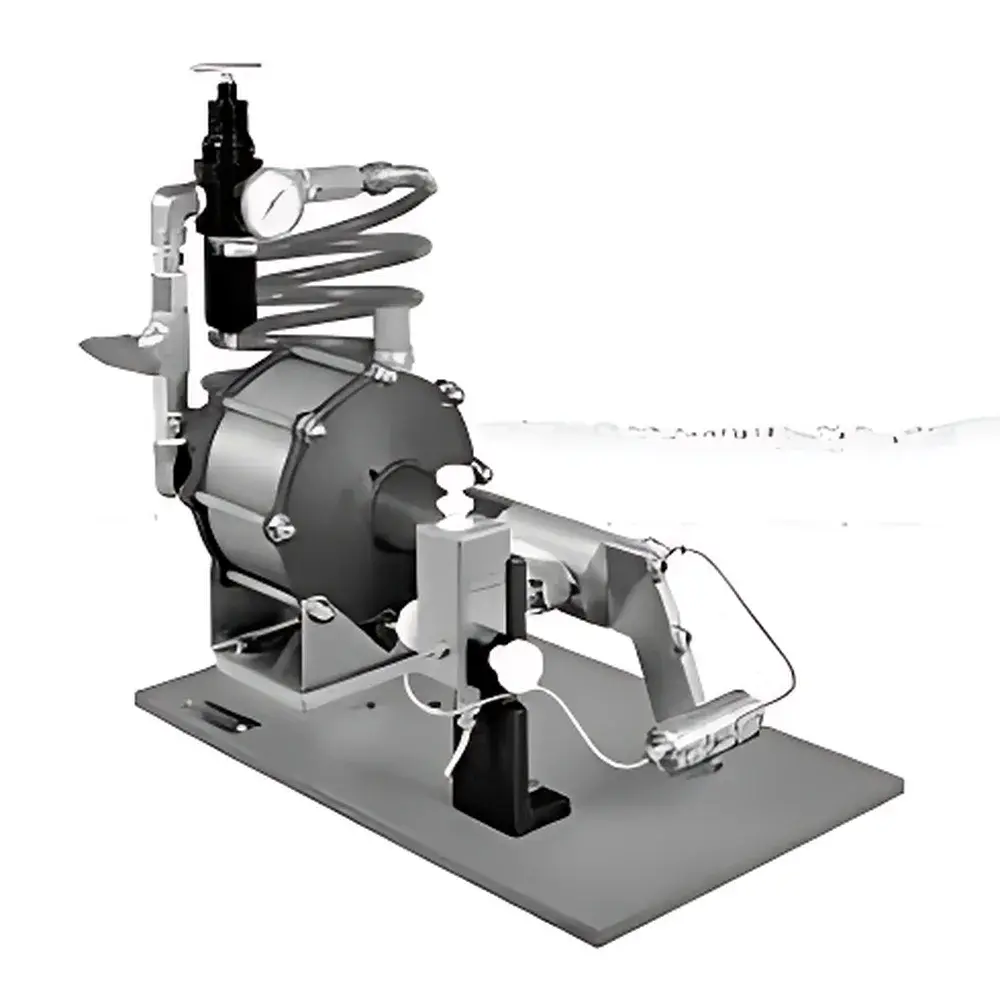
Microfluidics M-110S High-Pressure Microfluidizer Nanosizer (Laboratory Homogenizer)
| Origin | USA |
|---|---|
| Manufacturer Type | Authorized Distributor |
| Origin Category | Imported |
| Model | M-110S |
| Pricing | Available Upon Request |
| Operating Pressure Range | 3,000–23,000 psi (20.7–158.6 MPa) |
| Flow Rate | 200–600 mL/min |
| Max Feed Temperature | 75 °C |
| Minimum Sample Volume | 14 mL |
| Compressed Air Requirement | 120 psi @ 50 scfm, dew point 0–35 °F, 15 hp (11 kW) |
| Dimensions | 58 × 53 × 58 cm |
| Weight | 25 kg |
| Interaction Chamber | Fixed-geometry microchannel geometry, no moving parts |
| Cooling | Integrated mobile chiller unit |
| Material Contact | 316 stainless steel fluid path |
| Regulatory Compliance | Designed for GLP-compliant labs |
Overview
The Microfluidics M-110S High-Pressure Microfluidizer Nanosizer is a benchtop, air-driven homogenization system engineered for precise nanoscale particle size reduction and uniform dispersion of complex formulations. Unlike conventional rotor-stator or valve-based homogenizers, the M-110S employs a fixed-geometry interaction chamber—based on the principle of controlled microfluidic impingement—to subject samples to consistent, reproducible shear, cavitation, and impact forces at pressures up to 23,000 psi (158.6 MPa). This deterministic hydrodynamic process enables sub-100 nm particle generation with narrow polydispersity index (PDI), essential for stable colloidal systems in biopharmaceutical development, nanomedicine formulation, and advanced materials research. Its compact footprint, low minimum sample volume (14 mL), and compatibility with temperature-sensitive actives make it ideal for early-stage R&D where material conservation and scalability assurance are critical.
Key Features
- Fixed-geometry ceramic or diamond-coated interaction chamber with no moving internal components—ensuring long-term geometric fidelity, zero wear-induced performance drift, and exceptional batch-to-batch reproducibility.
- Scalable pressure control from 3,000 to 23,000 psi via precision-regulated compressed air supply, enabling method optimization across viscosity ranges and formulation classes.
- Integrated mobile cooling system maintains sample temperature ≤75 °C during continuous operation, preserving thermolabile biomolecules including proteins, mRNA, and liposomal payloads.
- 25 mL stainless steel (316 SS) reservoir with integrated level sensor and recirculation capability for efficient processing of small-volume, high-value samples.
- Single-pass cell disruption efficiency ≥95% for bacterial, yeast, and mammalian cells—achieved without enzymatic additives or chemical lysis agents, minimizing downstream contamination risk.
- Linear scale-up pathway validated from M-110S to pilot-scale M-725 and production-scale M-110EH systems, supporting seamless technology transfer under ICH Q5A and Q5C guidelines.
- CE-marked enclosure with explosion-proof pneumatic circuitry and emergency depressurization valve compliant with ATEX Zone 2/22 requirements for solvent-based or volatile formulations.
Sample Compatibility & Compliance
The M-110S processes aqueous and organic-phase suspensions, emulsions, liposomes, polymeric nanoparticles, protein aggregates, and cell lysates without cross-contamination. Fluid-contact surfaces consist exclusively of electropolished 316 stainless steel and chemically inert ceramics, meeting USP Class VI and ISO 10993-5 biocompatibility standards. The system operates within defined parameters aligned with ASTM F2337 (Standard Practice for Sterilization of Medical Devices Using Microfluidization), and its repeatable energy input profile supports validation per ISO 22442-1 for animal-derived material processing. When operated with traceable pressure logging and electronic batch records, it satisfies core elements of FDA 21 CFR Part 11 for electronic signatures and audit trails in regulated GMP environments.
Software & Data Management
While the M-110S operates as a standalone pneumatic instrument, optional digital instrumentation kits enable real-time monitoring of inlet pressure, flow rate, and coolant temperature via analog 4–20 mA outputs. These signals integrate with LabArchives ELN, DeltaV DCS, or custom SCADA platforms for automated data capture, trending, and deviation alerting. All operational parameters—including total run time, cumulative pressure cycles, and thermal history—are logged to non-volatile memory for retrospective review during regulatory audits. Firmware updates follow IEC 62304 Class B medical device software lifecycle protocols, ensuring ongoing compliance with evolving quality system requirements.
Applications
- Nanoprecipitation and homogenization of lipid nanoparticles (LNPs) for mRNA vaccine development.
- Size reduction and stabilization of poorly water-soluble drug compounds (BCS Class II/IV) into nanosuspensions meeting USP <724> dissolution criteria.
- Preparation of uniform liposomal carriers with encapsulation efficiency >90% and PDI <0.15.
- High-yield, non-denaturing extraction of intracellular enzymes, inclusion bodies, and exosomes.
- Dispersion of carbon nanotubes, graphene oxide, and metal-organic frameworks (MOFs) in polymer matrices for functional composites.
- Routine QC homogenization of reference standards and calibration suspensions for DLS, NTA, and SEM particle sizing validation.
FAQ
What is the smallest recommended sample volume for reliable processing?
The minimum effective volume is 14 mL, yielding ≥12 mL of processed output after system holdup volume compensation.
Can the M-110S be used for sterile processing?
Yes—when coupled with pre-sterilized single-use fluid paths and validated SIP protocols, it supports aseptic nanomanufacturing under ISO 13408-1.
How does the fixed-geometry chamber differ from adjustable valve homogenizers?
Unlike spring-loaded or hydraulic valves that drift with wear and temperature, the M-110S chamber’s microchannel dimensions remain invariant, delivering identical energy density per pass across thousands of operating hours.
Is training and method development support available?
Microfluidics-certified application scientists provide remote and on-site protocol optimization, DOE-based parameter mapping, and tech transfer documentation aligned with ICH Q8(R2) and Q9 principles.
What maintenance intervals are recommended for routine operation?
Daily visual inspection of seals and air filters; quarterly calibration of pressure transducers and annual chamber wear assessment using profilometry—full service kits and OEM spare parts are stocked globally.



