
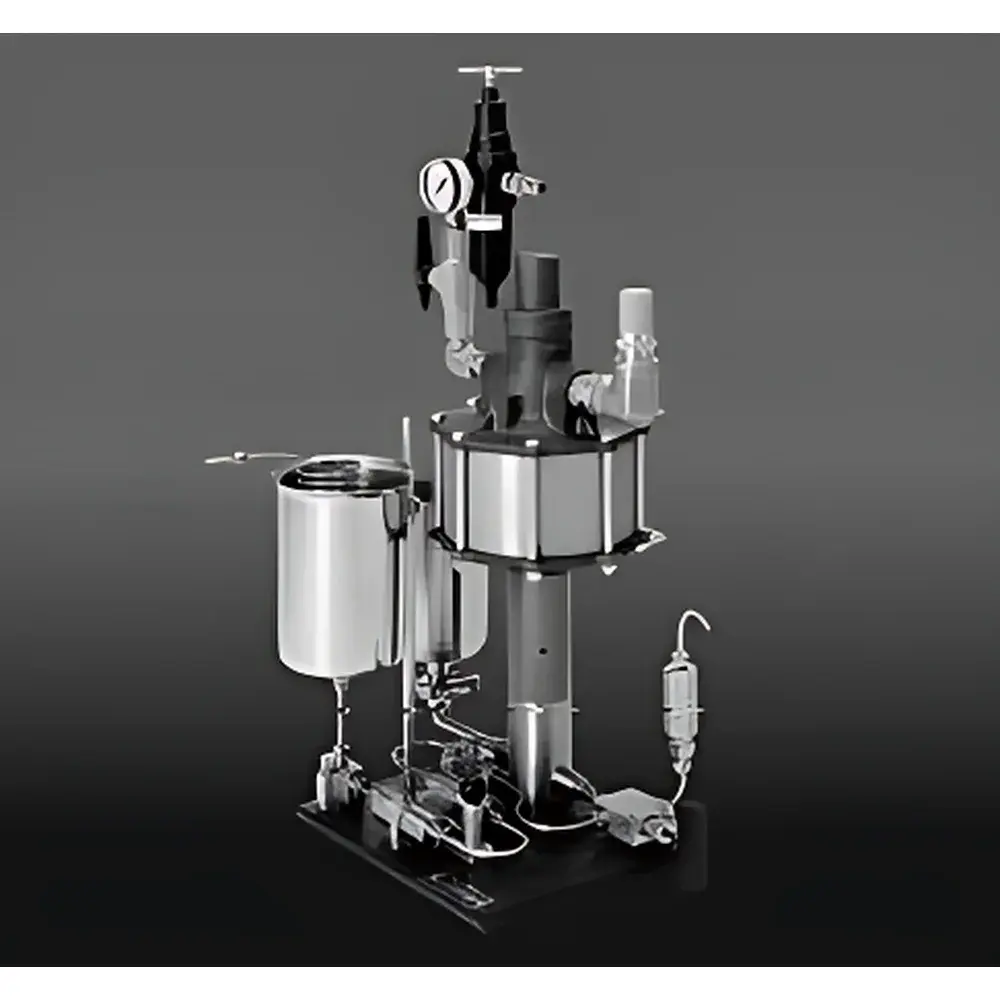
Microfluidics M-110Y High-Pressure Microfluidizer Nanoscale Homogenizer
| Origin | USA |
|---|---|
| Manufacturer Type | Authorized Distributor |
| Origin Category | Imported |
| Model | M-110Y |
| Pricing | Available Upon Request |
| Operating Pressure Range | 3,000–23,000 psi |
| Maximum Flow Rate | 250–600 mL/min |
| Feed Temperature Range | –25°C to +75°C |
| Minimum Sample Volume | 14 mL |
| Compressed Air Requirement | 57 scfm at 120 psi (15 hp / 11 kW) |
| Dimensions | 28 × 41 × 76 cm |
| Weight | 25 kg |
| Interaction Chamber Material | Diamond or Ceramic |
| Wetted Parts | 300-series Stainless Steel (Chromium-Plated Piston) |
| Integrated Cooling Coil | 17 ft (13 mL volume) |
| Cleaning | CIP-Compatible (Clean-in-Place) |
Overview
The Microfluidics M-110Y High-Pressure Microfluidizer Nanoscale Homogenizer is an air-driven, laboratory-scale microfluidization system engineered for reproducible, scalable nanoscale particle size reduction and homogenization. Unlike conventional rotor-stator or valve-based high-pressure homogenizers, the M-110Y employs a fixed-geometry interaction chamber—configured in either diamond or ceramic—to subject fluid streams to intense, controlled shear, cavitation, and impact forces under precisely regulated pressure (3,000–23,000 psi). This hydrodynamic principle enables uniform energy dissipation per unit volume, resulting in narrow particle size distributions (PSD) with modal diameters consistently below 100 nm. The system is widely deployed in preclinical formulation development, where batch-to-batch consistency, sterile process compatibility, and direct scalability to production-scale Microfluidizer platforms (e.g., M-110P, M-120F) are critical requirements.
Key Features
- Diamond or ceramic interaction chambers—engineered for extreme wear resistance and thermal stability—ensure long service life and consistent performance across thousands of processing cycles.
- Single-pass microbial and mammalian cell disruption efficiency exceeding 95%, preserving intracellular integrity and minimizing protein denaturation or nucleic acid shearing.
- Fully linear scale-up path: lab-scale M-110Y process parameters (pressure, flow rate, number of passes) directly translate to pilot and manufacturing systems without re-optimization.
- All fluid-contacting metallic surfaces constructed from electropolished 300-series stainless steel; piston surface chromium-plated to resist galling and corrosion under high-cycle operation.
- Integrated 17-foot stainless steel cooling coil (13 mL internal volume) maintains sample temperature within –25°C to +75°C during extended operation—critical for thermolabile biologics and lipid nanoparticles.
- Clean-in-Place (CIP) capability eliminates disassembly for routine sanitization; compatible with aqueous, alcohol-based, and low-concentration caustic cleaning protocols.
- Explosion-proof design (Class I, Division 1, Groups C & D compliant) and compact footprint (28 × 41 × 76 cm; 25 kg) support safe deployment in fume hoods, BSL-2 labs, and GMP-compliant cleanrooms.
Sample Compatibility & Compliance
The M-110Y accommodates a broad spectrum of complex formulations—including oil-in-water and water-in-oil emulsions, polymeric and lipid-based suspensions, liposomal dispersions, protein-loaded microcapsules, and viscous cell lysates—with solids content up to 40% w/w. Its robust architecture supports processing of shear-sensitive biomolecules (e.g., monoclonal antibodies, mRNA-LNPs, exosomes) while maintaining colloidal stability and functional activity. The system meets essential regulatory expectations for pharmaceutical development: wetted components comply with USP Class VI biocompatibility standards; surface finish (Ra ≤ 0.4 µm) satisfies ASME BPE-2022 requirements for hygienic design; and operational logging (via optional analog/digital pressure transducers) supports ALCOA+ data integrity principles aligned with FDA 21 CFR Part 11 and EU Annex 11.
Software & Data Management
While the base M-110Y operates via analog pressure regulation and manual flow control, it is fully compatible with third-party data acquisition systems for real-time monitoring of inlet pressure, outlet temperature, and cumulative processing time. When integrated with validated SCADA or LIMS platforms, the instrument supports full audit trails, electronic signatures, and automated report generation—enabling compliance with GLP and GMP documentation standards. Optional digital pressure controllers (e.g., Microfluidics PCD-2000) provide programmable pressure ramping, pass-count tracking, and CSV-exportable event logs for QC release documentation.
Applications
- Nanoprecipitation and size reduction of lipid nanoparticles (LNPs), solid lipid nanoparticles (SLNs), and nanostructured lipid carriers (NLCs) for mRNA and siRNA delivery.
- Preparation of stable sub-100 nm emulsions for topical, oral, and parenteral dosage forms—meeting USP & Ph. Eur. requirements for droplet size uniformity.
- High-yield, non-thermal lysis of Gram-negative and Gram-positive bacteria, yeast, and mammalian cells for recombinant protein extraction and organelle isolation.
- Homogenization of high-viscosity suspensions containing nanocrystals, metal oxides, quantum dots, or conductive polymers for advanced material synthesis.
- Manufacturing of uniform microcapsules and nanocapsules for controlled-release applications in agrochemicals, cosmetics, and nutraceuticals.
FAQ
What is the minimum viable sample volume for method development on the M-110Y?
The system requires a minimum of 14 mL to ensure stable flow dynamics and complete chamber filling—sufficient for initial formulation screening and DoE studies.
Can the M-110Y process heat-sensitive biologics without degradation?
Yes—the integrated 17-ft cooling coil, combined with adjustable flow rates and single-pass operation, enables precise thermal management; empirical validation shows <5°C temperature rise for typical LNP formulations at 15,000 psi.
Is the M-110Y suitable for GMP manufacturing environments?
It is qualified for R&D and clinical-stage manufacturing (Phase I–II); full GMP validation requires integration with qualified CIP/SIP systems, calibrated pressure/temperature sensors, and documented IQ/OQ/PQ protocols.
How does the diamond interaction chamber compare to ceramic in terms of lifetime and performance?
Diamond chambers exhibit >5× longer service life under abrasive conditions (e.g., TiO₂ suspensions) and deliver marginally tighter PSDs (<5% CV) due to superior dimensional stability and surface polish retention.
Does Microfluidics provide technical support for process transfer to larger-scale systems?
Yes—Microfluidics’ Application Science team offers formal scale-up studies, including comparative PSD analysis, zeta potential mapping, and stability profiling across M-110Y → M-110P → M-120F platforms.



