
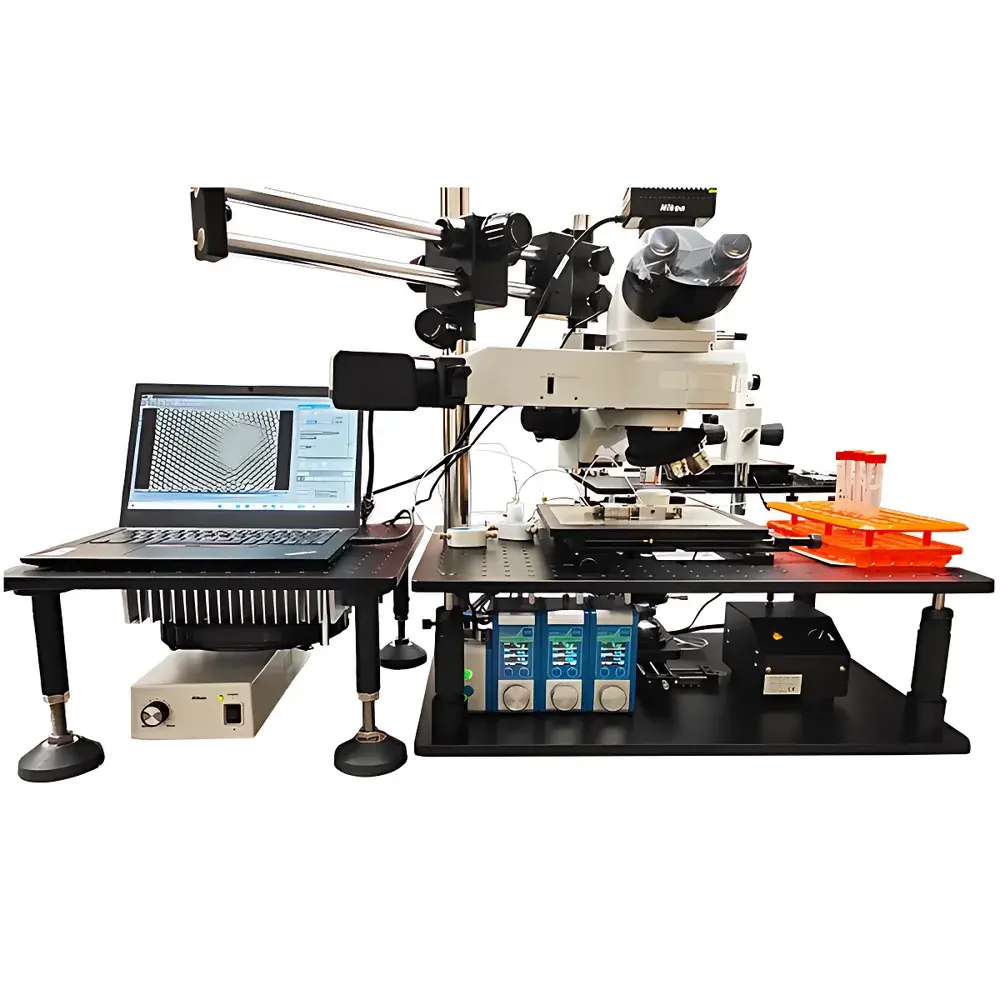
Microblox Microfluidic Integrated Optical Experiment Platform
| Brand | Microblox |
|---|---|
| Model | Microblox-Platform |
| Origin | Beijing, China |
| Construction | Dual-sided (central) laboratory workbench |
| Frame Material | Steel/aluminum-wood hybrid |
| Regulatory Classification | Domestic instrumentation |
| Distribution Model | Authorized distributor |
| Pricing | Available upon consultation |
| Customization | Fully supported |
Overview
The Microblox Microfluidic Integrated Optical Experiment Platform is a modular, research-grade infrastructure system engineered for precision fluid manipulation, real-time optical observation, and multi-modal detection in microscale environments. Built upon foundational principles of laminar flow physics, surface tension dominance, and low-Reynolds-number hydrodynamics, this platform integrates four interdependent subsystems—fluid actuation, process monitoring, microfluidic chip interfacing, and optical/analytical detection—into a single, co-located benchtop architecture. Unlike monolithic commercial systems, its open-architecture design enables seamless integration of third-party sensors, actuators, and imaging hardware while maintaining mechanical stability and optical alignment integrity. The central dual-sided workbench configuration provides dedicated zones for fluidic plumbing, optical path routing, and peripheral instrumentation—optimized for vibration isolation, cable management, and ergonomic access during long-duration experiments such as organoid culture or digital PCR setup.
Key Features
- Modular subsystem architecture with standardized pneumatic, electrical, and optical interfaces (e.g., SMA905 fiber ports, M6 threaded mounting holes, 24 V DC power rails)
- Dual-sided central laboratory workbench constructed from corrosion-resistant steel frame with aluminum-wood composite surface—designed for ≤0.5 µm RMS vibration transmission attenuation at 10–100 Hz
- Integrated fluid routing manifold with pressure-rated (≤15 bar) stainless-steel tubing pathways, leak-tested to ISO 13847 Class A standards
- Optical access zones featuring anti-reflective coated borosilicate glass inserts (thickness: 6 mm, transmission >92% @ 400–1100 nm) aligned to common microscope objective working distances
- Pre-wired I/O panel supporting TTL-triggered synchronization between pumps, valves, cameras, and detectors (latency <100 µs)
- Scalable mounting grid (25 × 25 mm pitch) compatible with Thorlabs, Newport, and Standa optical components
Sample Compatibility & Compliance
The platform accommodates standard microfluidic chip formats—including glass-silicon, PDMS-glass, and thermoplastic-based devices—with inlet/outlet port diameters ranging from 0.5 mm to 1.6 mm (1/16″–1/8″). It supports both aqueous and organic solvent-based workflows (e.g., DMSO, ethanol, mineral oil), with wetted materials compliant with USP Class VI biocompatibility requirements. All structural components meet EN 14727:2014 (laboratory furniture safety) and GB/T 3325–2017 (Chinese national standard for metal-wood lab furniture). The system architecture facilitates GLP-compliant experimental documentation when paired with validated software modules, and its mechanical design allows full traceability under ISO/IEC 17025 accreditation frameworks for method development labs.
Software & Data Management
While the platform itself is hardware-centric, it is fully compatible with industry-standard control and acquisition ecosystems: LabVIEW™ (NI DAQmx drivers), Python (via PySerial, PyVISA, and OpenCV), and MATLAB® Instrument Control Toolbox. Optional firmware packages support time-stamped event logging with NTP synchronization, audit-trail generation per FDA 21 CFR Part 11 Annex 11 requirements, and metadata embedding (e.g., chip ID, pump calibration timestamp, ambient temperature/humidity). Data export follows HDF5 v1.12 schema conventions for interoperability with image analysis platforms (e.g., Fiji, CellProfiler) and computational fluid dynamics post-processing tools (e.g., ParaView, ANSYS Fluent).
Applications
- Droplet generation and sorting (monodisperse emulsions, encapsulation efficiency quantification)
- 3D cell culture and organ-on-chip perfusion modeling (shear stress control: 0.01–10 dyn/cm²)
- Single-cell RNA sequencing library preparation via microfluidic partitioning
- Digital PCR reaction compartmentalization and endpoint fluorescence readout
- Surface acoustic wave (SAW)-assisted particle focusing and label-free cytometry
- Impedance spectroscopy-based cell viability monitoring in real time
- Microscale mixing kinetics studies using time-resolved absorption or fluorescence spectroscopy
FAQ
Can the platform accommodate high-pressure applications beyond 10 bar?
Yes—the structural workbench and integrated fluid manifolds are rated for continuous operation up to 15 bar; compatible with external high-pressure syringe pumps or piezoelectric-driven actuators.
Is chip alignment repeatable across experiments?
Each optical zone includes kinematic mounting features (three-point contact, ±2 µm positional repeatability) and reference fiducials for sub-pixel registration in automated microscopy workflows.
Does Microblox provide validation documentation for GMP environments?
Upon request, IQ/OQ protocols—including dimensional verification, material certificates, and functional testing reports—are available for integration into regulated quality systems.
How is thermal drift managed during long-term imaging sessions?
The aluminum-wood composite surface exhibits ≤0.02 °C/m·hr thermal gradient stability; optional Peltier-cooled stage mounts and ambient air shrouds further suppress convective perturbations.
Can third-party QCM-D or microspectrophotometers be mounted directly?
Yes—all major QCM-D systems (e.g., Biolin QSense, Malvern Panalytical) and microspectrophotometers (e.g., CRAIC Technologies) integrate via standardized 3-axis translation stages and C-mount or SM1-threaded optical adapters.



