
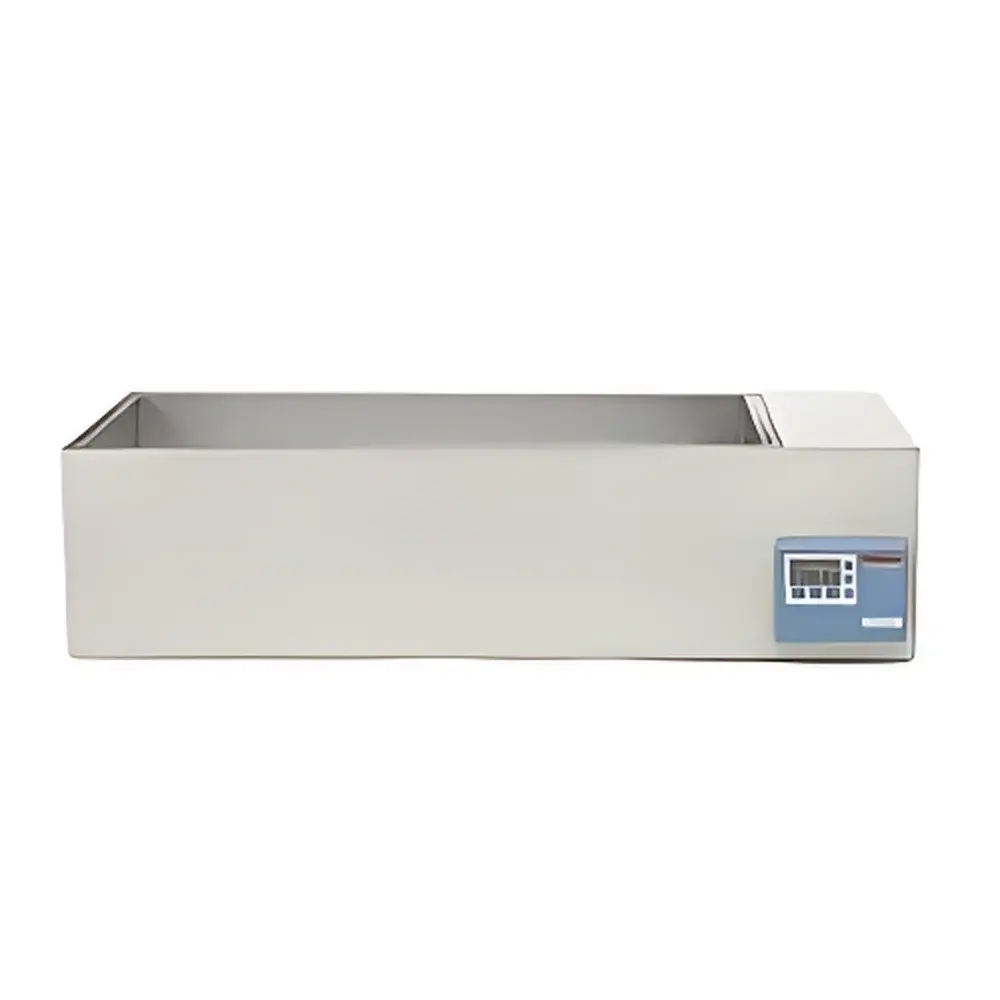
Thermo Fisher Precision™ Circulating Water Bath
| Brand | Thermo Fisher |
|---|---|
| Origin | USA |
| Manufacturer | Thermo Fisher Scientific |
| Product Type | Circulating Water Bath |
| Models | TSCIR19 / TSCIR35 / TSCIR89 |
| Bath Capacity | 19 L / 35 L / 89 L |
| Temperature Range | +5 °C to 100 °C |
| Temperature Stability | ±0.1 °C (±0.05 °C at 70 °C) |
| Circulation Type | Internal Recirculation |
| Control System | Microprocessor-Based PID Controller |
| Display | Icon-Driven Graphical LCD |
| Safety Features | Low-Level Fluid Detection, Audible Alarm, Over-Temperature Protection |
| Construction | Stainless Steel Bath Chamber with Removable Perforated Lid and Diffuser Tray |
| Power Rating | 1200 W (TSCIR19), 1500 W (TSCIR35 & TSCIR89) |
| Working Chamber Dimensions (L × W × H) | 305 × 387 × 192 mm (TSCIR19), 305 × 692 × 192 mm (TSCIR35), 483 × 914 × 241 mm (TSCIR89) |
Overview
The Thermo Fisher Precision™ Circulating Water Bath is an engineered solution for laboratories requiring high-fidelity thermal control in enzymatic assays, serological testing, cell culture incubation support, and other applications where temperature uniformity, repeatability, and long-term stability are critical. Utilizing a closed-loop internal recirculation system driven by a low-turbulence pump, this bath maintains precise thermal equilibrium across the entire working chamber—eliminating stratification and minimizing spatial gradients. Its microprocessor-based PID temperature controller continuously monitors sensor feedback and dynamically adjusts heating output to sustain setpoint accuracy within ±0.1 °C (±0.05 °C at 70 °C), meeting stringent requirements for GLP-compliant workflows and method validation under ISO/IEC 17025 frameworks.
Key Features
- Three scalable models (TSCIR19, TSCIR35, TSCIR89) accommodate diverse throughput needs—from benchtop assay preparation to large-volume sample conditioning.
- Stainless steel bath chamber with seamless welds and electropolished interior resists corrosion and facilitates cleaning—critical for labs adhering to USP <85> endotoxin testing or CLIA-certified protocols.
- Icon-driven graphical LCD interface provides intuitive navigation without requiring technical training; real-time status indicators include temperature deviation, fluid level, and system fault codes.
- Hinged, tool-free lid design enables rapid access for sample insertion or bath maintenance while preserving structural integrity and thermal seal integrity.
- Integrated low-level detection circuitry automatically disables heating and triggers audible alarm if fluid volume falls below operational threshold—preventing dry-run damage and ensuring equipment longevity.
- Diffuser tray and perforated stainless steel cover optimize laminar flow distribution, enhancing thermal homogeneity across the full working zone (verified per ASTM E2251-22 standard test methods for liquid bath uniformity).
Sample Compatibility & Compliance
The Precision™ Circulating Water Bath supports compatibility with glassware (e.g., flasks, tubes, cuvettes), plastic vessels rated for continuous immersion at elevated temperatures, and sealed reaction blocks used in molecular diagnostics. It complies with IEC 61010-1:2010 safety standards for laboratory electrical equipment and meets electromagnetic compatibility (EMC) requirements per EN 61326-1. For regulated environments—including clinical labs operating under CLIA, CAP, or FDA 21 CFR Part 11—its deterministic alarm logging, non-volatile setpoint memory, and absence of user-modifiable firmware parameters support audit-ready documentation practices. Optional calibration certificate traceable to NIST standards is available upon request.
Software & Data Management
While the unit operates as a standalone instrument, its analog voltage output (0–5 V DC proportional to bath temperature) enables integration with third-party data acquisition systems (e.g., LabVIEW, SCADA platforms) for centralized monitoring and electronic record retention. The microprocessor stores up to 10 user-defined temperature profiles with ramp/soak sequences, each timestamped and retained after power cycling. All alarm events—including over-temperature, low-fluid, and sensor failure—are logged with date/time stamps in non-volatile memory, supporting root-cause analysis during internal quality audits. No proprietary software installation is required; configuration remains accessible via front-panel interface only, reducing cybersecurity exposure vectors.
Applications
- Enzyme kinetics studies requiring stable thermal environments between 25–37 °C for reproducible Michaelis-Menten parameter derivation.
- Serological agglutination assays (e.g., blood typing, rheumatoid factor detection) where minor temperature fluctuations impact antigen-antibody binding kinetics.
- Pre-incubation of PCR master mixes and restriction digests prior to thermocycling to ensure complete reagent dissolution and enzyme activation.
- Calibration of temperature-sensitive sensors (e.g., RTDs, thermistors) using fixed-point reference baths in metrology labs.
- Supporting ASTM D92 (flash point testing) and ASTM D1500 (color measurement) sample conditioning steps where bath uniformity directly affects result validity.
FAQ
Is external circulation supported?
No—the Precision™ series is designed exclusively for internal recirculation to maximize thermal consistency and minimize contamination risk. External loop configurations require alternative Thermo Fisher models (e.g., Haake CW series).
Can the bath be used with oils or other heat-transfer fluids?
It is validated only for deionized or distilled water. Use of oils or glycols voids warranty and may compromise sensor calibration and pump longevity.
What is the recommended calibration frequency?
Annual calibration against a NIST-traceable reference thermometer is advised; more frequent verification (e.g., quarterly) is recommended in GxP-regulated settings.
Does the unit meet FDA 21 CFR Part 11 requirements?
The device itself does not provide electronic signature capability, but its deterministic alarm logs and immutable parameter storage support Part 11 compliance when integrated into validated electronic lab notebook (ELN) or LIMS workflows.
How is temperature uniformity verified across the bath chamber?
Uniformity is validated per ASTM E2251-22 using nine-point probe mapping at multiple setpoints (25 °C, 37 °C, 70 °C); certified reports document maximum deviation ≤ ±0.08 °C across all tested volumes.



