
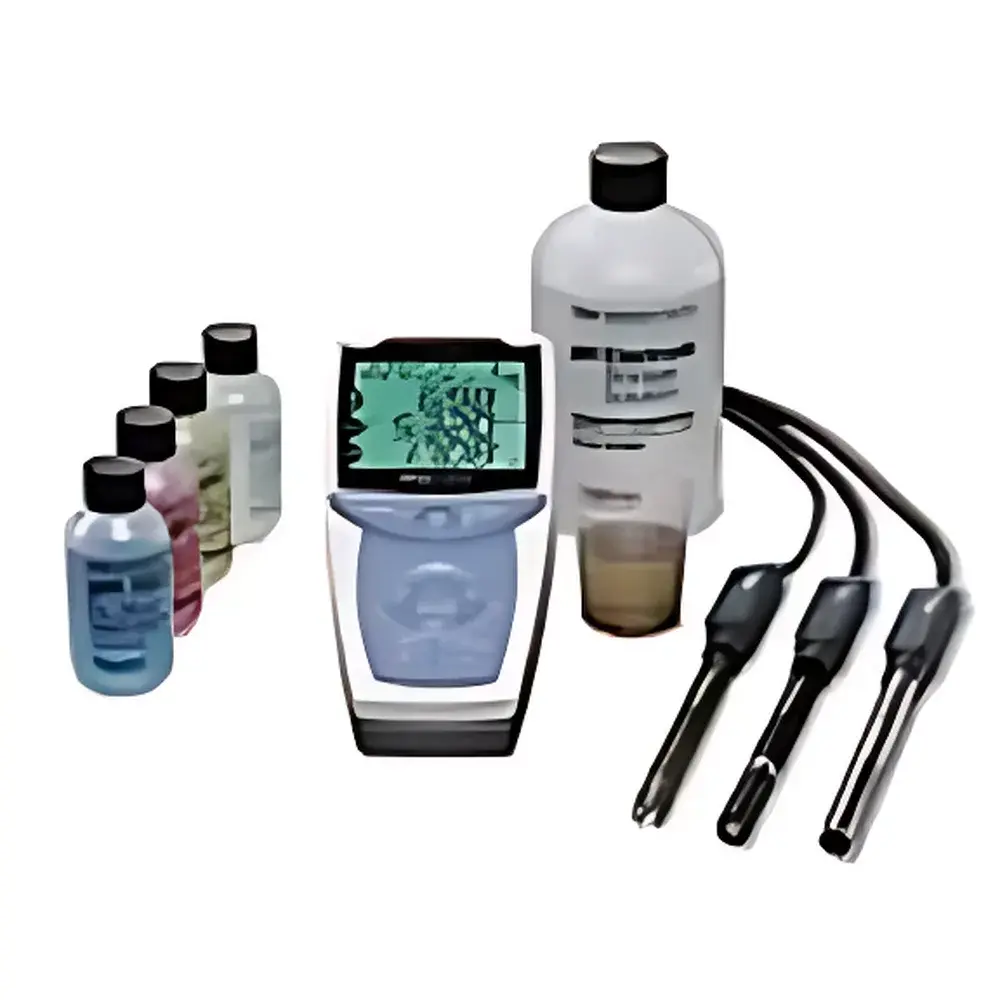
Orion 5-Star Portable pH/ORP/ISE/Conductivity/Dissolved Oxygen Meter
| Origin | USA |
|---|---|
| Manufacturer Type | Authorized Distributor |
| Origin Category | Imported |
| Model | Orion 5-Star |
| Pricing | Upon Request |
Overview
The Orion 5-Star Portable pH/ORP/ISE/Conductivity/Dissolved Oxygen Meter is a field-deployable, multi-parameter electrochemical analyzer engineered for high-precision water quality assessment in environmental monitoring, wastewater treatment, aquaculture, and regulatory compliance applications. Built upon Thermo Fisher Scientific’s legacy Star platform, this instrument integrates five core measurement modalities—potentiometric pH and ORP, ion-selective electrode (ISE) analysis, conductometric conductivity, amperometric dissolved oxygen (DO), and thermistor-based temperature compensation—within a single ruggedized, IP67-rated housing. Its operational principle relies on standardized electrochemical transduction: pH and ORP employ glass and noble-metal reference electrodes following Nernstian response; ISE measurements utilize membrane-selective potentials calibrated against standard solutions; conductivity is determined via four-electrode AC excitation to minimize polarization errors; and DO quantification follows Clark-type polarographic or optical luminescence principles depending on probe configuration. Designed for traceable, auditable field data collection, the system meets foundational requirements for GLP-compliant workflows and supports alignment with ISO 5667 (water sampling), ASTM D1293 (pH of water), ASTM D5391 (conductivity), and EPA Method 4500-O (dissolved oxygen).
Key Features
- Integrated five-parameter capability: simultaneous real-time measurement of pH, ORP, ISE (up to 10 programmable ions), specific conductivity, total dissolved solids (TDS), salinity, resistivity, dissolved oxygen (mg/L and % saturation), and temperature
- Rugged, waterproof (IP67) enclosure rated for extended outdoor use under rain, dust, and incidental submersion conditions
- Backlit graphical LCD display with adjustable contrast for legibility in low-light or direct-sun environments
- Extended battery life: up to 2000 hours of continuous operation on four AA alkaline batteries—ideal for remote site surveys and unattended logging
- SMART STABILITY™ and SMART AVERAGING™ algorithms dynamically adjust measurement dwell time and data averaging based on signal noise, ensuring optimal precision without manual intervention
- GLP-compliant data handling: automatic timestamping, operator ID entry, calibration history storage, and full audit trail generation
- Onboard security: ten password-protected method templates for rapid reconfiguration across sampling sites or parameter sets
Sample Compatibility & Compliance
The Orion 5-Star accommodates standard 12-mm diameter laboratory and field probes—including Ross Ultra pH electrodes, Orion ORP combination electrodes, solid-state and liquid-filled ISEs (e.g., fluoride, nitrate, ammonium), conductivity cells (K = 0.1, 1.0, 10 cm⁻¹), and polarographic or optical DO sensors. It supports aqueous matrices ranging from ultrapure water (≥18.2 MΩ·cm) to high-salinity seawater (up to 45 ppt). Calibration protocols follow NIST-traceable standards, and the instrument complies with key regulatory frameworks including FDA 21 CFR Part 11 (electronic records/signatures), ISO/IEC 17025 (testing laboratory competence), and US EPA guidance for field instrumentation validation. All firmware and calibration routines are version-controlled and support documented change management.
Software & Data Management
Data export is supported via USB interface to Thermo Fisher’s Orion LogR software (Windows-compatible), enabling batch download, graphical trend analysis, statistical reporting (mean, SD, RSD), and customizable certificate-of-analysis generation. The onboard memory retains ≥2000 data points with full metadata (date/time, probe ID, calibration status, operator code). Audit trails record every calibration event, sensor replacement, firmware update, and user login—retained indefinitely unless manually purged under administrator privileges. Exported CSV files include column headers compliant with LIMS ingestion standards and retain embedded uncertainty estimates per parameter.
Applications
- Regulatory field monitoring: EPA NPDES permit compliance, drinking water source assessment, and stormwater runoff characterization
- Wastewater process control: aeration basin DO optimization, influent/effluent pH and conductivity profiling, and nutrient (e.g., NH₄⁺, NO₃⁻) tracking via ISE
- Aquatic ecosystem studies: lake stratification profiling, wetland biogeochemistry surveys, and coral reef health monitoring
- Industrial pretreatment verification: electroplating rinse water pH/ORP control, boiler feedwater conductivity surveillance, and cooling tower biocide efficacy evaluation
- Educational field labs: undergraduate environmental science curricula requiring portable, multi-analyte instrumentation with pedagogical data transparency
FAQ
Does the Orion 5-Star support USP General Chapter <781> for conductivity testing in pharmaceutical water systems?
Yes—when paired with a certified K = 0.1 cm⁻¹ cell and calibrated using USP-certified KCl standards, it satisfies the instrument qualification and measurement criteria outlined in <781> for Purified Water and Water for Injection.
Can I perform ISE measurements without internal temperature compensation?
No—the instrument mandates temperature input for all ISE calibrations and measurements; either via integrated probe thermistor or manual entry, as Nernst slope correction is applied automatically.
Is firmware upgrade capability available in the field?
Yes—via USB-connected PC and Orion LogR software; upgrades preserve existing calibration data and user configurations.
What is the maximum allowable conductivity range for accurate TDS conversion?
TDS calculation remains valid up to 100 mS/cm when using the default 0.65 conversion factor; beyond this, manual factor adjustment or direct conductivity reporting is recommended.
How does the system handle electrode drift during extended field deployment?
The SMART STABILITY™ algorithm detects slow signal drift and prompts recalibration only when deviation exceeds configurable thresholds—reducing unnecessary field interventions while maintaining data integrity.







