
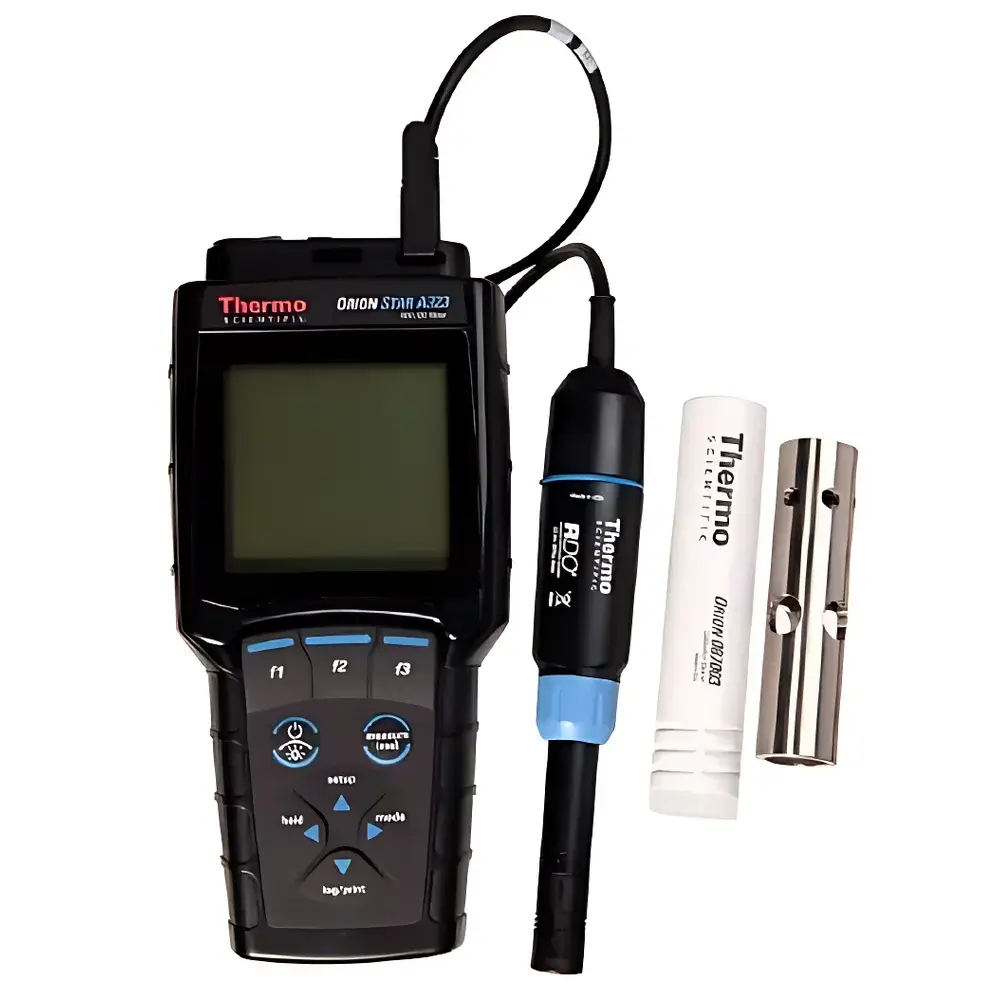
Thermo Fisher Scientific Orion Star A216/A326 Benchtop & Portable pH / Dissolved Oxygen Meter
| Brand | Thermo Fisher Scientific |
|---|---|
| Origin | Singapore |
| Manufacturer | Thermo Fisher Scientific |
| Origin Category | Imported |
| Model | A216 (Benchtop) / A326 (Portable) |
| Instrument Type | Laboratory |
| pH Range | −2.000 to 20.000 |
| pH Accuracy | ±0.001 |
| pH Resolution | 0.1 / 0.01 / 0.001 |
| mV Range | ±2000.0 mV |
| mV Accuracy | ±0.1 mV |
| DO Measurement Principle | Polarographic or Luminescent (RDO) |
| Polarographic DO Range | 0–90 mg/L (±0.2 mg/L accuracy) |
| RDO DO Range | 0–50 mg/L (±0.1 mg/L @ 0–8 mg/L |
| DO Saturation Range | 0–600% (Polarographic) / 0–500% (RDO) |
| DO Saturation Accuracy | ±2% |
| Atmospheric Pressure Compensation | 450.0–850.0 mmHg |
| Salinity Correction | 0–45 ppt |
| Temperature Range | 0–50 °C |
| Temp Accuracy | ±0.1 °C |
| Data Storage | 2000 entries (A216) / 5000 entries (A326), with timestamp, sample ID, user ID, and calibration metadata |
| Compliance | GLP-compliant data logging, FDA 21 CFR Part 11-ready audit trail support via optional software |
| Enclosure Rating | IP54 (A216), IP67 (A326) |
Overview
The Thermo Fisher Scientific Orion Star A216 (benchtop) and A326 (portable) pH / Dissolved Oxygen Meters are precision laboratory-grade instruments engineered for rigorous water quality analysis in environmental monitoring, wastewater treatment, aquaculture, drinking water compliance, and research applications. These dual-channel analyzers integrate two distinct electrochemical measurement principles—potentiometric pH determination and either polarographic or luminescent (RDO) dissolved oxygen sensing—within a single, unified platform. The pH module operates on the Nernst equation principle, delivering high-resolution potentiometric readings across an extended range of −2.000 to 20.000, while the DO module supports interchangeable probe technologies: traditional Clark-type polarographic sensors for robust field use or modern optical RDO probes offering zero-oxygen-consumption, minimal maintenance, and superior long-term stability. Both configurations feature automatic temperature compensation (ATC), pressure- and salinity-corrected DO algorithms, and real-time electrode diagnostics—ensuring metrological traceability and measurement integrity under variable environmental conditions.
Key Features
- Simultaneous dual-parameter display: pH/mV/RmV and DO concentration (mg/L) or saturation (%), with optional side-by-side channel view
- AUTO-READ™ functionality with stability indicator icon—locks reading only when signal drift falls below user-defined thresholds
- Intelligent buffer recognition: auto-detects and applies calibration parameters for USA, NIST, and DIN pH standards
- Editable calibration curves: enables manual adjustment of slope and offset post-calibration to optimize fit for non-ideal electrodes or atypical matrices
- Multi-probe compatibility: seamless detection and configuration of both polarographic DO probes and RDO optical sensors via 9-pin mini-DIN interface
- Flexible power architecture: benchtop A216 accepts universal AC input (100–240 VAC); portable A326 operates on four AA alkaline batteries or optional AC adapter—enabling continuous operation in remote or mobile labs
- Dual-rated ingress protection: IP54 (A216) for splash resistance in lab environments; IP67 (A326) for full dust-tightness and immersion up to 1 m for 30 minutes
- GLP-compliant data management: all stored measurements include timestamp, operator ID, sample ID, electrode serial number, calibration history, and environmental metadata (T, P, salinity)
Sample Compatibility & Compliance
The Star A series accommodates a broad spectrum of aqueous samples—from ultrapure water and buffered standards to high-ionic-strength wastewater, seawater, and biological media—without requiring hardware modification. Its pH electrode interface (BNC + reference pin) supports all standard combination or separate-body pH electrodes, including low-temperature, high-temperature, and specialized gel-filled variants. For DO, the instrument automatically configures gain, polarization voltage, and warm-up protocols based on detected probe type. Regulatory alignment is embedded into firmware design: data logging conforms to Good Laboratory Practice (GLP) requirements per ISO/IEC 17025 and EPA Method 4500-O, with optional Orion™ Software enabling 21 CFR Part 11-compliant electronic signatures, audit trails, and role-based access control. Calibration verification logs, sensor health diagnostics, and certificate-of-conformance templates facilitate internal QA audits and external accreditation reviews (e.g., ISO 17025, CAP, CLIA).
Software & Data Management
Data transfer and instrument configuration are managed via USB or RS232 connectivity using Thermo Fisher’s proprietary Orion™ Software (Windows-compatible). This application supports bidirectional communication: downloading full datasets—including raw sensor outputs, calibration coefficients, and environmental correction values—as CSV or proprietary .ORI files; uploading custom method templates, user-defined units, and alarm thresholds; and performing remote firmware updates. All exported records retain native GLP metadata fields, enabling direct import into LIMS platforms or statistical analysis tools (e.g., JMP, Minitab). The software also generates PDF calibration reports compliant with ISO/IEC 17025 Annex A.2, documenting electrode response time, slope deviation, asymmetry potential, and DO zero-point stability—all traceable to NIST-traceable reference materials.
Applications
- Regulatory compliance testing: EPA Methods 4500-PB (pH), 4500-O (DO), ASTM D888 (DO in water), and ISO 5814 (electrochemical DO)
- Wastewater treatment plant process control: aeration basin DO optimization, influent/effluent pH monitoring, and sludge digestion pH profiling
- Aquatic ecosystem assessment: field-based DO diurnal cycling studies, hypolimnetic oxygen depletion tracking, and sediment-water interface flux modeling
- Pharmaceutical water systems: USP purified water and WFI conductivity-pH correlation validation
- Academic and environmental research: long-term limnological surveys, climate-driven DO solubility modeling, and acid mine drainage characterization
- Food & beverage QC: pH stability during fermentation, DO ingress in carbonated beverages, and cold-chain transport monitoring
FAQ
Does the A326 support both polarographic and RDO probes interchangeably?
Yes—the A326 automatically detects connected probe type via electrical signature and configures appropriate excitation voltage, warm-up sequence, and algorithmic corrections without manual intervention.
Can calibration data be exported separately from measurement records?
Yes—Orion Software allows selective export of calibration logs (including date/time, buffer IDs, slope, offset, and electrode impedance) as standalone CSV or PDF reports.
Is temperature calibration required for each DO measurement?
No—temperature is measured continuously via integrated thermistor; however, a one-point temperature calibration is recommended annually for traceability.
How does atmospheric pressure compensation affect DO accuracy?
The built-in barometric sensor (450.0–850.0 mmHg range) dynamically adjusts saturation calculations—critical for accurate mg/L conversion at elevations >500 m or during rapid weather changes.
Are electrode diagnostics accessible in real time during measurement?
Yes—LCD icons indicate electrode status (e.g., “OK”, “LOW SLOPE”, “OPEN CIRCUIT”, “SHORTED”), and diagnostic values (impedance, asymmetry potential) are viewable in service mode.







