
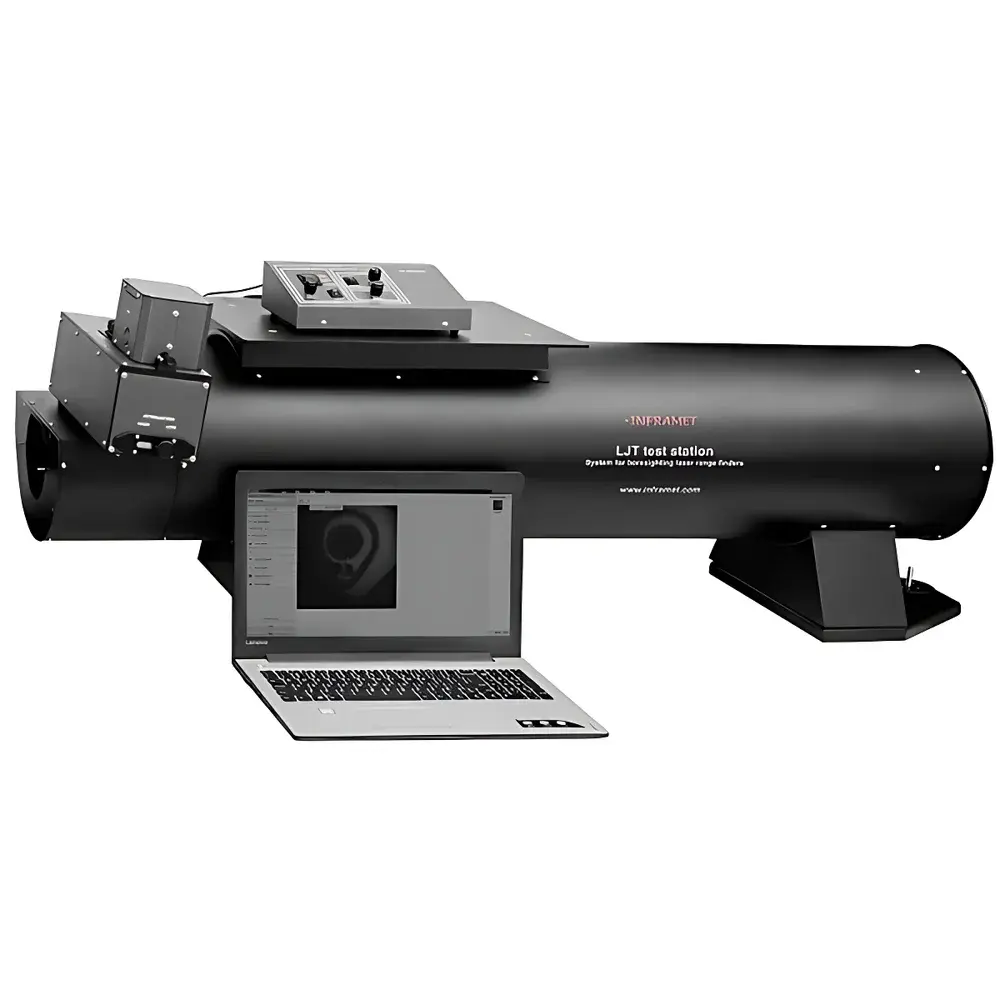
Inframet LJT120 Laser Axis Alignment Test System
| Brand | Inframet |
|---|---|
| Origin | Poland |
| Model | LJT120 |
| Wavelength Compatibility | 905/910 nm, 1064 nm, 1540 nm, 1550 nm, 1570 nm (custom wavelengths available) |
| Max. Aperture for Tested LRF | 70 mm |
| Max. Inter-Channel Distance (e.g., LRF to thermal imager) | 80 mm |
| System Weight | 45 kg (main module + platform) + 3 kg (accessories) + PC |
| Dimensions (H × L × W) | 650 mm × 1600 mm × 300 mm |
| Application Scope | Single-pulse/multi-pulse, coaxial/bi-directional, internally or externally indicated laser rangefinders |
Overview
The Inframet LJT120 Laser Axis Alignment Test System is a precision optical metrology platform engineered for quantitative verification and calibration of collimation and boresight alignment between the transmit and receive optical paths of laser rangefinders (LRFs), as well as between the LRF and auxiliary electro-optical channels—including visible-light cameras, thermal imagers, and aiming optics (e.g., day sights, night vision devices). Operating on the principle of high-resolution beam centroid analysis and multi-channel spatial registration, the system utilizes calibrated reference targets, motorized alignment stages, and synchronized imaging detectors to determine angular misalignment with sub-milliradian repeatability. It is designed specifically for demanding environments where traceable, standardized axis alignment validation is required—such as defense system integration, aerospace avionics qualification, industrial LRF manufacturing QA/QC, and R&D laboratories developing multi-sensor targeting systems.
Key Features
- Multi-wavelength support: Fully compatible with common LRF wavelengths (905/910 nm, 1064 nm, 1540 nm, 1550 nm, 1570 nm); optional spectral modules available for custom wavelengths.
- Comprehensive channel alignment mapping: Measures boresight error between LRF transmitter and receiver, LRF transmitter and thermal imager, LRF transmitter and VIS/NIR camera, and LRF transmitter and optical sight—each reported in horizontal and vertical angular deviation (mrad).
- Beam characterization capability: Quantifies transmitted laser divergence angle (full-angle, FWHM) and receiver field-of-view (FOV) using calibrated target arrays and intensity profiling algorithms.
- Modular mechanical architecture: Integrates a rigid optical bench (1600 mm length), motorized translation/rotation stages, and interchangeable detector modules—enabling repeatable setup across diverse LRF form factors.
- High-aperture handling: Supports LRF apertures up to 70 mm diameter and inter-channel separations up to 80 mm—accommodating both compact handheld and vehicle-mounted dual-sensor configurations.
- Factory-calibrated metrology chain: All optical references, position encoders, and detector responsivities are traceably calibrated per ISO/IEC 17025 requirements, ensuring measurement integrity across laboratory, production line, and field maintenance settings.
Sample Compatibility & Compliance
The LJT120 accommodates a broad spectrum of laser rangefinder architectures: single-pulse and multi-pulse time-of-flight systems; coaxial (shared aperture) and bi-directional (separate Tx/Rx apertures) designs; and configurations with internal or external indication channels (e.g., integrated LED aim points or co-aligned laser pointers). It complies with foundational optical alignment standards including MIL-STD-810G (environmental testing), ISO 11553-1 (laser product safety), and EN 60825-1 (laser classification). While not a medical device, its measurement methodology aligns with principles referenced in NATO AEP-97 (Laser Safety and Hazard Assessment) and supports documentation required for DO-160G (avionics environmental conditions) and MIL-STD-461G (EMI/EMC) test reports.
Software & Data Management
The system operates under Inframet’s proprietary LJT Control Suite—a Windows-based application supporting real-time image acquisition, automatic centroid detection, angular deviation computation, and report generation in PDF and CSV formats. Software features include audit-trail logging compliant with GLP and GMP practices, user role-based access control (administrator/operator), electronic signature support, and configurable pass/fail thresholds aligned with internal quality specifications or customer-defined technical data packages (TDPs). Data export conforms to ASTM E2081 (Standard Guide for Digital Image Data Exchange) and enables integration into enterprise MES or PLM platforms via OPC UA interface.
Applications
- Final acceptance testing of military-grade LRFs prior to field deployment.
- In-process alignment verification during automated assembly of multi-sensor targeting pods (e.g., for UAVs, armored vehicles, naval fire control systems).
- Periodic recalibration and performance validation in depot-level maintenance facilities.
- R&D validation of novel LRF architectures incorporating SWIR or MWIR co-alignment.
- Third-party certification testing for export-controlled electro-optical systems subject to ITAR/EAR compliance review.
- Academic research on multi-modal sensor fusion accuracy and boresight drift under thermal cycling or mechanical shock.
FAQ
Does the LJT120 support real-time dynamic alignment monitoring?
No—the system is optimized for static, high-accuracy alignment verification under controlled ambient conditions. Dynamic tracking requires complementary high-speed imaging hardware not included in the standard configuration.
Can the LJT120 be used for non-LRF applications such as telescope collimation or fiber optic coupling alignment?
While its core metrology principles are transferable, the mechanical interface, software algorithms, and calibration artifacts are specifically validated for LRF geometries and operational parameters. Custom adaptation would require formal requalification per ISO/IEC 17025.
Is remote operation supported for integration into automated test cells?
Yes—LJT Control Suite provides a documented COM/ActiveX API and TCP/IP command set, enabling full remote control and data acquisition from external test sequencers or PLC-based systems.
What documentation is provided with the system for regulatory audits?
Each unit ships with a Certificate of Calibration (traceable to PTB and NIST standards), Factory Acceptance Test Report (FATR), Software Validation Protocol (SVP), and a complete set of mechanical and optical schematics compliant with ASME Y14.5 GD&T standards.



