
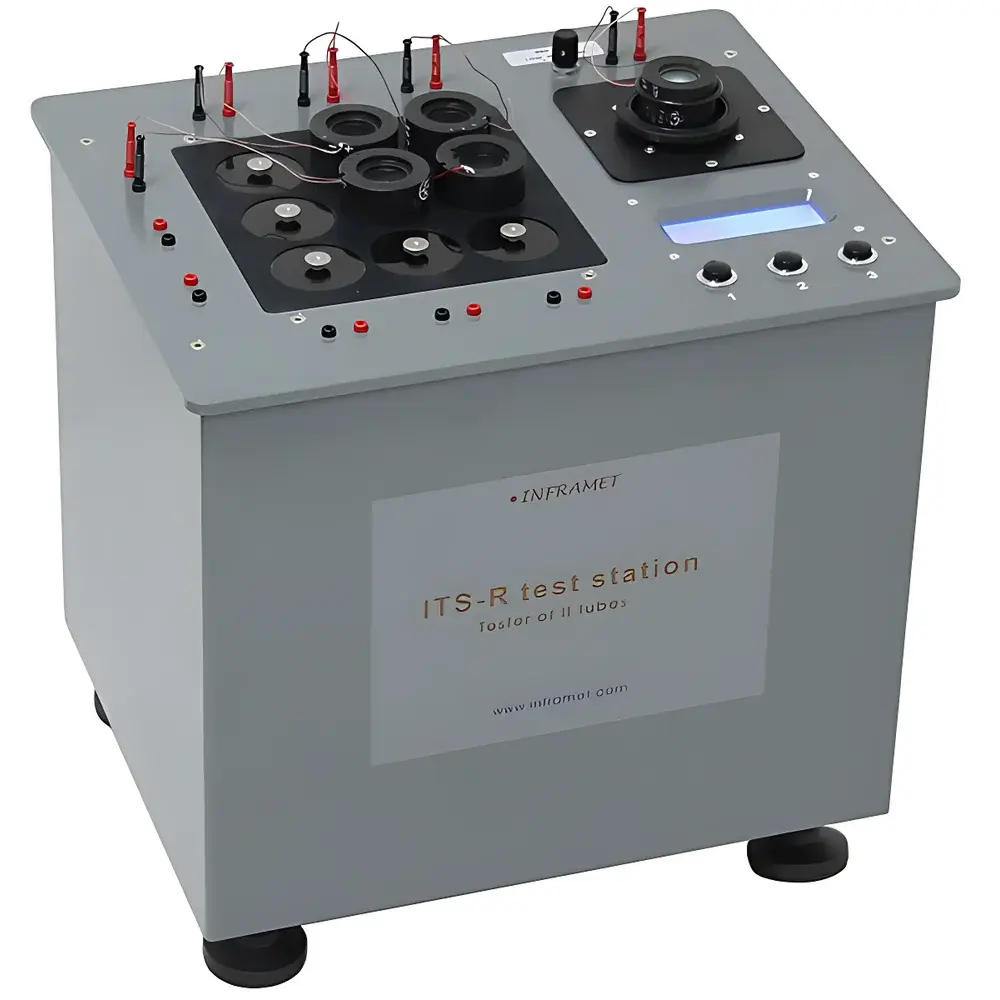
Inframet ITIR Image Intensifier Reliability Parameter Testing System
| Brand | Inframet |
|---|---|
| Origin | Poland |
| Model | ITIR |
| Light Source | 2856 K LED (0.05–50 lx, PC-controlled, resolution ≥0.05 lx) & 2856 K Halogen Spot Source (50 mlm, fixed, 1 mm × 1 mm cathode illumination) |
| Test Capabilities | Burn-in, Standard Reliability, Aging Reliability, Bright-Point Protection |
| Compliance | MIL-standard-based test protocols |
| Sample Capacity | 9 image intensifiers (BM-R module), 1 for bright-point testing |
| Power Supply | DC 2.7 V |
| Interface | USB |
| Dimensions | 300 × 370 × 380 mm |
| Weight | 11 kg |
| Software | ITR Control Suite (customizable non-MIL test definition, audit-ready logging, UTS-R recalibration support) |
| Accessories | BM-R main module, DC cabling set, PS3 power supply, intensifier adapters (MX-10160/MX-10130 or user-defined), calibration kit (optional) |
| Application Scope | Packaged Gen II, III, and IV image intensifiers |
Overview
The Inframet ITIR Image Intensifier Reliability Parameter Testing System is a purpose-built, automated instrumentation platform engineered to quantify the long-term operational stability and degradation behavior of vacuum-based image intensifier tubes under controlled photonic stress. It operates on the principle of accelerated life testing—applying calibrated, spectrally stable illumination (2856 K correlated color temperature) to the photocathode surface while monitoring parametric drift in gain uniformity, spatial noise distribution, and localized luminance anomalies. Unlike generic optical aging setups, the ITIR system implements physics-based stress profiles aligned with military-grade reliability frameworks (e.g., MIL-STD-344A, MIL-STD-810G Annex G), enabling quantitative assessment of three distinct failure modes: transient burn-in (short-duration, high-flux exposure), standard reliability (intermediate-duration, moderate-flux), and aging reliability (long-duration, low-to-moderate flux up to 10,000 hours). Its dual-source architecture—comprising a programmable LED array for broad-area illumination and a fixed-intensity halogen micro-spot source for localized bright-point excitation—allows decoupled evaluation of global versus localized degradation mechanisms.
Key Features
- Fully automated test sequencing with zero operator intervention during runtime—enabling unattended 24/7 reliability campaigns.
- MIL-compliant test execution engine supporting configurable exposure durations (50 h for burn-in; 2,000–10,000 h for aging), irradiance levels, and thermal stabilization intervals.
- Dual-source optical stimulation: PC-controlled 2856 K LED array (0.05–50 lx, resolution ≤0.05 lx) for uniform field stress; fixed 2856 K halogen spot source (50 mlm, 1 mm × 1 mm spot at photocathode plane) for bright-point damage assessment.
- Modular hardware design centered on the BM-R main module, compatible with Gen II, III, and IV packaged image intensifiers via interchangeable mechanical adapters (MX-10160, MX-10130, or custom-defined).
- ITR Control Software with full parameter logging, timestamped event tracking, pass/fail threshold configuration, and exportable CSV/JSON datasets compliant with GLP/GMP documentation requirements.
- Optional recalibration kit for traceable revalidation against UTS-R reference standards—supporting laboratory accreditation under ISO/IEC 17025.
Sample Compatibility & Compliance
The ITIR system accommodates commercially sealed image intensifier tubes across all generations currently in service: Gen II (S-20/S-25 photocathodes), Gen III (GaAs photocathodes with ion-barrier films), and Gen IV (filmless GaAs configurations). Mechanical compatibility is ensured through standardized adapter interfaces (MX-10160 for 18 mm Ø tubes; MX-10130 for 25 mm Ø), with provision for user-defined adapters to support proprietary tube housings. All test protocols are structured to satisfy MIL-STD-344A Section 4.5.2 (intensifier tube life testing), MIL-STD-810G Method 502.6 (temperature/humidity preconditioning), and ISO 9022-18 (optical instrument environmental testing). Data acquisition meets FDA 21 CFR Part 11 requirements for electronic records and signatures when audit-trail mode is enabled in software.
Software & Data Management
The ITR Control Software provides a deterministic, scriptable test environment built on a real-time Windows subsystem. Users define test sequences via hierarchical templates—including exposure duration, luminance ramp profiles, dwell times, and inter-test cooldown periods. Each run generates a structured metadata log containing ambient temperature/humidity, source calibration timestamps, voltage/current telemetry from the PS3 supply, and raw intensity readings from integrated photometric sensors. All logs are digitally signed and archived with SHA-256 hash integrity verification. Export formats include ANSI-compliant CSV (for statistical process control integration), XML (for LIMS ingestion), and PDF summary reports with embedded spectral irradiance curves. Optional UTS-R recalibration workflows generate NIST-traceable correction coefficients stored in encrypted firmware registers.
Applications
This system serves as a critical validation tool across defense electronics manufacturing, night vision device (NVD) quality assurance, and electro-optical R&D laboratories. Typical use cases include: qualification of new photocathode formulations under sustained luminance stress; comparative lifetime modeling of filmless vs. ion-barrier Gen III tubes; root-cause analysis of bright-spot-induced gain collapse in helmet-mounted display systems; and production-line screening of batch-level reliability outliers prior to final assembly. Its ability to isolate burn-in (cathode fatigue) from aging (ion feedback accumulation) enables accurate MTTF prediction per MIL-HDBK-217F methodology. The platform also supports development of accelerated test models correlating lab-scale results with field failure data from deployed NVD fleets.
FAQ
Does the ITIR system support non-MIL test protocols?
Yes—the ITR Control Software allows users to define custom illumination profiles, exposure schedules, and pass/fail criteria independent of military specifications.
Can the system test unmounted photocathodes or only packaged tubes?
It is designed exclusively for fully packaged, vacuum-sealed image intensifier assemblies—not bare photocathodes or open-tube configurations.
Is photometric calibration traceable to national standards?
The optional calibration kit enables end-to-end traceability to UTS-R reference sources, with documentation supporting ISO/IEC 17025 accreditation.
What safety features prevent accidental overexposure of intensifier tubes?
Hardware-enforced current limiting on the PS3 supply, redundant photodiode feedback loops, and software-imposed maximum irradiance ceilings prevent uncontrolled luminance escalation.
How is data integrity maintained during multi-week aging tests?
All measurements are logged to non-volatile memory with periodic RAID-backed backups; power-loss recovery resumes from last valid checkpoint without data corruption.





