
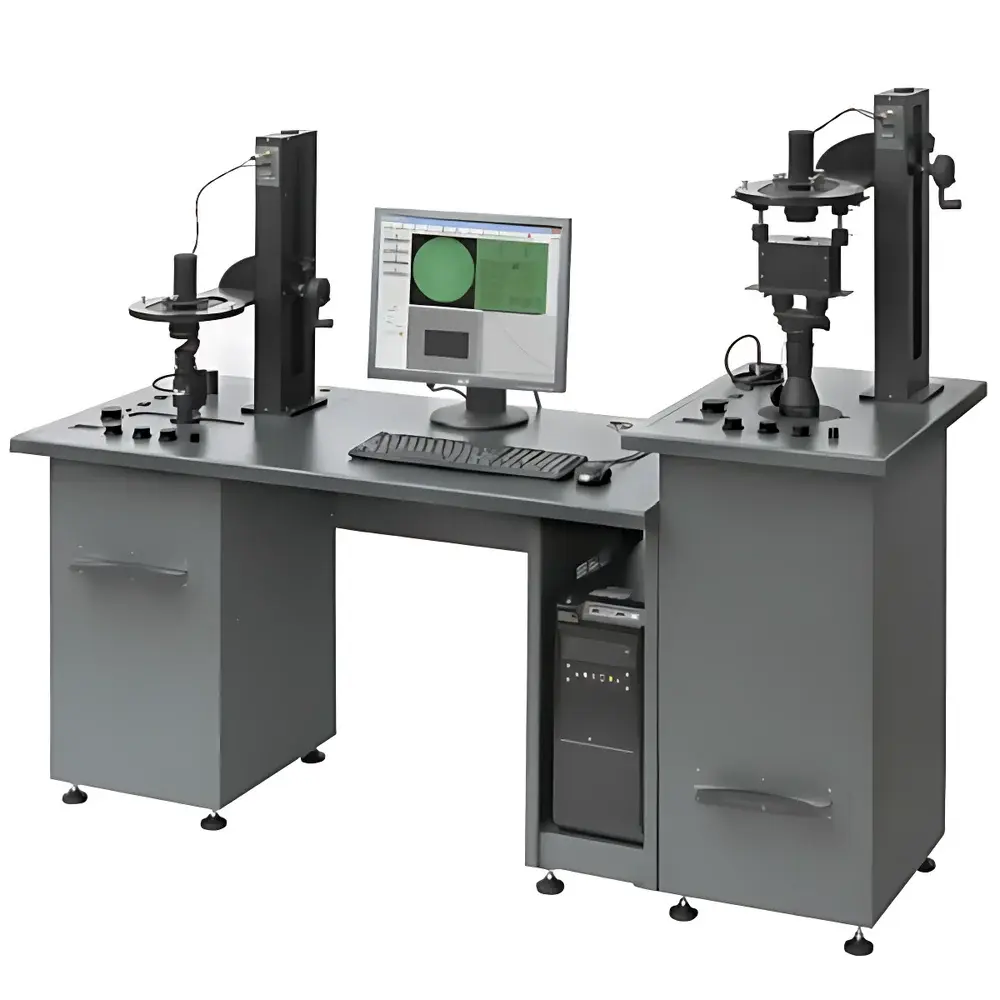
Inframet NIMAX Computerized Night Vision Device Test System
| Brand | Inframet |
|---|---|
| Origin | Poland |
| Model | NIMAX |
| Light Source Options | 2850 K halogen & 660 nm LED |
| Luminance Range | 2×10⁻⁵ to 200 lx |
| Luminance Resolution | 10 µlx (low-light range) |
| Collimator Apertures | 35 mm and 120 mm |
| Collimator Resolution | >30 lp/mrad (35 mm), >60 lp/mrad (120 mm) |
| Brightness Meter Range | 0.01–100 cd/m² |
| Operating Temperature | 5–40 °C |
| Dimensions | 1771 × 1429 × 553 mm |
| Weight | 130 kg |
| Power Supply | 110–230 VAC, 50/60 Hz |
Overview
The Inframet NIMAX Computerized Night Vision Device (NVD) Test System is a precision-engineered optical metrology platform designed for comprehensive performance evaluation of image-intensifier-based night vision equipment. Built upon dual-collimator projection architecture, the system projects standardized test targets—calibrated for photometric, geometric, and contrast fidelity—into the input aperture of NVDs under test. It operates on the principle of controlled stimulus-response characterization: by illuminating high-accuracy reticles (e.g., USAF 1951, Siemens star, contrast wedges) at defined luminance levels and spectral distributions, the NIMAX enables quantitative assessment of electro-optical transfer functions, including modulation transfer function (MTF), signal-to-noise ratio (SNR), minimum resolvable contrast (MRC), and equivalent background illumination (EBI). Its modular collimator design—featuring both 35 mm (for short-range monoculars and binoculars with ~40° FOV) and 120 mm (for long-range surveillance systems with narrow FOV <13°) apertures—ensures physical compatibility across the full spectrum of Gen II, Gen II+, and Gen III image intensifier tubes and integrated night vision assemblies.
Key Features
- Dual-collimator optical architecture supporting simultaneous calibration of short- and long-range NVD configurations
- Traceable photometric control via dual calibrated brightness meters (LP1/LP2) compliant with CIE 1931 colorimetric standards
- High-stability, spectrally selective illumination: 2850 K blackbody-mimicking halogen source for broad-spectrum testing and 660 nm narrowband LED for spectral responsivity validation
- Modular adapter system enabling rapid reconfiguration for diverse NVD form factors—including monoculars, binoculars, weapon sights, and surveillance optics
- Integrated high-resolution imaging subsystem (NVC camera + frame grabber) for digital capture and spatial analysis of intensified output images
- Software-controlled luminance adjustment with ≤2% stability deviation and 10 µlx resolution in sub-millilux regime
- Configurable test versions (A/B/C series) aligned with operational requirements—from basic qualification (A1/B1/C1) to GLP-compliant full electro-optical characterization (A5/B5/C5)
Sample Compatibility & Compliance
The NIMAX accommodates all mainstream night vision device classes per MIL-STD-3009, STANAG 4521 Ed.3, and ISO 16505 Annex D specifications. It supports image intensifier tubes (IITs) with photocathode diameters from 16 mm to 25 mm, objective lens focal lengths ranging from 25 mm to 300 mm, and magnification factors up to ×15. The system’s mechanical interface includes interchangeable tube adapters (R-series for resolution verification, G-series for gain measurement), beam combiners (BC12/BC21), and collimated target projectors meeting ANSI PH2.58-2019 angular resolution tolerances. All photometric measurements are referenced to NIST-traceable standards, and luminance uniformity across the projected field exceeds ±3% over central 80% area. The platform meets CE marking requirements for electromagnetic compatibility (EN 61326-1) and low-voltage safety (EN 61010-1), and its software architecture supports audit trails required under FDA 21 CFR Part 11 for regulated defense and law enforcement QA/QC environments.
Software & Data Management
TAS-NV software—the core application suite—provides synchronized control of illumination, target selection, image acquisition, and analytical processing. It features multi-device batch testing capability, automated pass/fail reporting against user-defined thresholds, and export of results in CSV, XML, and PDF formats compliant with MIL-HDBK-344A. Image data is stored with embedded metadata (timestamp, operator ID, calibration certificate ID, environmental conditions). The NIMAX Display Program enables real-time overlay of MTF curves, SNR maps, and distortion grids onto captured frames. For regulatory compliance, TAS-NV implements role-based access control, electronic signatures, and immutable audit logs meeting GLP and ISO/IEC 17025 documentation requirements. Optional integration with laboratory information management systems (LIMS) is supported via HL7 and RESTful API interfaces.
Applications
- Production-line acceptance testing of military-grade night vision goggles (NVGs) and weapon-mounted sights
- R&D validation of new image intensifier tube designs, including halo reduction and scintillation mitigation
- Periodic maintenance verification for aviation, maritime, and ground vehicle NVD fleets
- Third-party certification testing per NATO AEP-97 and DEF STAN 00-136
- Comparative performance benchmarking across Gen II/III/III+ platforms under standardized low-light conditions
- Quantitative assessment of EBI drift, gain nonuniformity, and MRC degradation during accelerated aging studies
FAQ
What NVD form factors does the NIMAX support?
The system accommodates monoculars, binoculars, bi-oculars, helmet-mounted NVGs, weapon sights, and long-range surveillance optics—with dedicated adapters for 16 mm, 18 mm, 25 mm, and 25.4 mm image intensifier tubes.
Can the NIMAX perform MTF measurements without external interferometry?
Yes—using its calibrated Siemens star and edge-spread function (ESF) targets, the NIMAX calculates MTF directly from digitized output images via Fourier analysis, eliminating dependency on auxiliary optical benches.
Is software validation documentation available for regulated environments?
Yes—Inframet provides IQ/OQ/PQ protocols, traceable calibration certificates, and 21 CFR Part 11 validation packages upon request.
How is luminance uniformity verified across the projected field?
A motorized XY stage positions the LP1/LP2 brightness meter at ≥25 predefined points within the collimated beam; uniformity is calculated per ISO 9241-307 Annex B.
Does the system support automated test sequencing for unattended operation?
Yes—TAS-NV includes scriptable test workflows with conditional branching, error recovery, and email/SNMP alerting for production-floor deployment.




